How India has managed to weave ‘RCEP minus China’
MULTILATERAL ORGANISATIONS
28 DECEMBER 2025
- A little more than six years after India stepped away from joining the Regional Comprehensive Economic Partnership (RCEP), India is in a position to reap the benefits such a grouping would have provided it, without exposing itself to the risks.
- India and New Zealand on December 22, 2025 announced the conclusion of negotiations on a Free Trade Agreement (FTA).
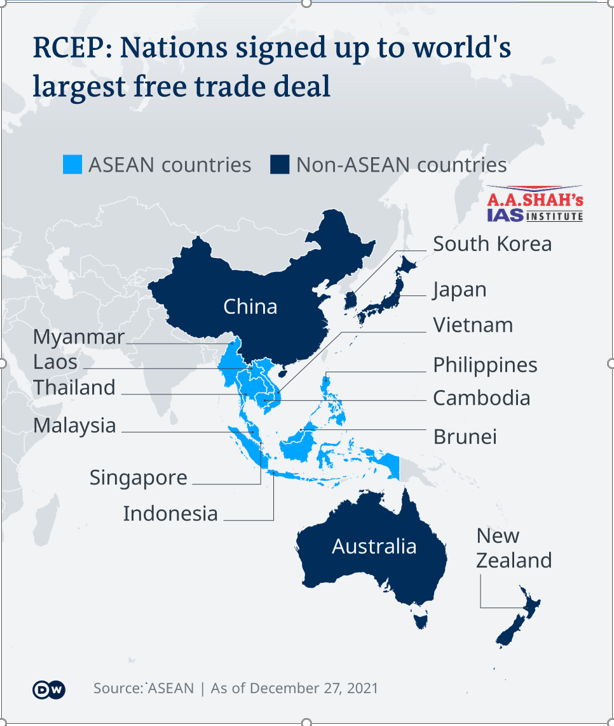
- Once the FTA comes into effect, India would have such FTAs with all the countries in the RCEP except for China.
- The RCEP countries are the 10 ASEAN members (Brunei, Cambodia, Indonesia, Laos, Malaysia, Myanmar, Philippines, Singapore, Thailand, Vietnam), Australia, China, Japan, South Korea and New Zealand.
- In November 2019, just as the soon-to-be members of RCEP were about to finalise an agreement, Prime Minister Narendra Modi announced India would not be a part of the grouping in its current form.
- “India’s decision to stay out of RCEP reflects smart risk management: by signing bilateral FTAs with 14 of the 15 RCEP members and keeping China limited to a narrow APTA framework, India secures market access without surrendering tariff control.”
- India and China are currently signatories to the Asia Pacific Trade Agreement (APTA), which is a preferential trade pact that provides lower tariffs on a few items rather than an FTA, which typically lowers most tariffs to zero.
- Most of India’s trade deals with the RCEP members came into effect before the Modi government came to power in 2014.
- However, a few key ones have been finalised since then.