SC refuses nod for Haryana govt.’s jungle safari project in Aravalis
ENVIRONMENT – BIODIVERSITY
13 FEBRUARY 2026
Aravali jungle safari project
- The Supreme Court has refused to allow the Haryana government to proceed with its proposed Aravali jungle safari project until experts clearly define what constitutes the “Aravali range.”
- Initially proposed over 10,000 acres, it is now revised to about 3,300 acres.
- It is planned in Gurugram and Nuh districts.
- It is intended to be the world’s largest zoo safari
- It will include big cat zones and hundreds of bird, reptile, and butterfly species.
- The project was stopped by the Supreme Court in October 2025 after a petition filed by five retired Indian Forest Service officers and the NGO People for Aravalis.
Supreme Court’s stand now
- The Bench led by CJI Surya Kant stated: “Till the definition of the Aravali range is finalised, we will not allow anyone to touch the Aravalis.”
- The Court emphasized that:
- The Aravalis span multiple States, not just Haryana or Rajasthan.
- The issue of the safari project will be considered along with the main matter on defining the Aravali range.
- Experts — not the Court — will determine the definition.
Supreme Court’s stand earlier
- In November 2025, the Supreme Court had accepted a definition for the Aravalli Hills and Ranges, proposed by a MoEFCC-led committee.
- This definition defined an “Aravalli Hill” as any landform rising at least 100 metres above the local relief, and an “Aravalli Range” as clusters of such hills within a 500-metre gap of each other.
- This definition excluded 90% of the Aravalis from environmental protection.
- Because of these ambiguities, the Court has kept earlier directions in abeyance and is awaiting expert clarification.
About Aravallis
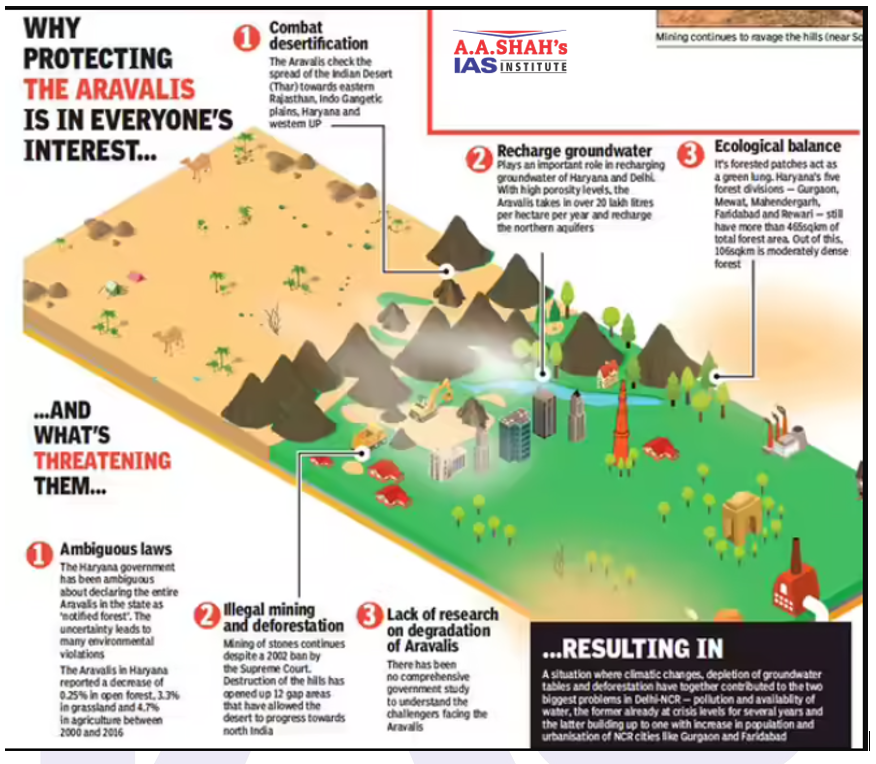
- Aravallis are an ancient range of weathered hills rambling across four States, from the outskirts of Delhi passing through Haryana, Rajasthan and Gujarat, with the bulk of it in Rajasthan.
- The 670 km Aravalli Range in south-west direction, is the oldest fold-mountain belt in India, dating back to the Paleoproterozoic era.
- The highest peak is Guru Shikhar in Mount Abu, Rajasthan at 1,722 m (5,650 ft).