Vande Mataram, its six stanzas and a settled question
CULTURE
13 FEBRUARY 2026
MHA Order on Vande Mataram: Constitutional Debate
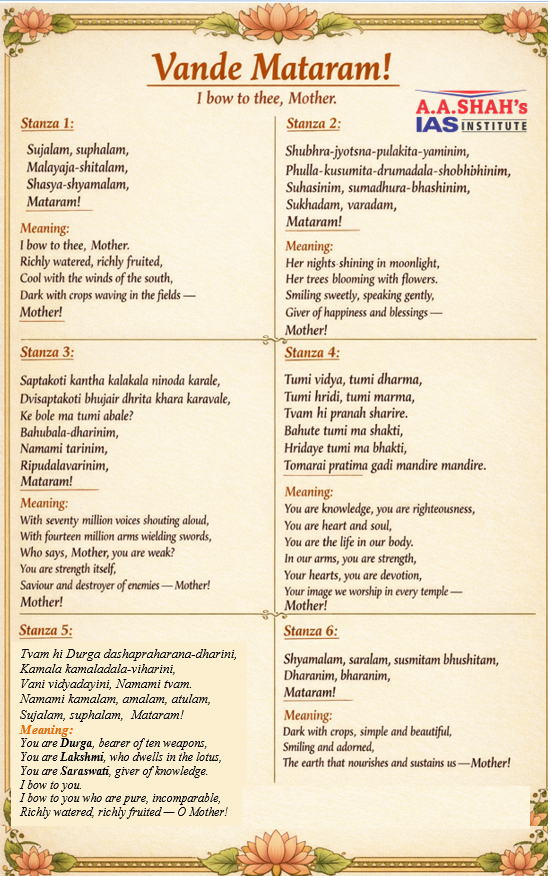
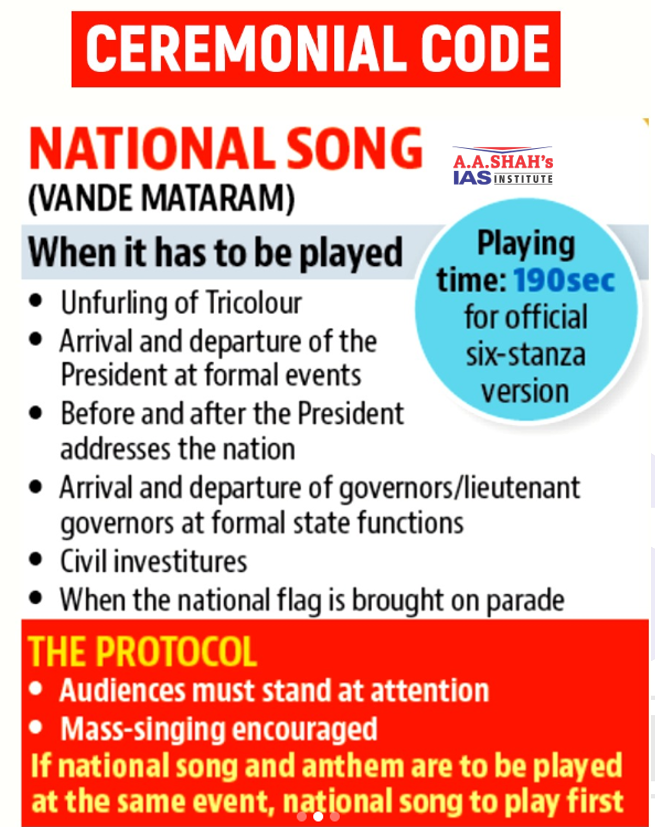
- The January 28, 2026 order of the Ministry of Home Affairs (MHA) — mandates that all six stanzas of Vande Mataram be played at official functions, with everyone required to stand at attention
Historical Context: The 1937 Settlement
In October 1937, the Congress Working Committee:
- Recognised objections from Muslim leaders to certain verses.
- Unanimously resolved that only the first two stanzas would be used at national gatherings.
- Leaders involved included Dr. Rajendra Prasad, Sardar Vallabhbhai Patel and Mahatma Gandhi
- Later stanzas invoke Hindu goddesses Durga, Lakshmi, and Saraswati.
- The compromise ensured national unity without religious imposition.
- Even Rabindranath Tagore supported limiting it to two stanzas.
🇮🇳 Constituent Assembly’s Decision (1950)
On January 24, 1950:
- Jana Gana Mana was declared the National Anthem.
- Vande Mataram was given equal honour as the National Song.
- However, only the first two stanzas were recognised officially.
Article 51A(a)
- The Constitution mentions only the National Flag and National Anthem under Article 51A(a).
- The National Song is not mentioned.
Prevention of Insults to National Honour Act, 1971
- The Act protects the NAional Anthem, the Flag and the Constitution but not Vande Mataram.
- This reflects a deliberate constitutional distinction.
Landmark Case: Bijoe Emmanuel vs State of Kerala (1986)
Three Jehovah’s Witness students:
- Stood respectfully during the National Anthem.
- Refused to sing due to religious beliefs.
- Were expelled from school.
The Supreme Court ruled in their favour.
Justice O. Chinnappa Reddy held:
- Standing respectfully is sufficient.
- Not singing does not amount to disrespect.
- Freedom of speech includes the right to remain silent.
- Freedom of religion under Article 25 protects conscience.
The Court quoted U.S. Justice Robert Jackson:
No official can prescribe what shall be orthodox in politics, nationalism, or religion.
This judgment protects:
- Individual conscience
- Freedom from compelled expression
Why the MHA Order is Controversial
The new directive:
- Mandates playing all six stanzas.
- Requires everyone to stand at attention.
- Encourages community singing in schools.
- Includes explicitly devotional verses invoking Hindu deities.
- If citizens cannot be forced to sing the National Anthem, they certainly cannot be forced to sing the National Song.
- Compelling participation in religiously specific verses may violate Article 25 (freedom of religion, undermine secularism and conflict with constitutional morality
Core Constitutional Issues
| Issue | Constitutional Concern |
| Compulsory participation | Article 19 (freedom of speech) |
| Religious verses | Article 25 (freedom of conscience) |
| Executive order without legislation | Separation of powers |
| Ignoring 1937 compromise | Secular tradition |
Central Question
- Can the government compel participation in a song that includes religious imagery under the banner of patriotism?
- According to the reasoning in Bijoe Emmanuel, the answer would likely be no, if it violates conscience or compels expression.
Broader Themes
- Secularism vs majoritarian symbolism
- Constitutional morality vs executive power
- Patriotism vs coerced expression
- Federal and pluralistic identity
Conclusion
- Respect for Vande Mataram is not in question.
- The first two stanzas are inclusive and historically unifying.
- Forcing participation in all six stanzas undermines undermine secular foundation, freedom of conscience and constitutional equality