SC clarifies Centre can reassess all AGR dues of Vodafone
ECONOMY – TAXATION
4 NOVEMBER 2025
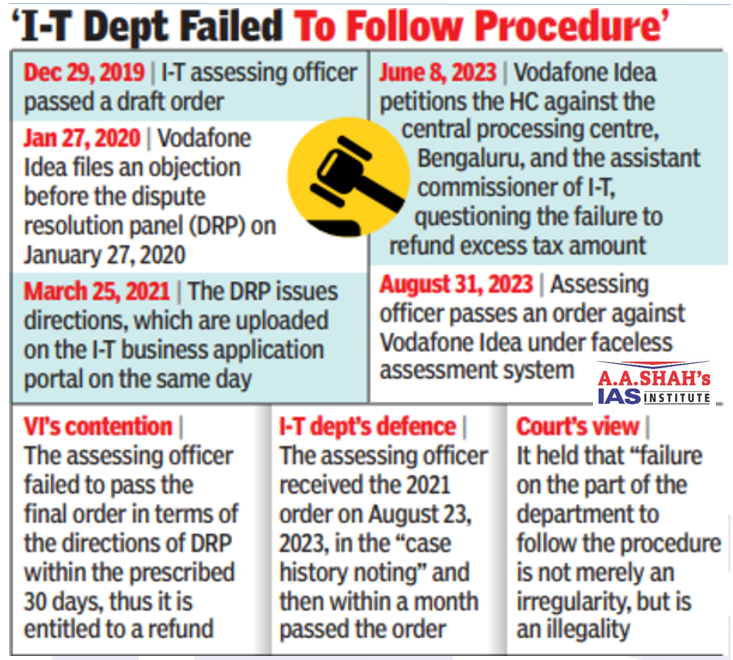
- The Supreme Court clarified that the Union government can comprehensively assess and reconcile all Adjusted Gross Revenue (AGR) dues of Vodafone-Idea up to the financial year 2016-17 in accordance with the Deduction Verification Guidelines of Feb 2020.
- Vodafone-Idea (VI), represented by senior advocates Mukul Rohatgi and Mahesh Agarwal, pointed out that though a composite plea was made to reassess “all” the AGR, the sixth paragraph of the court’s October 27 order inadvertently said the telecom major was asking only for a reconciliation of the “additional” AGR demand made by the Department of Telecom (DoT) for the period up to the financial 2016-17.
TAX HAVENS
- A tax haven is a country or jurisdiction that offers very low or zero taxes, high financial secrecy, and lenient regulatory frameworks to attract foreign capital and companies.
- Essentially, tax havens allow individuals or corporations to store wealth or route profits in a way that minimizes tax liability in their home countries.
Well-known tax havens:
- Cayman Islands
- Bermuda
- British Virgin Islands
- Panama
- Luxembourg
- Switzerland (historically)
- Singapore (for corporations)
Why Companies and Individuals Use Tax Havens
- Tax avoidance (legally minimizing taxes).
- Tax evasion (illegally concealing income).
- Asset protection and confidentiality.
- Easier global investment and profit shifting through “shell” or “letterbox” companies.
Mechanisms Used
- Transfer Pricing: Artificially inflating or deflating prices between subsidiaries to move profits to low-tax countries.
- Shell Companies: Entities set up in tax havens to hold assets or profits without real operations.
- Offshore Accounts: Hidden bank accounts shielding identity and funds.
- Treaty Shopping: Exploiting loopholes in double taxation treaties between nations.
VODAFONE – INDIA CASE
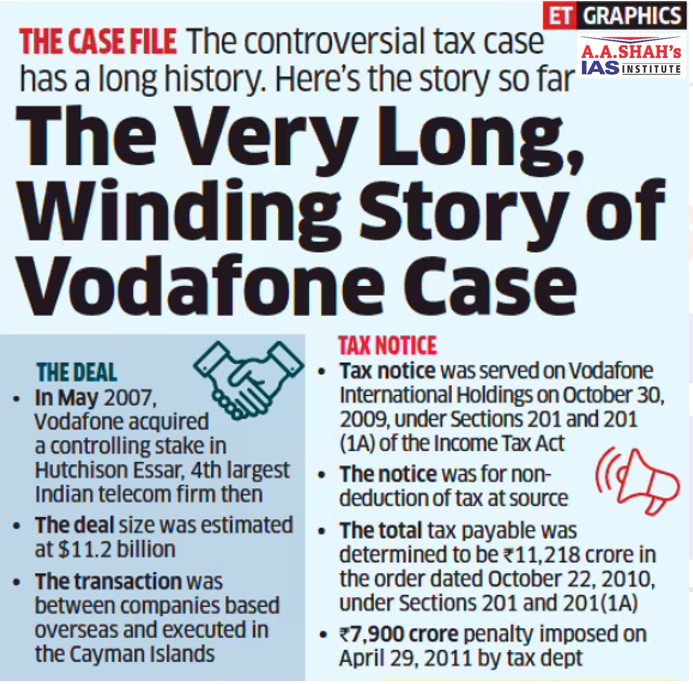
The Deal
- In 2007, Vodafone International Holdings BV (Netherlands) purchased a 67% stake in Hutchison Essar Limited (India) from Hutchison Telecommunications International (Hong Kong).
- The deal was worth about $11.1 billion (USD).
- The transaction was carried out outside India — between two foreign entities — but it involved underlying assets in India (since Hutchison Essar operated in India).
The Dispute
- The Indian Income Tax Department claimed that Vodafone should have deducted tax at source (TDS) on the capital gains arising from the transaction, as it involved transfer of Indian assets (telecom licenses, infrastructure, etc.).
- Income Tax Department issued a show-cause notice to Vodafone for failure to withhold tax, amounting to approx.. ₹22,100 crore including tax, interest, and penalty.
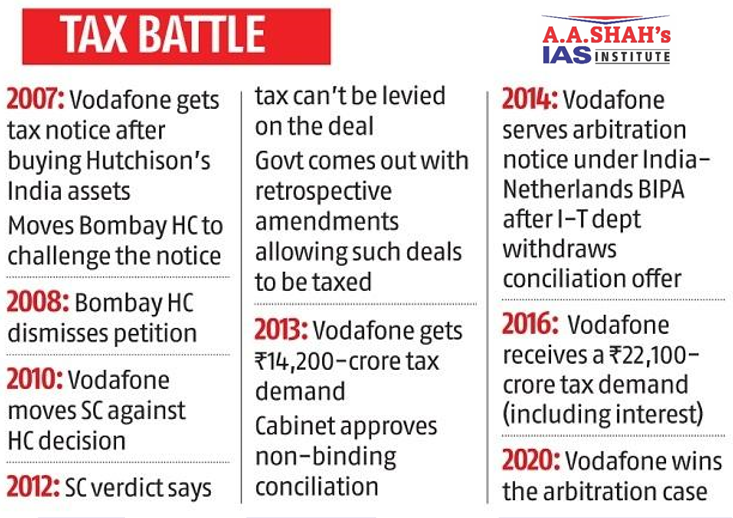
- The Bombay High Court upheld the tax department’s claim.
Supreme Court Ruling (2012)
- Vodafone then appealed to the Supreme Court of India whose judgment in January 2012 favoured Vodafone ruling that the transfer of shares between two foreign companies was outside India’s jurisdiction.
- The court also ordered that the government refund ₹2,500 crore deposited by Vodafone.
Retrospective Taxation (2012)
- The Indian government, dissatisfied with the Supreme Court’s ruling, amended the Income Tax Act, 1961 through the Finance Act, 2012.
- The amendment made taxation retrospective from 1962, allowing India to tax indirect transfer of Indian assets even if the transaction occurred outside India.
- This became known as “Retrospective Taxation” and was criticized globally as investor-unfriendly.
International Arbitration (2014–2020)
- Vodafone initiated arbitration proceedings under the India–Netherlands Bilateral Investment Treaty (BIT), at The Permanent Court of Arbitration, The Hague
- In 2020, it ruled in Vodafone’s favour.
- It held that:
- India’s retrospective tax demand was in violation of international law.
- The demand was unfair and inequitable.
- India must cease the demand and reimburse legal costs to Vodafone.
Government’s Response
- Initially, India considered challenging the arbitration award.
- However, after years of criticism and damage to India’s investment image, the government in August 2021 decided to repeal the retrospective tax law, and refund taxes collected under it (without interest).