SC to review surrogacy ban on couples with one child
POLITY – JUDICIARY
5 NOVEMBER 2025
- The Supreme Court decided to examine whether a law banning married couples facing secondary infertility from using surrogacy to have a second child amounts to a state restriction on the reproductive choices of citizens.
- The Union government has supported the constitutionality of the legal provision, Section 4(iii)(C)(II) of the Surrogacy (Regulation) Act, 2021, arguing that availing surrogacy cannot be claimed as a fundamental right.
- It has contended that surrogacy involves the use of the womb of another woman, the surrogate mother, and should be availed only after all other options to attain parenthood have failed, including natural birth and assisted reproductive technologies (ART).
- The lawyer submitted that the definition of “infertility” in the context of surrogacy both in the ART Act and the Surrogacy Act was not restricted to primary infertility.
- The government pointed to the proviso to the Section, which offers an exception for couples with a child who is mentally or physically challenged or suffers from a life-threatening disorder or a fatal illness with no permanent cure. This applies whether their existing child is biologically theirs, adopted, or through surrogacy.
- The Adoption Regulations, 2017 under the Juvenile Justice Act, 2015, which allow three children of any gender to be adopted.
Surrogacy (Regulation) Act, 2021
- Surrogacy is an arrangement in which a woman carries and gives birth to a child for another couple or individual.
- India allows only altruistic surrogacy, meaning no monetary compensation is allowed except for medical and insurance expenses.
- Commercial surrogacy (done for profit) is banned.
Background
- India emerged as a global hub for commercial surrogacy in the 2000s due to low costs and lax regulation.
- Reports surfaced of exploitation of poor women, custody disputes, and abandoned babies by foreign couples.
Eligibility – Intending Couple
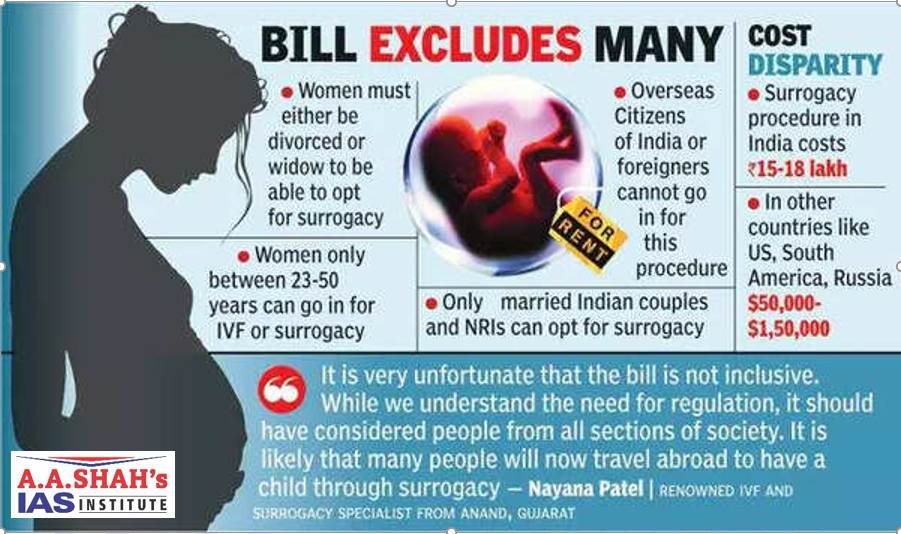
- Must be Indian citizens.
- Must be legally married for at least 5 years.
- Age limits: Wife 23–50 years; Husband 26–55 years.
- Must be medically certified infertile by a District Medical Board.
- Must not have any living biological, adopted, or surrogate child, except in case of disability or serious illness.
- An amendment in March 2023, banned the use of donor eggs or sperm, requiring intending couples to use their own gametes.
- An amendment in February 2024, permitted married couples to use a donor gamete if a District Magistrate Board certifies a medical condition preventing either partner from using their own. However, at least one gamete must be from the intending parents.
- The amendment in March 2023, permitted widows and divorced women (aged 35–45 years) to opt for altruistic surrogacy using their own eggs and donor sperm..
Eligibility – Surrogate Mother
- Must be an Indian woman.
- Should be married and have at least one biological child.
- Age: 25–35 years.
- Can act as a surrogate only once in her lifetime.
- Must pass medical and psychological fitness tests.