Altermagnetism emerges as new class of magnetic order
S&T – PHYSICS
11 NOVEMBER 2025
Traditional Magnetism:
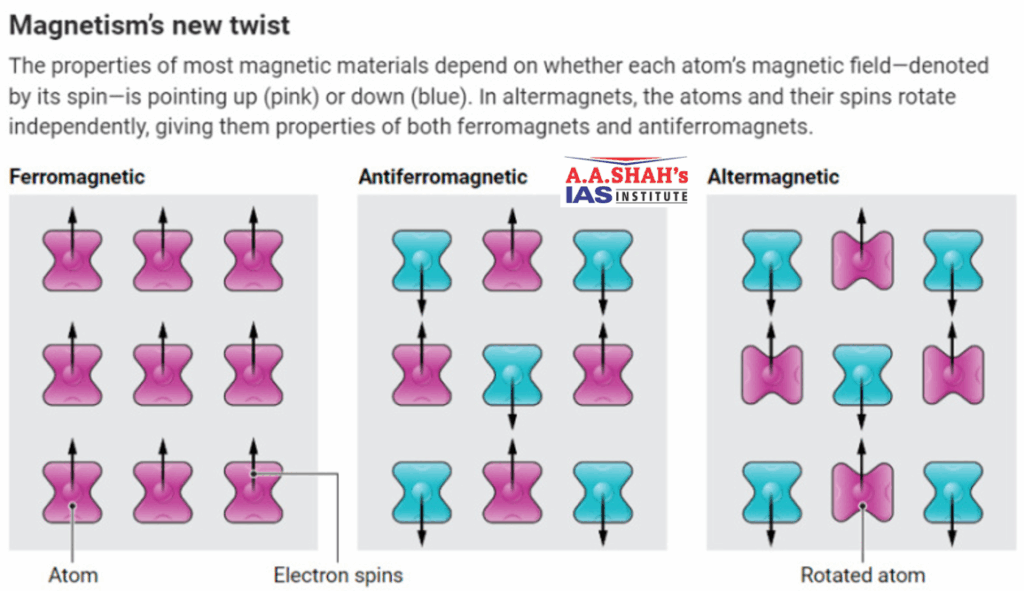
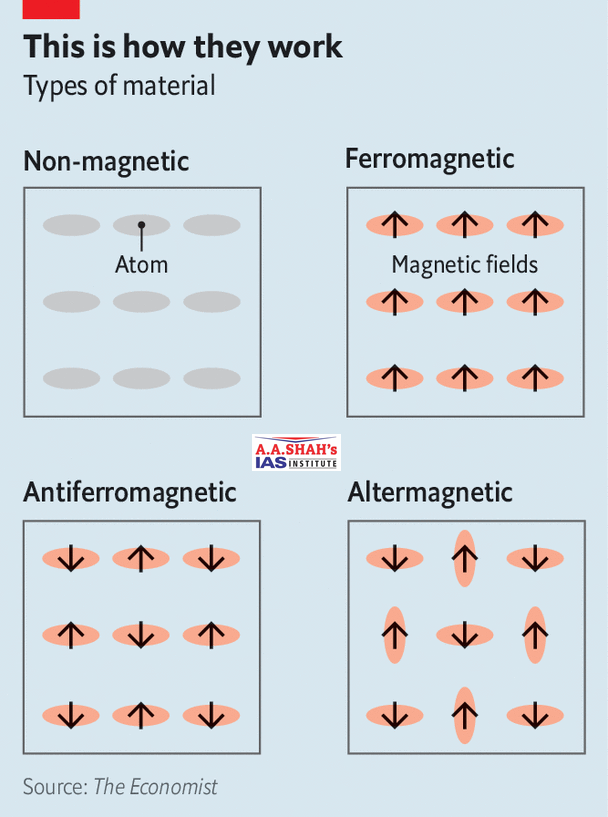
- For over a century, magnetism was divided into ferromagnetism (spins aligned, strong external field) and antiferromagnetism (alternating spins, no net field).
Discovery:
- Altermagnetism proposed around 2019, confirmed experimentally in 2024 (e.g., in manganese telluride – MnTe) represents a third type of magnetic order.
Core Idea:
- Spins are antiparallel (like in antiferromagnets), but the two sublattices are related by rotation or mirror symmetry, not just translation.
- This gives zero net magnetisation, yet allows spin-splitting in electronic bands (like ferromagnets).
Key Properties:
- No external magnetic field (magnetically silent).
- Internally, electrons with opposite spins occupy different energy bands.
- Can carry spin-polarised currents without stray magnetic fields.
- Shows anomalous Hall effect, enabling electrical detection of magnetic states.
Technological Potential:
- Ideal for spintronics — smaller, faster, energy-efficient devices.
- Potential terahertz-speed spin switching (≈1000× faster than ferromagnetic GHz speeds).
- Could also benefit quantum technologies due to low magnetic noise.
Experimental Verification:
- Proven using angle-resolved photoemission spectroscopy (ARPES) and X-ray magnetic dichroism.
- New X-ray methods (2024) can directly probe opposing spin groups.
Challenges Ahead:
- Need to grow high-quality single-domain crystals (avoid multiple magnetic domains).
- Must develop scalable fabrication techniques for devices.
Example Materials:
- Manganese telluride (MnTe) and ruthenium dioxide (RuO₂) are model altermagnets.