8th Central Pay Commission chaired by Justice (Rtd) Ranjana Prakash Desai
POLITY – EXECUTIVE
11 NOVEMBER 2025
Constitution of the Commission:
- The 8th CPC has been constituted by the Central Government.
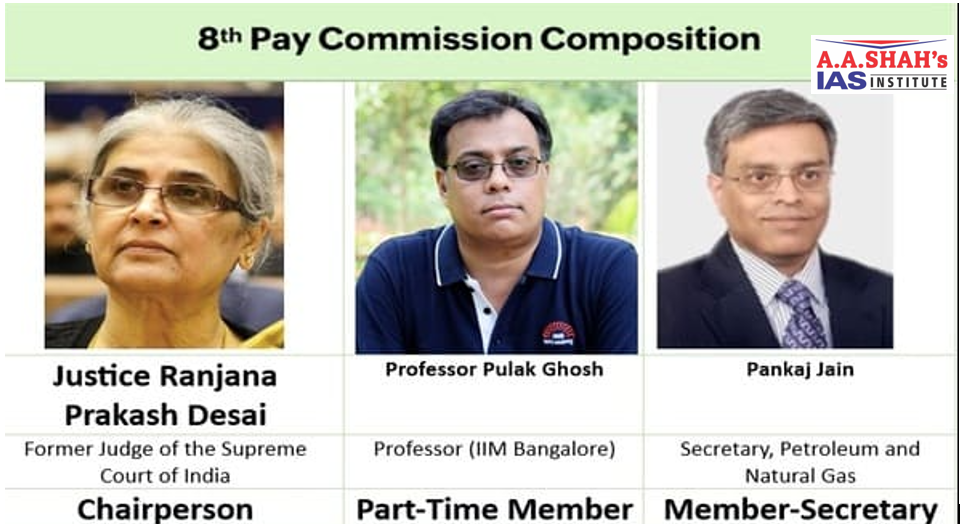
- Chairperson: Retired Justice Ranjana Prakash Desai
- Members: Professor Pulak Ghosh (IIM Bangalore, part-time) and Pankaj Jain, IAS (Member-Secretary).
- Timeline: Report to be submitted within 18 months.
What is a Pay Commission?
- A Pay Commission is set up by the government (through an executive order) to review and recommend changes to salaries, allowances, pensions, and service conditions of Central government employees (including defence personnel).
- The first CPC was set up in 1946.
Terms of Reference (TOR):
- Finalised by the Union Cabinet.
- The 8th CPC will consider:
- India’s economic conditions and fiscal prudence.
- Resources needed for welfare and development spending.
- Unfunded pension liabilities of non-contributory schemes.
- Impact on State finances (since many states adopt CPC recommendations).
- Comparison with Central PSUs and private sector pay structures.
Global Practices in Public Sector Pay:
- Till 1970s: Focus on equity — parity with private sector.
- 1980s: Shift to efficiency as guiding principle.
- 1990s onwards: Emphasis on performance, incentives, and affordability.
- Current trend: balancing talent retention with cost control.
- Contrary to public perception, India’s public sector employment and wage levels are lower than those in several other major democracies on key parameters.
Key Issues to Address in the 8th CPC:
- Pay comparison with private sector:
Entry-level: government salaries higher.
Top/specialist posts: private salaries higher.
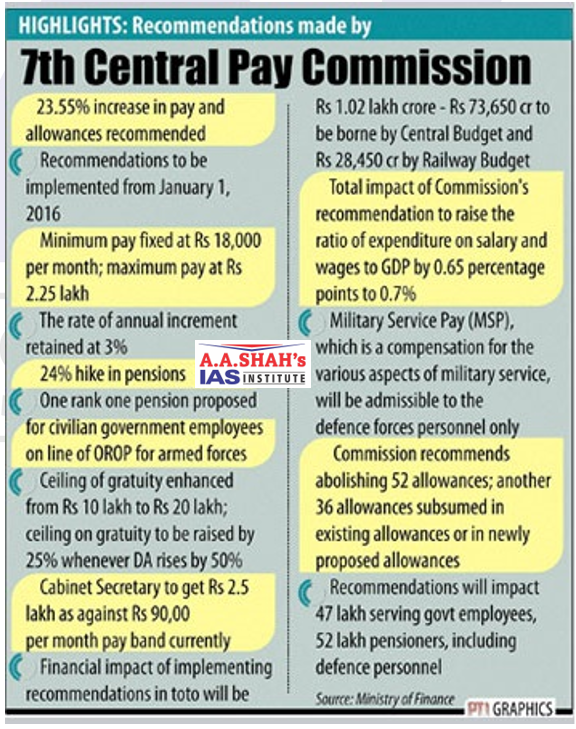
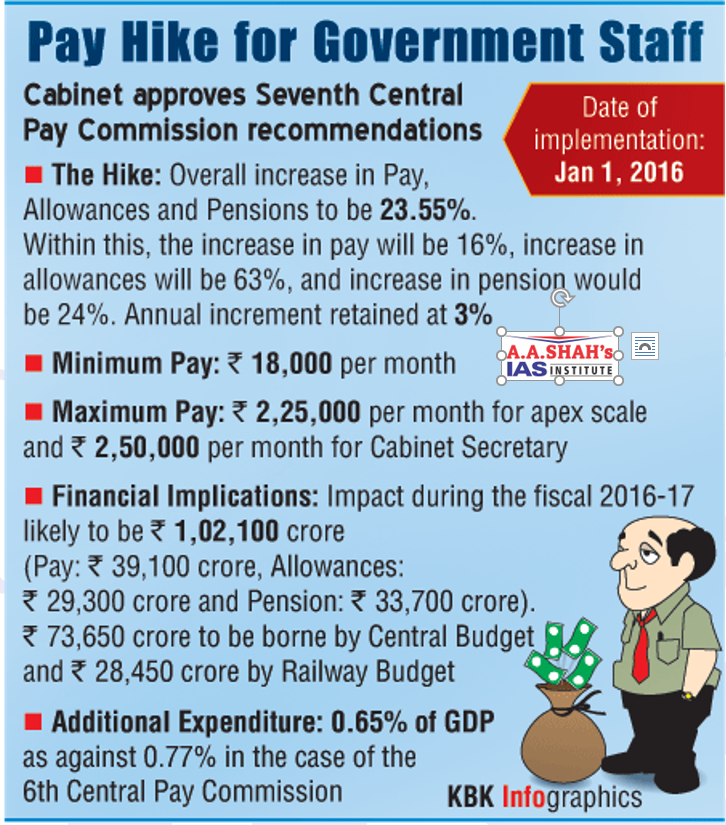
- Compression ratio (lowest to highest pay): 1:12.5 (as per 7th CPC).
- Perks, job security, and privileges partially offset lower top-level salaries, but a review is needed for specialist and leadership roles.
- Non-monetary factors (like training, work flexibility, and health promotion) are absent from TOR and should be addressed.
- Fiscal Considerations:
- The pension bill (2025–26): ₹2.76 lakh crore out of total revenue expenditure of ₹39.44 lakh crore.
- The CPC must weigh pension sustainability and fiscal limits while making recommendations.