Three workers killed, several feared trapped in U.P. quarry collapse
DISASTER MANAGEMENT
17 NOVEMBER 2025
- Three workers were killed and at least eight more were trapped after a stone quarry collapsed at Obra in Sonbhadra district of Uttar Pradesh.
- An FIR was lodged at the Obra police station against a company named Krishna Mines, alleging negligence and non-adherence to mining safety protocols.
- The body of a labourer was recovered during the relief operation by the NDRF/SDRF team,
Disaster Management Act, 2005
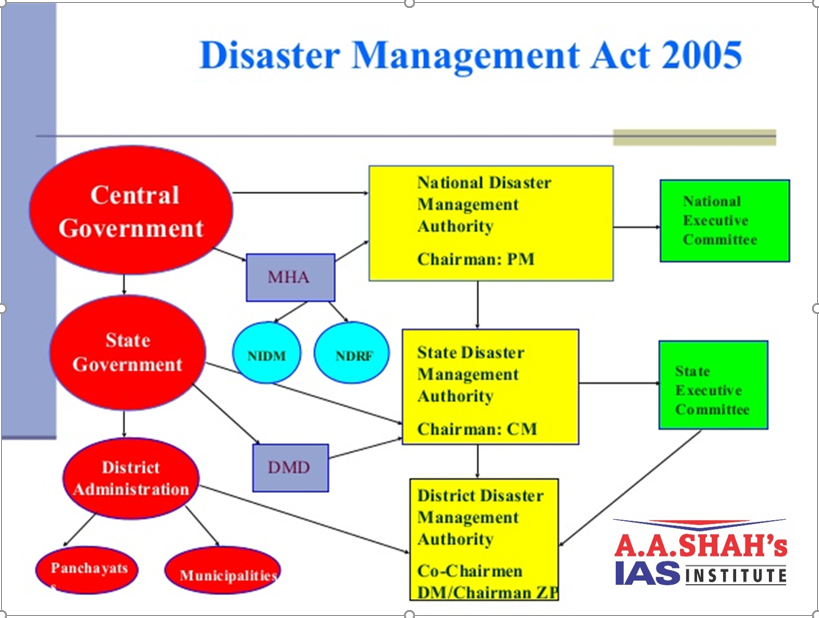
- The Disaster Management Act, 2005 provides a comprehensive legal framework for planning, coordinating, and implementing disaster management at the national, state, and district levels.
- It was enacted after the 2004 tsunami highlighted gaps in India’s disaster response system.
Definition of “DISASTER”
- Section 2(d) defines a disaster as:
- A catastrophe, mishap, calamity, or grave occurrence (natural or man-made) beyond the coping capacity of the affected community.
- This broad definition covers:
- Natural disasters: flood, cyclone, earthquake
- Man-made disasters: chemical leaks, industrial accidents
- Biological disasters: epidemics, pandemics (COVID-19), biological attacks
INSTITUTIONAL FRAMEWORK
A. National Level
(i) National Disaster Management Authority (NDMA) – Sec 3
- Apex body for disaster management.
- Chaired by the Prime Minister.
- Maximum 9 members including Vice-Chairperson.
Functions of NDMA (Sec 6):
- Formulate national policy.
- Approve national plans.
- Issue guidelines to Ministries/States.
- Coordinate enforcement of policies.
(ii) National Executive Committee (NEC) – Sec 8
- Implements NDMA policies.
- Coordinates response and preparedness.
Composition:
- Union Home Secretary = Chairperson
- Secretaries of key ministries: agriculture, defence, environment, health, power, etc.
Functions:
- Prepare National Plan.
- Coordinate disaster response.
- Monitor implementation of policies.
(iii) National Institute of Disaster Management (NIDM) – Sec 42
- For training, research, capacity building.
- Prepares educational materials and conducts courses.
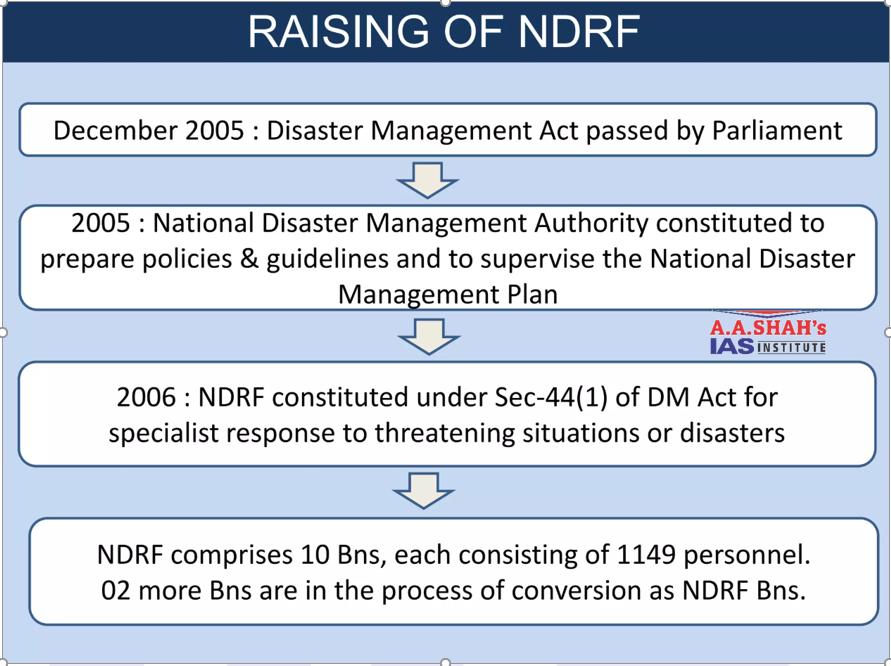
(iv) National Disaster Response Force (NDRF) – Sec 44
- Specialized response force.
- Drawn from paramilitary forces.
- Trained in search & rescue, CBRN (chemical, biological, radiological, nuclear) emergencies.
B. State Level
State Disaster Management Authority (SDMA) – Sec 14
- Headed by Chief Minister.
- Formulates state disaster management policy and plan.
State Executive Committee (SEC) – Sec 20
- Headed by Chief Secretary.
- Implements SDMA policies.
There is no section in the Act that mandates or establishes an SDRF force.
C. District Level
District Disaster Management Authority (DDMA) – Sec 25
- Headed by District Collector or DM.
- Responsible for planning and response at district level.
DISASTER MANAGEMENT PLANS (MANDATORY)
(i) National Plan – Sec 11
Prepared by NEC and approved by NDMA.
Includes:
- Mitigation measures
- Preparedness plans
- Capacity development
- Response and recovery strategy
(ii) State Plan – Sec 23
Prepared by SDMA.
(iii) District Plan – Sec 31
Prepared by DDMA.
FINANCIAL PROVISIONS
National Disaster Response Fund (NDRF) – Sec 46
- For immediate relief after disasters.
National Disaster Mitigation Fund (NDMF) – Sec 47
- For mitigation projects.
- Not operational for many years (criticism).
State Disaster Response Fund (SDRF) – Section 48(1)(a)
- Main fund used by states for disaster relief.
COVID-19 Pandemic (2020–2022)
- DMA was invoked nationwide for the first time.
- Lockdowns, containment zones, mandatory masks, movement restrictions were all enforced under Section 10 and 72.