Centre notifies four new Labour Codes
POLITY – RULES/CODES
22 NOVEMBER 2025
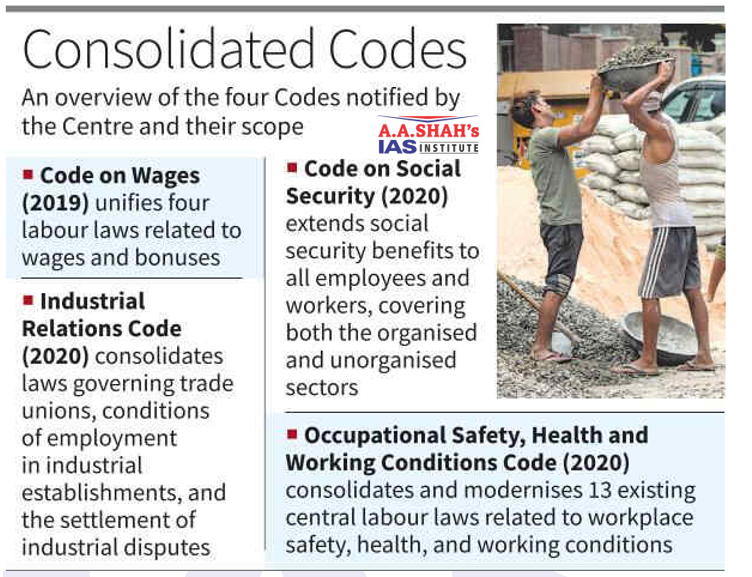
- The Centre notified all four Labour Codes, the Code on Wages (2019), Industrial Relations Code (2020), Code on Social Security (2020), and the Occupational Safety, Health and Working Conditions (OSHWC) Code (2020)
- They had been held back due to protests from trade unions, which continue.
- In a joint statement, 10 Central Trade Unions called the Codes an “anti-worker and pro-employer” reform.
- The laws, which came into effect on 21st November, 2025, replace 29 fragmented laws, many of which date back to pre-Independence and early post-Independence eras (1930s-1950s).
Code on Wages, (2019)
- Universal Minimum Wage
- Applicable to all employees, not only scheduled industries.
- Centre to set a floor wage; states cannot set minimum wages below this.
- Timely Payment of Wages
- Fixed wage payment cycle universally defined (weekly, fortnightly, monthly).
- Simplified Wage Definition
- “Wages” = basic pay + Dearness Allowance + Retaining Allowance.
- Allowances capped at 50% — improves PF, gratuity, overtime calculations.
- Equal Remuneration
- No discrimination on wages based on gender for same work.
- Bonus
- Single framework for bonus eligibility and calculation.
Industrial Relations (IR) Code, 2020
- Increased Threshold for Layoff/Closure Permissions
- Industrial establishments need government approval for layoff/closure only if they have 300+ workers (earlier 100).
- Helps MSMEs with flexibility.
- Fixed Term Employment (FTE)
- FTE employees get same benefits as permanent workers.
- Eligible for gratuity even if employment < 5 years (pro-rated).
- Trade Union Recognition
- Union with 51% members becomes the “negotiating union”.
- If none has 51%, a negotiating council is formed.
- Standing Orders
- Mandatory only for establishments with 300+ workers.
- Brings clarity to rules of conduct, hiring, classification, etc.
- Strikes
- 14 days’ notice mandatory before strikes or lockouts in all establishments.
- Earlier, notice requirement applied only to public utility services.
Code on Social Security (SS), 2020
- Universal Social Security
- Coverage extended to gig workers, platform workers, unorganised sector, and fixed-term employees.
- National database for unorganised, gig and platform workers (Aadhaar-linked).
- PF, ESI, Gratuity
- Provident Fund and Employee State Insurance norms simplified under single definitions.
- Gratuity entitlement for Fixed Term Employees (proportionate).
- Maternity Benefits
- 26 weeks maternity leave continues.
- Adoption and surrogacy benefits included.
- Gig & Platform Workers’ Benefits
- Aggregators (Uber, Zomato, Swiggy, Ola, etc.) must contribute 1–2% of turnover to gig workers’ welfare fund.
- Schemes for Unorganised Workers
- Health insurance
- Pension (like PM-Shram Yogi Maandhan)
- Disability and accident insurance
Occupational Safety, Health & Working Conditions (OSHWC) Code, 2020
- Applicability
- Establishments with 10+ workers (if using power) OR 20+ without power.
- All mines, docks, plantations covered.
- Working Hours & Overtime
- Daily working hours capped at 8 hours.
- Overtime at double wages.
- States allowed to operate 4-day work week (12 hours/day, 48 hours/week).
- Appointment Letter Mandatory
- Every employer must issue written appointment letters to workers.
- Inter-State Migrant Workers
- Definition broadened: anyone earning <₹18,000 per month and migrating for work.
- Eligible for:
- Journey allowance
- Toll-free helpline
- Mandatory registration
- Social security schemes
- Free Annual Health Check-up
- All workers aged 40+ must receive a free annual health check-up from the employer.
- Helps in early detection of occupational diseases and chronic illnesses.
- Pan-India ESIC Coverage
- ESIC extended to all states and UTs, including hazardous process industries.
- Improves nationwide uniformity in health & insurance coverage.
- Single Registration–Licence–Return System
- Establishments now follow a one-stop unified compliance system for:
- Registration
- Licensing
- Filing returns
- Reduces paperwork and duplicity for employers; ensures transparency.
Systemic Reforms
1. Inspector-cum-Facilitator Model
- Old inspection system replaced with a friendly, supportive compliance model.
- Inspectors guide establishments instead of only penalising them.
- Inspections based on risk-based criteria and randomised computerised selection.
2. Faster Dispute Resolution
- Introduction of two-member Industrial Tribunals:
- Chairperson
- Judicial/Administrative member
- Ensures quicker judgments on labour disputes, settlements, and claims.
3. National Occupational Safety and Health (OSH) Board
- Central board created to:
- Harmonise safety and health standards across states.
- Recommend uniform rules, standards, and training guidelines.
- Oversee implementation and periodic review of safety norms.
]
- The free annual health check-ups for workers aged over 40 years, pan-India ESIC coverage including hazardous process units, and a single registration, licence and return system.
- Additional systemic reforms include a
- inspector-cum-facilitator model for supportive compliance, faster dispute resolution through two-member tribunals, and a National Occupational Safety, Health (OSH) Board to harmonise safety standards.