SC reserves verdict on plea for passive euthanasia
POLITY – JUDICIARY
15 JANUARY 2026
- The Supreme Court reserved judgement on a plea for passive euthanasia by means of withdrawing artificial life support to a 31-year-old man.
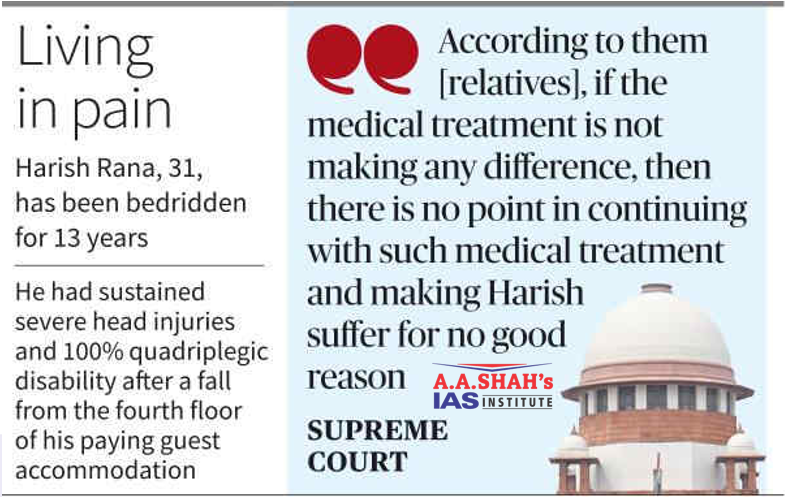
- The judges personally met his parents and siblings, who said they did not want him to suffer anymore.
- The court also recorded the submission made by Additional Solicitor-General Aishwarya Bhati, appearing for the Centre, that primary and secondary boards of doctors who visited Harish Rana were also of the opinion that medical treatment should be discontinued and “nature should be allowed to take its own course”.
- “The doctors are of the opinion that Harish would remain in this permanent vegetative state (PVS) for years to come, with the tubes inserted all over his body. However, he would never be able to recover and live a normal life,” the court recounted.
- Harish sustained severe head injuries and 100% quadriplegic disability after falling from the fourth floor of his paying guest accommodation as a Panjab University student in 2013.
- He has been bedridden for over 13 years now.
Euthanasia
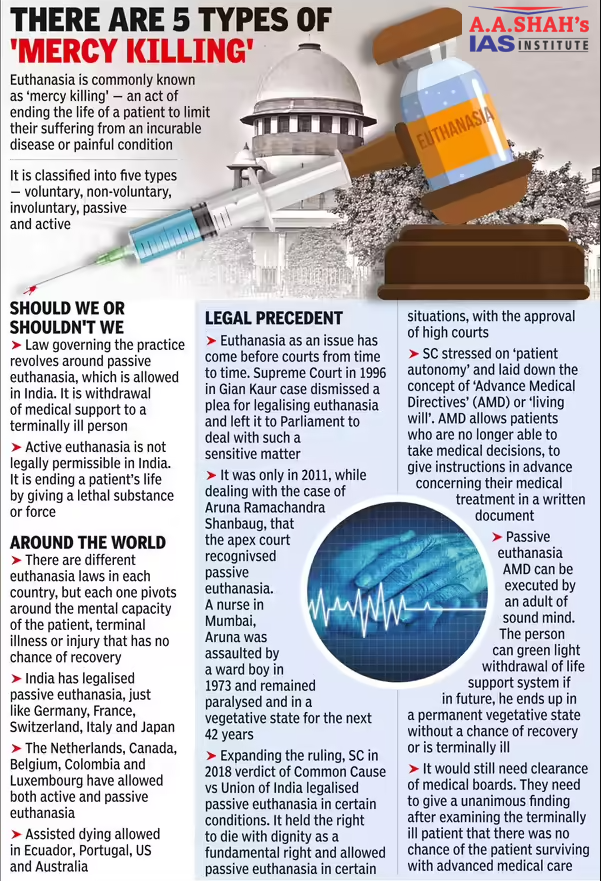
- Euthanasia is commonly known as “mercy killing”.
- It is an act of ending the life of a patient to limit suffering caused by an incurable disease or a painful condition.
Types of Euthanasia
- Euthanasia is classified into five types: voluntary, non-voluntary, involuntary, passive and active.
- Voluntary euthanasia: Done with the patient’s clear consent to end their life.
- Non-voluntary euthanasia: Done when the patient is unable to give consent.
- Involuntary euthanasia: Done against the patient’s expressed wishes.
- Passive euthanasia: Withdrawal or withholding of life-sustaining treatment.
- Active euthanasia: Deliberate use of drugs or force to cause death.
- The law governing euthanasia in India revolves around passive euthanasia, which is permitted.
- Passive euthanasia involves the withdrawal of medical support from a terminally ill person.
- Active euthanasia, however, is not legally permissible in India, as it involves ending a patient’s life by administering a lethal substance or by force.
- India has legalised passive euthanasia, similar to Germany, France, Switzerland, Italy and Japan.
- Countries such as the Netherlands, Canada, Belgium, Colombia and Luxembourg have allowed both active and passive euthanasia.
- Assisted dying is permitted in Ecuador, Portugal, the United States and Australia.
Gian Kaur case, 1996
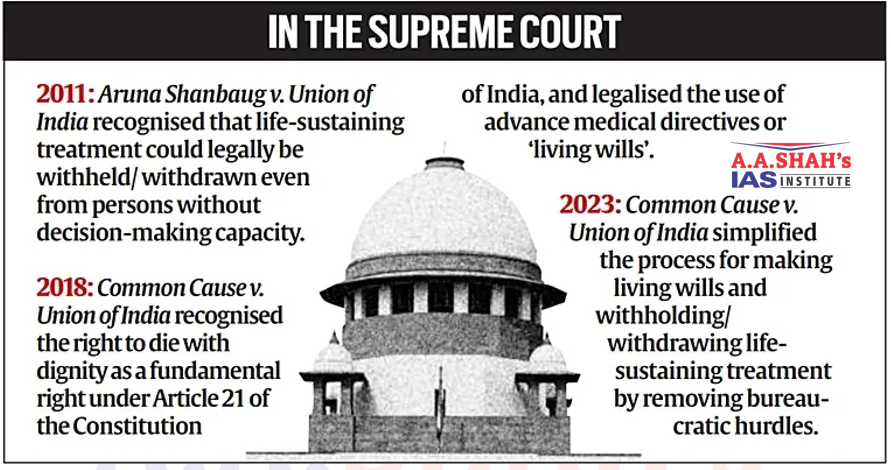
- In 1996, the Supreme Court, in the Gian Kaur case, dismissed a plea to legalise euthanasia and left the matter to Parliament, considering it a sensitive issue.
Aruna Shanbaug case, 2011
- In 2011, while dealing with the Aruna Ramachandra Shanbaug case, the apex court recognised passive euthanasia.
- Aruna, a nurse in KEM Hospital, Mumbai, was assaulted by a ward boy in 1973 and remained paralysed and in a vegetative state for the next 42 years.
- Expanding this ruling, the Supreme Court in its 2018 verdict in Common Cause vs Union of India legalised passive euthanasia in certain situations with the approval of high courts.
Advance Medical Directives (AMD) or living will
- The Supreme Court emphasised patient autonomy and introduced the concept of Advance Medical Directives (AMD), also known as a living will.
- An AMD allows patients who are no longer able to take medical decisions to give written instructions in advance regarding their medical treatment.
- Passive euthanasia through an AMD can be executed by an adult of sound mind, who may permit withdrawal of life support if, in the future, they enter a permanent vegetative state with no chance of recovery or suffer from a terminal illness. H
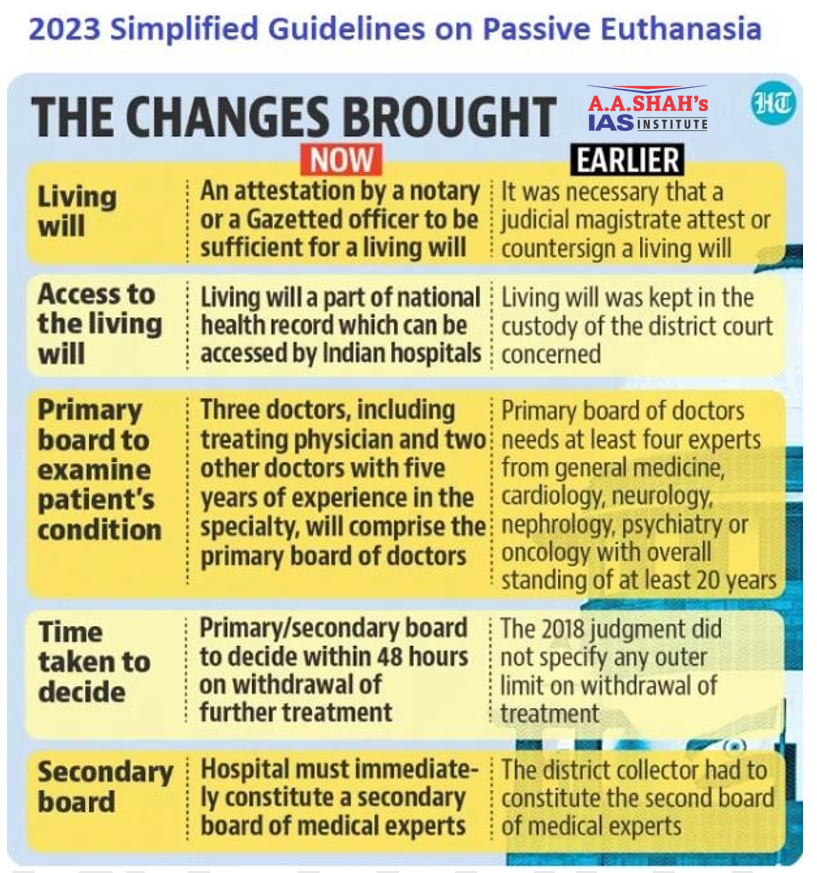
- owever, such decisions require clearance from medical boards, which must unanimously conclude after examination that the patient has no chance of survival even with advanced medical care.