Lokpal scraps plaint against BJP MP Dubey as ‘frivolous’
POLITY-LOKPAL
15 JANUARY 2026
- Anti-corruption ombudsman Lokpal has dismissed a graft complaint against BJP MP Nishikant Dubey and termed the allegations as “frivolous” and “vexatious”.
- In its 134-page order, the Lokpal pointed out that the complainant — former IPS officer Amitabh Thakur — had failed to make out any case to persuade it to proceed against Mr. Dubey regarding the allegation of acquisition of disproportionate assets than the known sources of his income.
- Lucknow-based Mr. Thakur, who is also the national president of Azad Adhikar Sena party, had in May 2025 filed a complaint against Mr. Dubey alleging acquisition of disproportionate assets by him
- It is alleged that Dubey’s election affidavits from 2009 to 2024 show unexplained increases in his spouse’s assets.
- Lokpal Bench headed by its Chairperson Justice A.M. Khanwilkar held that the allegations were frivolous, vexatious, and devoid of merit, claiming that the complaint targeted Dubey’s wife rather than the MP himself, who alone falls under the Lokpal’s jurisdiction.
- The former judge claimed Thakur had acted with apparent personal or political animus, and violated confidentiality norms by publicising the complaint on social media.
- The Lokpal mentioned several disapprovals of Thakur’s conduct in the 134-page order.
- “The Honorable Lokpal has ordered that, on the basis of these false allegations, to tarnish the honour of my family, I should file a case of harassment against these people in the judiciary or the Lok Sabha. Satyameva Jayate,” ANI quoted Dubey as having said.
- This is not the first time Justice Khanwilkar has ordered retributive action to be taken against a petitioner whom he has rejected in court.
- Justice Khanwilkar was part of the bench that in 2022 dismissed Zakia Jafri’s plea challenging the Special Investigation Team’s (SIT) clean chit to 64 people, including Narendra Modi, in the 2002 Gujarat riots case.
- In October 2025, public criticism arose following the floating of a tender by Lokpal to procure seven BMW 3 Series luxury cars for all members.
Meaning of Lokpal
- Lokpal means “caretaker of the people.”
- It is an anti-corruption ombudsman at the national level.
- Established to inquire into allegations of corruption against public functionaries.
Background and Origin
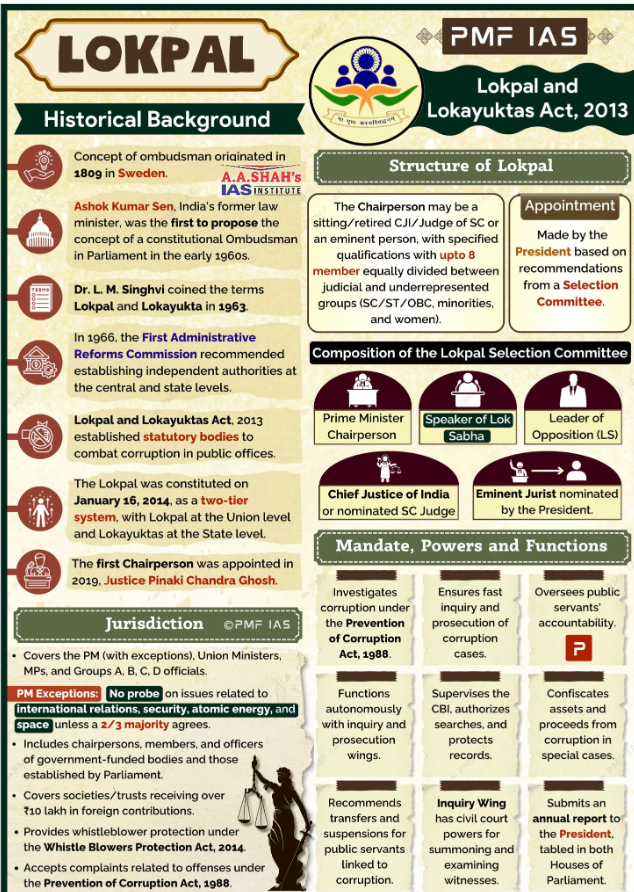
- Concept first proposed in 1963 by Law Minister Ashok Kumar Sen.
- Inspired by the Ombudsman system of Sweden.
- Several Lokpal Bills introduced between 1968–2011, but none passed.
- Massive public movement led by Anna Hazare (2011) revived the demand.
- Lokpal is a statutory body (not constitutional) created under the Lokpal and Lokayuktas Act, 2013.
- Came into force on 16 January 2014.
Objective of Lokpal
- To prevent corruption in public offices.
- To ensure accountability and transparency in governance.
- To provide speedy investigation and prosecution.
- To restore public trust in the administration.
Composition of Lokpal
- Consists of 1 Chairperson + up to 8 Members.
- 50% members must be judicial members i.e. Former Supreme Court Judges or Chief Justices of High Courts.
- Non-Judicial Members: Eminent persons with expertise in public administration, vigilance, finance, law, etc.
- Also, 50% members must belong to SC/ST/OBC/Minorities/Women.
Chairperson
- Must be:
- Former Chief Justice of India, or
- Former Judge of the Supreme Court, or
- Eminent person with integrity and anti-corruption experience.
Appointment of Lokpal
- Appointed by the President of India.
- On recommendation of a Selection Committee consisting of:
- Prime Minister (Chairperson)
- Speaker of Lok Sabha
- Leader of Opposition in Lok Sabha
- Chief Justice of India or nominee
- Eminent jurist (nominated)
Tenure and Removal
- Tenure: 5 years or till age 70 years (whichever earlier).
- Not eligible for reappointment.
- Can be removed by the President on grounds of misbehavior or incapacity
- Removal after Supreme Court inquiry.
Jurisdiction of Lokpal
Lokpal has jurisdiction over:
A. Public Functionaries
- Prime Minister, including former PMs
- Ministers
- Members of Parliament
- Group A, B, C & D officers
- Employees of Central Government
- Officials of PSUs, societies, trusts receiving government funds
B. Prime Minister (Limitations)
- Does NOT include matters related to:
- National security
- Foreign relations
- Atomic energy
- Space
C. All entities (NGOs) receiving donations from foreign source in the context of the Foreign Contribution Regulation Act (FCRA) in excess of Rs 10 lakh per year are under the jurisdiction of Lokpal.
Powers and Functions
- Can inquire into corruption complaints.
- Can order CBI investigations.
- Supervises investigations by CBI.
- Can order prosecution.
- Can attach property obtained through corruption.
- Can recommend disciplinary action.
- Has powers of a civil court.
Complaint Mechanism
- Complaints can be filed by any citizen or NGOs
- Must be supported by affidavit.
- False complaints are punishable.
Investigation Process
- Preliminary inquiry by Lokpal.
- If prima facie case found → full investigation.
- Investigation must be completed within 6 months (extendable).
- Trial in Special Court.
Lokayuktas (State Level)
- States must establish Lokayuktas.
- Structure and powers decided by states.
- Function similar to Lokpal at state level.