Greenland holds hazardous U.S. waste
INTERNATIONAL – USA
22 JANUARY 2026
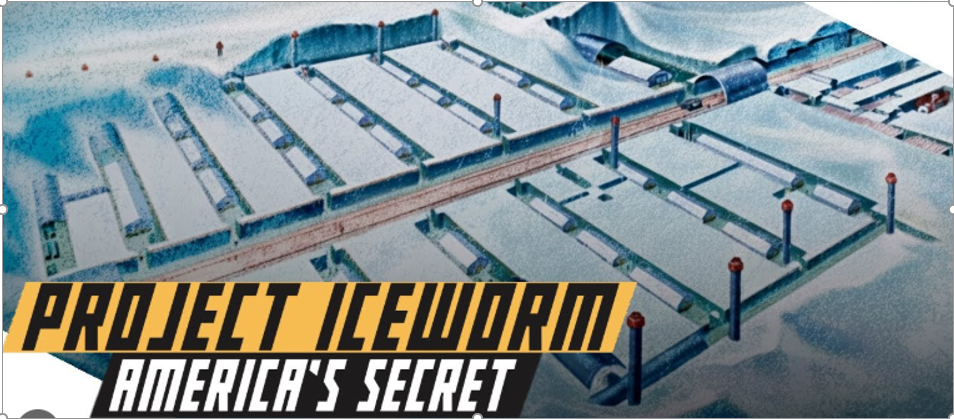
Project Iceworm
- Camp Century was a pilot for Project Iceworm, a classified plan for the U.S. to bore 4,000 km of tunnels to house 600 Iceman nuclear missiles.
- In 1959, the U.S. Army Corps of Engineers used large rotary milling machines to cut a system of trenches in the ice called Camp Century in Greenland.
- The central trench, colloquially called Main Street, was 1,100 feet long, 26 feet wide, and 28 feet high.
- The military expected to use the opaque ice sheet to hide the launchers from Soviet reconnaissance.
- The project flopped because the engineers had misunderstood the material properties of the ice: they treated it as a fixed solid whereas in reality, under the immense pressure of its own mass, glacial ice behaves like a visco-elastic fluid.
- That is, the trench walls flowed slowly rather than standing still, eventually twisting out of shape and becoming much narrower, threatening to crush the launchers.
- The changes were so severe that the U.S. military abandoned the base in 1967.
- But before it left, the U.S. Army had installed a portable pressurised light-water nuclear reactor here that used highly enriched uranium-235 as fuel.
- When Camp Century was decommissioned, the Army removed the reactor but not the associated nuclear waste.
- One 2016-study catalogued the inventory left behind, which the U.S. assumed the snow would entomb forever: 2 lakh litres of diesel, 2.4 lakh litres of wastewater and sewage, and large quantities of polychlorinated biphenyls and radioactive coolant.
Project Crested Ice
- In 1968, a B-52 bomber crashed onto the sea ice near the base, and conventional explosives onboard detonated and dispersed plutonium, uranium, and americium across the ice.
- The clean-up, which was the project and which included removing large quantities of contaminated snow to a site in the U.S., was a U.S.-Denmark effort that also created a political dispute.
- The operation was led by the U.S. Air Force and Danish Atomic Energy Commission.
- But, because the ice was fragile in the area, the U.S. couldn’t land its heavy equipment there. Manual labour was required, and more than 60% of those who performed it were Danish and Greenlandic civilians.
- The U.S. Air Force monitored its own personnel for radiation exposure whereas the civilians received less protective gear and didn’t receive the same long-term health monitoring.
- So, in the decades following the clean-up, many of the civilian workers developed cancers and other illnesses they attributed to radiation exposure.
- While the U.S. compensated the Danish government in the 1990s, it has generally maintained that the radiation levels were too low to cause illness, a stance that continues to cause diplomatic friction.
Climate change
- Climate models have indicated that by the end of the century, this part of Greenland could lose more ice mass than it gains. When that happens, the toxic slurry will leach into the subglacial aquifers and start flowing towards the ocean.
- Research has already shown that Arctic winters are becoming warmer and shorter, so in the not too distant future the ground will start accumulating heat.
Conclusion
- For decades, the U.S. treated Greenland as a disposable utility; now, rather than remediate the hazardous waste at Camp Century or address the instability at Pituffik, the U.S. is demanding title to the very land it poisoned.
- From Greenland’s and Denmark’s points of view, this is as much a question of sovereignty now as of dignity: the U.S. has proven itself a reckless tenant that trashed the property, and now it threatens to bankrupt the landlord and seize the deed.