Panel to probe repeated failures of PSLV, says ISRO
S&T – SPACE
25 FEBRUARY 2026
- A committee that includes K. Vijay Raghavan, former Principal Scientific Adviser, and S. Somanath, former Chairman, India Space Research Organisation (ISRO), will probe “systemic issues” underlying the successive failures of the ISRO’s Polar Satellite Launch Vehicle (PSLV).
- While technical committees probe and submit ‘failure analysis reports’ when mishaps occur, this committee will investigate questions on whether “organisational” problems may have played a role in the debacles involving the PSLV.
- The PSLV’s failures would be the core focus of the report, and the committee would be looking into the processes in the manufacture, procurement, and assembling of various components of the rocket.
- India’s space ecosystem now involves several private companies and, therefore, the probe will not only be about which part or component failed, and who was responsible, but also whether there is a process in place to fix accountability, and how it may be improved.
PSLV-C62 & PSLV-C61 failures
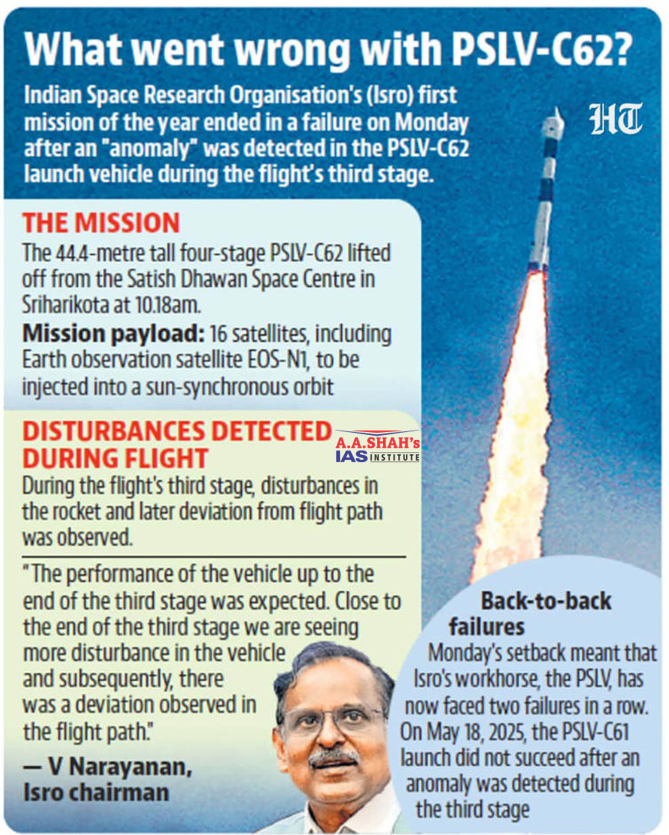
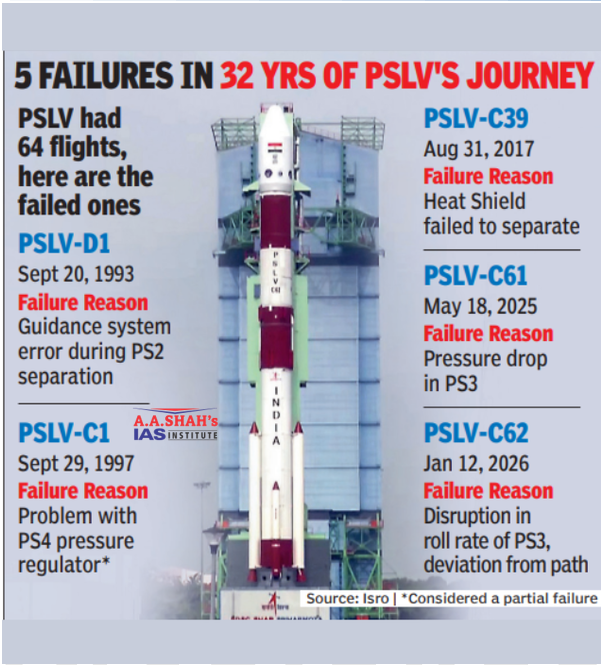
- On January 12, 2026, the PSLV-C62 failed in its mission to deliver 16 satellites into orbit, and crashed into the sea after the third stage of the rocket failed to ignite.
- This was similar to the May 18, 2025 failure of the PSLV-C61, in which, too, the third stage failed to fire.
PSLV C-62 payloads
- PSLV-C62 carried the EOS-N1 Earth observation satellite also known as ‘Anvesha’, a hyperspectral imaging satellite for strategic purposes and 18 secondary payloads.
- A key payload was Kestrel Initial Demonstrator (KID), a 25 kg re-entry capsule from Spain-based Orbital Paradigm.
- Several Indian private satellites were included, such as AayulSAT (India’s first on-orbit refuelling demonstration), CGUSAT-1, DA-1, SR-2, Lachit-1, Solaras-S4, and DSAT-1.
PSLV C-61 payloads
- PSLV-C61 carried the EOS-09 (RISAT-1B) satellite as its primary payload.
- This 1696.24 kg Earth Observation satellite was designed for all-weather, day-night imaging using a C-band Synthetic Aperture Radar (SAR).
- The satellite was expected to boost India’s space surveillance capabilities and contribute to smarter governance and faster disaster response.