Centre suspends rice fortification scheme; activists back move
SOCIAL – HEALTH
1 MARCH 2026
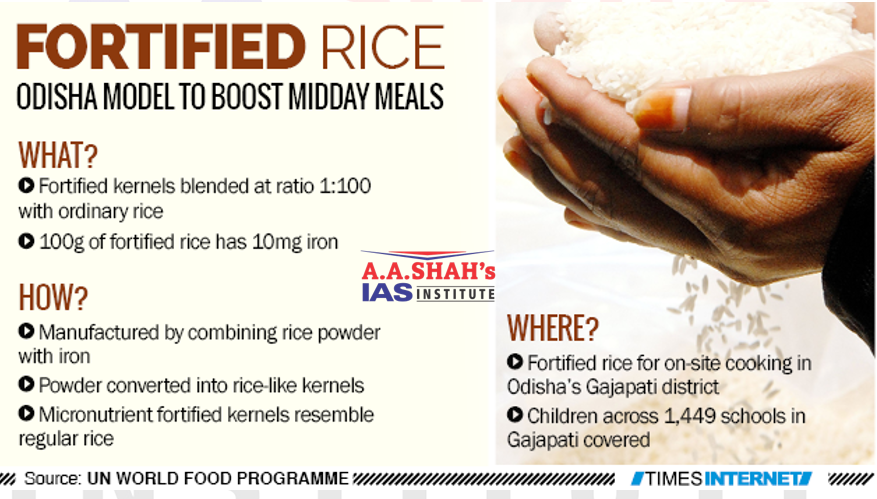
- The Union Food Ministry decided to temporarily discontinue the process of rice fortification under the Pradhan Mantri Garib Kalyan Anna Yojana (PMGKAY) and other welfare schemes “until a more effective mechanism for delivery of nutrients to beneficiaries is identified”.
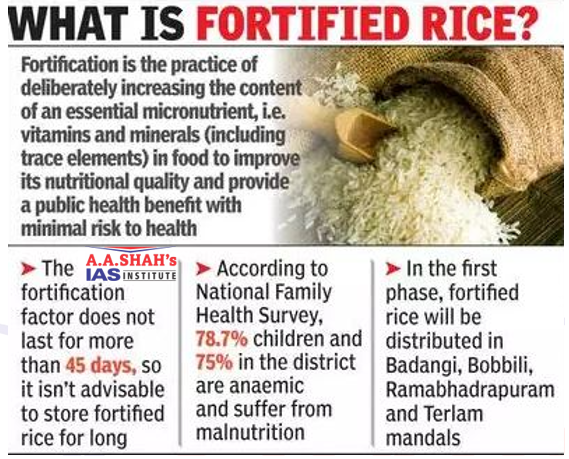
- Rice fortification was started in India in 2019.
Activists argument
- Activists who had challenged the scheme in the Supreme Court have welcomed the move, and said fortification is not a scientific method to curb anaemia.
- Social activist Kavitha Kuruganti said rice fortification is an expensive and ineffective intervention, which is unsafe and toxic. “While the government is citing a study to stop this large-scale fortification, we had shown much evidence that not all anaemia is linked to iron deficiency, nor is fortification an effective solution,” she said.
IIT Kharagpur study
- IIT, Kharagpur conducted a study to assess the shelf life of fortified rice kernels and fortified rice under actual storage conditions in diverse agro climatic zones in the country.
- “The report concludes that factors such as moisture content, storage conditions, temperature, relative humidity, and packaging material critically influence their stability and shelf life. They are susceptible to micronutrient reduction and shortening of shelf life during prolonged storage and routine handling. This reduction is rendering the effective shelf life shorter than expected and, in turn, limiting the intended nutritional outcomes,” the release added.
Anaemia Prevalence in India
- Official data from the National Family Health Survey-5 (2019-21) shows that
- 67.1% of children (6–59 months) are anaemic.
- 59.1% of adolescent girls (15–19 years) are anaemic.
- Around 57% of women (15–49 years) are anaemic.
- More than half the population in key groups — especially children and women — suffers from anaemia.
- These high percentages show that anaemia is a major public health concern in India.