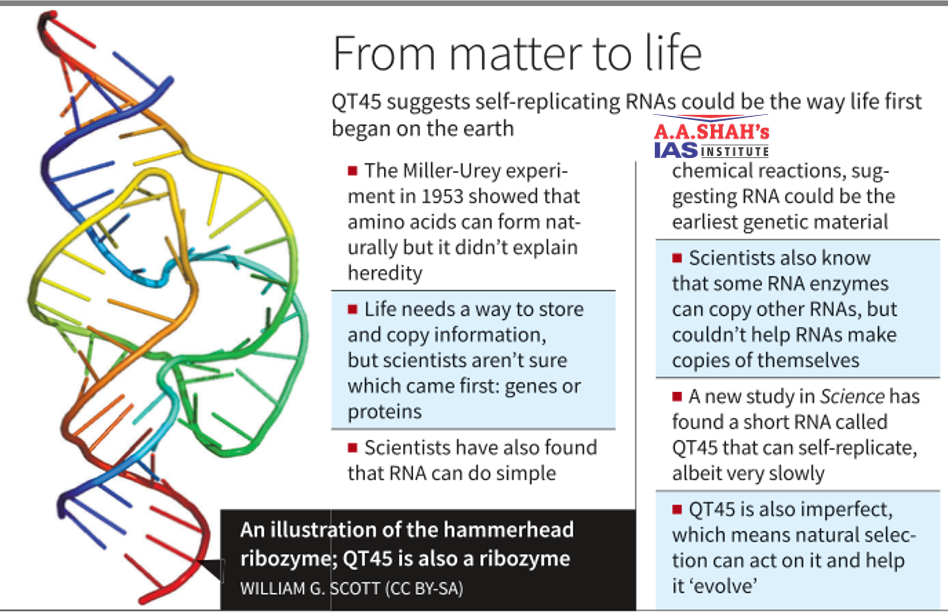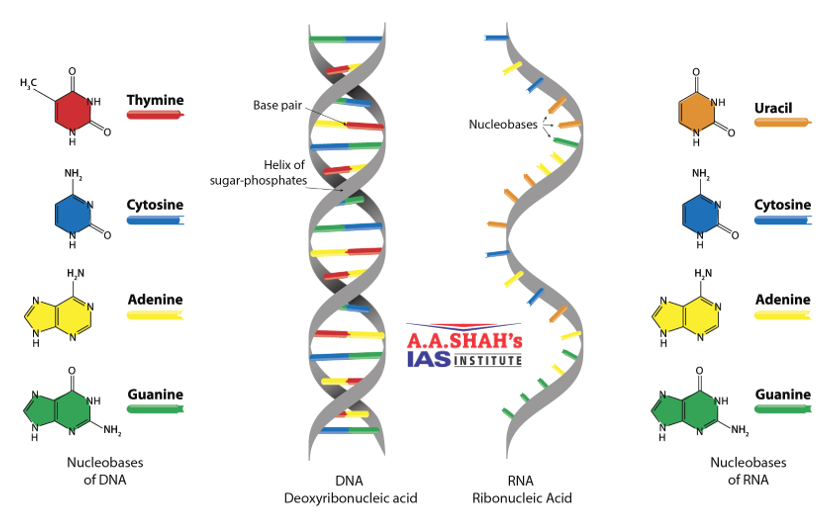
A small piece of RNA copies itself, hinting at how life began
S&T – BIOTECHNOLOGY
1 MARCH 2026
The Early Experiment (1953)
- In 1953, Stanley Miller and Harold Urey conducted a famous experiment simulating early Earth conditions.
- They showed that organic molecules like amino acids (building blocks of proteins) could form naturally.
- This supported the idea that life’s ingredients could arise from simple chemicals.
- However, they did not produce genetic material like DNA or RNA, which is essential for storing and copying life’s instructions.
The “Chicken-and-Egg” Problem
- Living systems require genetic material (DNA/RNA) to store information and proteins (enzymes) to copy that genetic material.
- But DNA/RNA needs protein enzymes to replicate.
- Proteins are made using instructions from DNA/RNA.
- So which came first?
The RNA World Hypothesis
- In the early 1980s, scientists discovered that RNA can act as both:
- A carrier of genetic information
- A catalyst (performing chemical reactions)
- This led to the RNA World Hypothesis, suggesting that early life may have been based solely on RNA.
- If RNA could both store information and copy itself, it could solve the chicken-and-egg problem.
QT45: The New Breakthrough
Scientists at the MRC Laboratory of Molecular Biology recently reported a major development in the journal Science.
- They created a small RNA molecule called QT45 only 45 nucleotides long and capable of copying its own genetic information.
- It is considered the first known self-replicating RNA molecule
QT45 Limitations
- Extremely slow replication (weeks for one copy).
- Requires special lab conditions.
- Copying accuracy only 92–94% (makes errors).
- But this imperfection is actually important:
- Errors create variation.
- Variation allows natural selection.
- Natural selection drives evolution.
Conclusion
- QT45 does not prove that RNA was the first genetic material. But it strongly supports the possibility.
- Primitive Earth had millions of years, so even slow replication might have been enough for life to gradually emerge.