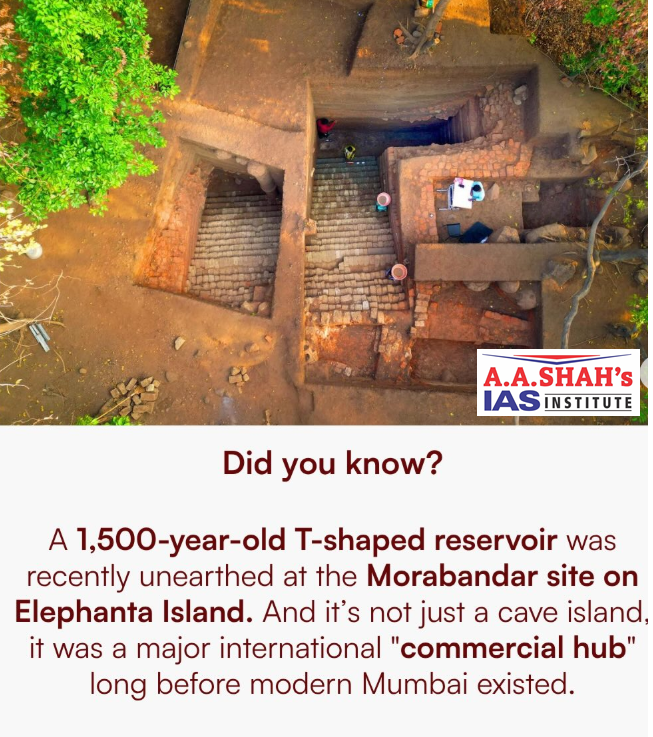
Ancient reservoir unearthed on Elephanta Island
HISTORY
9 APRIL 2026
- The Archaeological Survey of India (ASI), Mumbai Circle began the excavation on the Elephanta Island off the Mumbai coast in November 2025. It has excavated 19 trenches, each measuring 10 metres x 10 metres.
Stepped reservoir discovered
- In the scrub jungle on a hill on the Elephanta Island off the Mumbai coast, excavation has revealed a series of steps leading to a reservoir below.
- The stepped reservoir— about 14.7 metres long, and 6.7 metres and 10.8 metres wide, forming a T-shape — is estimated to be about 1,500 years old.
- A five metre deep excavation has exposed 20 steps.
- The steps are built with stone blocks, which are not from the island. They were ferried from the mainland.
- It was a carefully designed architecture for storing water.
- Although the island receives a large amount of rainfall from the monsoon, very little seeps into the soil because of the island’s rocky nature, and the water runs off into the sea.
Coins unearthed
- Importantly, 60 copper, lead and silver coins have so far been found in the excavations.
- Several copper coins have been identified as belonging to ruler Krishnaraja of the Kalachuri dynasty of the sixth century CE,
- The identification was made on the basis of the motif of a seated bull on the obverse and a temple symbol with the legend of Sri Krishnaraja on the reverse.
Other artefacts
- The excavation has earlier yielded a beautifully built brick structure, which could be a dyeing vat for colouring textiles, a big storage pot, terracotta figurines, glass and stone bangles, beads made of carnelian and quartz and stone anchors.
- A total of about 3,000 amphorae sherds of Mediterranean origin and torpedo jar sherds from West Asia, including Mesopotamia, have been unearthed.
- Amphorae and torpedo jars were used for storing wine, oil and fish sauce. Their potsherds showed the island’s long-distance maritime contacts.