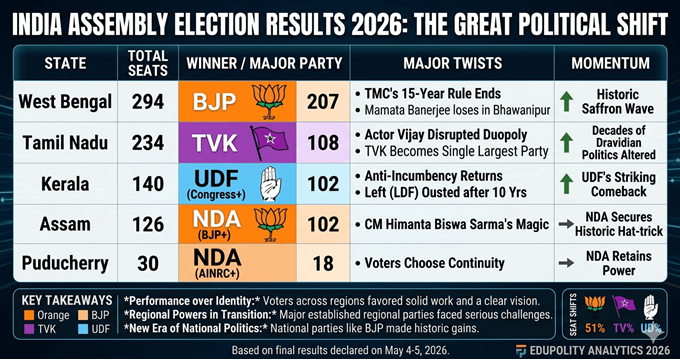
NDA’s success in Bengal & Assam; failure in Tamil Nadu & Kerala
POLITY – ELECTIONS
5 MAY 2026
- The results of the 2026 Assembly elections in Assam, West Bengal, Tamil Nadu, Kerala and Puducherry highlight several factors that have a bearing on India’s direction as a secular, democratic, federal republic.
- In Assam and Puducherry, the BJP and its partners retained power, while in the other three States, incumbents were swept away in a strong current of changed popular opinion.
Assam
- In Assam, for the first time, the BJP crossed the halfway mark of 64 seats on its own and, with its partners, won 101 seats in the 126-member Assembly.
- For the Congress, this is its worst performance — even lower than its 1985 tally in the aftermath of the Assam Agitation.
- Assam Chief Minister Himanta Biswa Sarma has reinforced his position in the State through a mix of polarising communal rhetoric and redistribution schemes.
West Bengal
- In West Bengal, the BJP has achieved a decisive victory through long-term planning, aided by the State’s political history, a tainted election process, and the exhaustion of the Trinamool Congress (TMC)’s politics that had run its course.
- Bengal has been home to India’s national movement and to Hindutva ideas long before they spread elsewhere, and has carried a strong sense of regional identity.
- The BJP, through years of meticulous organisation, converted a threshold population of the State to its totalising nationalist narrative
- The TMC faces existential danger, with its founder-leader Mamata Banerjee at 71 and its cadre and voters now susceptible to pressure from the BJP.
- This election was also the most tainted in India’s elections: around 27 lakh people were arbitrarily removed from the electoral rolls, and the Supreme Court of India took an unhelpful view of that grave assault on the fundamentals of democracy.
- If that is the sign of things to come, it is cause for serious concern.
Tamil Nadu
- In Tamil Nadu, the political start-up, the TVK, led by actor C. Joseph Vijay has made a stunning debut.
- Mr. Vijay is set to become the first Chief Minister not from either of the two principal Dravidian parties since the DMK first captured power in the State — a historic rupture in Tamil politics.
- While his popularity is now established, his acumen in navigating the complexities of governance and managing the relationship with the BJP and the Centre will be tested from day one.
- Though the differences in vote share among the formations — the DMK-led alliance, the AIADMK-led alliance, and TVK contesting alone — were not large, a three-cornered contest and the first past the post mechanism delivered an outsized advantage to the TVK.
Kerala
- In Kerala, the Congress-led UDF’s overwhelming victory is as notable as the pitiable performance of the CPI(M)-led LDF.
- The LDF’s defeat belongs principally to outgoing Chief Minister Pinarayi Vijayan, who — uncharacteristically for the State and more so for the Left — had built a personality cult.
- The BJP has won a historic high of three seats, but the UDF’s return, while restoring Kerala’s traditional alternation in power, could act as a speedbreaker to the BJP’s ambitions.
- The DMK and the TMC have been bulwarks of Opposition politics within and outside Parliament, as demonstrated in the recent parliamentary vote on the Delimitation Bill.
- With both beaten at the hustings, and buoyed by its victories in Assam and West Bengal, the BJP will feel tempted and emboldened to continue its course of unilateralism.
- The defeat of the DMK and TMC sets the stage for a potential realignment of the Opposition, opening the possibility for the Congress to aggregate and galvanise social and other interest groups — and to position itself as a weightier axis of anti-BJP politics.
Opposition wipe off
- The DMK and the TMC have been bulwarks of Opposition politics within and outside Parliament, as demonstrated in the recent parliamentary vote on the Delimitation Bill.
- With both beaten at the hustings, and buoyed by its victories in Assam and West Bengal, the BJP will feel tempted and emboldened to continue its course of unilateralism.
- The defeat of the DMK and TMC sets the stage for a potential realignment of the Opposition, opening the possibility for the Congress to aggregate and galvanise social and other interest groups — and to position itself as a weightier axis of anti-BJP politics.