Centre operationalises Labour Codes; trade unions protest
POLITY – BILL/ACT
10 MAY 2026
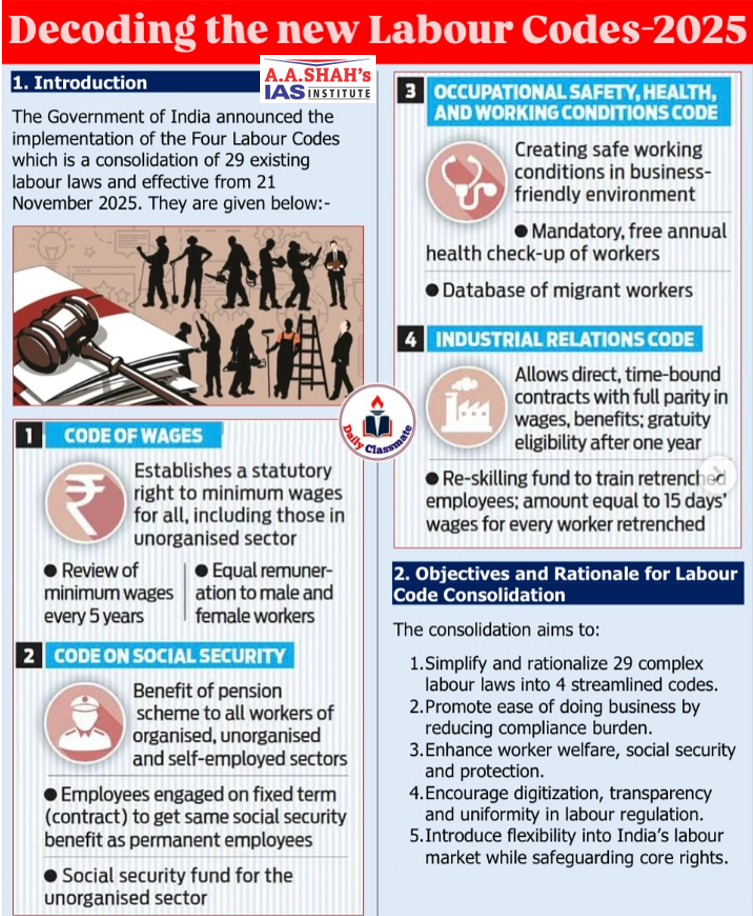
- In over 30 gazette notifications issued, the Union government fully operationalised the four Labour Codes.
- Officials maintained that the rules had been published with “minor amendments” to the draft rules pre-published in December 2025.
- The government had announced the implementation of the four Labour Codes from November 21, 2025.
- With the notification of the Rules, the Codes will replace 29 labour laws that governed provisions, including wages, social security, working hours, retirement benefits, and trade union rights.
- Soon after the publication of Rules, members of 10 central trade unions held protests across the country, burning copies of it.
Rules of the Code on Wages
- On the controversial subject of minimum wages, the Rules of the Code on Wages said the criteria shall be separately specified by the Union government by a special or general order, and the rate of wages for a day is fixed, and “such amount shall be divided by eight for fixing the rate of wages for an hour and multiplied by twenty six for fixing the rate of wages for a month…”
- The number of hours of work for a normal working day “for an employee whose wage period is on a daily basis” shall be eight hours. For other employees, the total number of weekly working hours shall not exceed 48 hours.
- The Rules mandate that every employer shall issue wage slips, electronically or in physical form to the employees.
The Rules for Code on Social Security
- The Rules for Code on Social Security changes 12 rules, including the Employees’ State Insurance (Central) Rules, 1950 and the Employees’ Provident Funds Appellate Tribunal (Conditions of Service) Rules, 1997.
- The Code on Industrial Relations says where there is only one registered trade union operating in an industrial establishment having its membership not less than 30% of the total workers employed in the industrial establishment, the employer of such industrial establishment shall recognise such trade union as the sole negotiating union of the workers.
- The Communist Party of India (Marxist) said in a statement that the Union government “deceptively waited” till the Assembly election in four States and a Union Territory were over before notifying the Rules.
Objections
- “Hire and Fire” Policies: The Industrial Relations Code makes it easier for companies to lay off workers or close establishments without prior government permission by raising the threshold for applicable establishments (from 100 to 300 workers).
- Restricted Right to Strike: The Codes mandate stricter conditions for strikes, including a compulsory 60-day notice period and mandatory conciliation proceedings, effectively undermining the workers’ right to collective bargaining.
- Expanded Contractualisation: By providing a legal framework for “Fixed-Term Employment,” unions argue that the Codes institutionalize precarious contractual work over permanent jobs and deny terminal benefits to many.
- Weakened Enforcement and Inspections: The introduction of systems like the “web-enabled inspection scheme” and “randomized inspections” limits the physical oversight of workplaces, reducing the accountability of employers.
- Unclear Minimum Wage Standards: Universal minimum wages are difficult to ensure because wage determination is left to rule-making, and workers in very small enterprises (under 10 or 20 workers) remain outside the law’s protection.
- Inadequate Social Security for Gig Workers: The Code on Social Security brings gig and platform workers into the fold but lacks dedicated funding mechanisms, making their welfare benefits largely dependent on sporadic government schemes rather than guaranteed rights