Meta told to disable ‘child sex abuse’ content
SOCIAL – MEDIA
6 JULY 2026
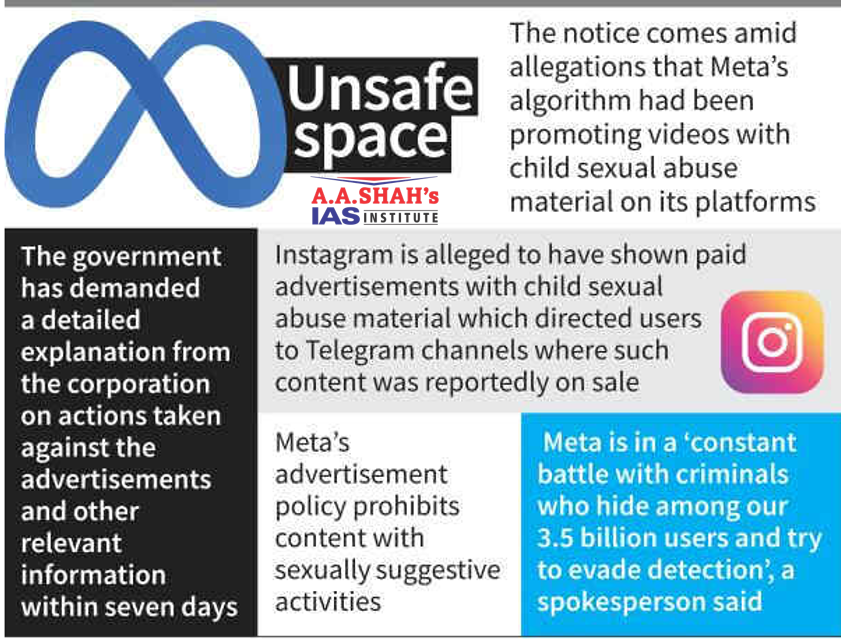
- The Ministry of Electronics and Information Technology has directed Meta, the parent body of several social media platforms, to disable advertisements and content promoting and facilitating access to child sexual exploitative and abuse material (CSEAM) on Instagram, according to government sources.
BBC Eye’s Investigative Report
- The move came a day after the BBC Eye published its investigation revealing that Instagram had allegedly been running “paid adverts promoting child sexual abuse material in India” and that such advertisements linked users to channels on Telegram, where they could buy the material.
Meta’s policy
- Meta’s policy on advertisements, meanwhile, stipulate that their content must comply with community standards and must not have imagery depicting nudity and activities that are sexual or sexually suggestive.
- In response to a query on the notice, a Meta spokesperson pointed to an earlier statement shared after the BBC report came out, where Meta said it had a “zero tolerance policy for soliciting or sharing CSEAM” and added that while the company deployed technology to detect such advertisements, it was in a “constant battle with criminals who hide among 3.5 billion users and try to evade our detection”.
Information Technology Act, 2000
- The IT Act, 2000 provides punishment for publishing or transmitting obscene material and material containing sexually explicit acts in electronic form.
- The Act also provides for stringent punishment for publishing or transmitting material depicting children in sexually explicit acts in electronic form.
- Besides, the IT (Intermediary Guidelines and Digital Media Ethics Code) Rules, 2021 enforces obligations on the intermediaries, including social media intermediaries, to observe due diligence.
- If they fail to observe it, they lose the exemption under law for third-party information or data or communication links hosted by them.
- The intermediaries are required to remove any such content within 24 hours.
- Section 79(3)(b) of the Information Technology Act, 2000, under which social media platforms could lose “safe harbour” for content posted by users, and end up defending themselves in court alongside the people whose content has been targeted by authorities.
National Cyber Crime Reporting Portal
- The Ministry of Home Affairs operates the National Cyber Crime Reporting Portal to receive complaints against cybercrimes, with special focus on cybercrimes against children.
- It has also set up the Indian Cyber Crime Coordination Centre (I4C) for such crimes.
- The government has, from time to time, blocked websites containing CSAM, based on lists from Interpol received through the Central Bureau of Investigation.
- It has issued an order to Internet Service Providers (ISPs), directing them to block access to such web pages or websites, said the reply.