‘Third language should start in Class 6 and stop in Class 9’
SOCIAL – EDUCATION
17 JULY 2026
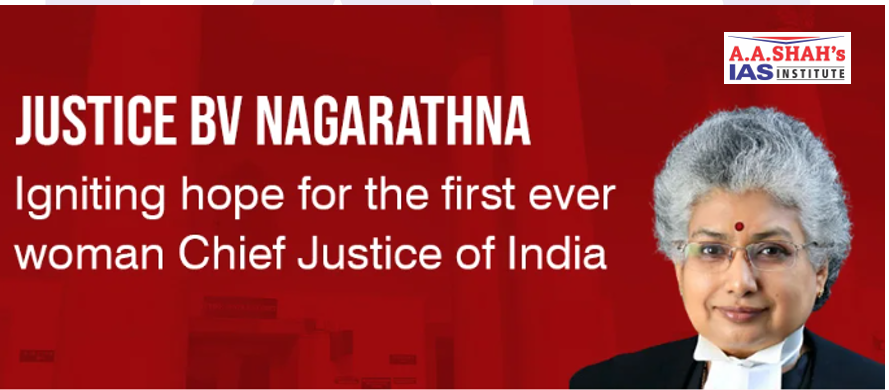
- Supreme Court judge, Justice B.V. Nagarathna, made an oral appeal in open court to the government to not introduce a third language (R3) in Class 9 as part of the three-language scheme, saying it would be too stressful for children with Board exams just a year away.
- She said a third language should be introduced in Class 6 and stopped in Class 9.
- The judge, who is in line to become the first woman Chief Justice of India as per the seniority norm, recalled how, while she was in school, the teaching of lessons meant for Class 10 would begin in Class 8 itself. “And this was in 1976. You can just imagine what the pressure would be on children now,” she remarked.
- The Supreme Court was hearing petitions filed on introduction of Navodaya schools in Tamil Nadu.
- The State government, during the previous Dravida Munnetra Kazhagam (DMK) regime, had maintained that the schools envisioned under the Jawahar Navodaya Vidyalaya Scheme were “fundamentally incompatible” with the two-language policy followed in Tamil Nadu.
- The State had, in earlier hearings, argued that the Navodaya scheme based on the three-language formula was a deviation from the mandate of the Tamil Nadu Tamil Learning Act, 2006.
- The Tamil Nadu government had maintained that the imposition of the scheme was a “backdoor” ploy to make Hindi compulsory.
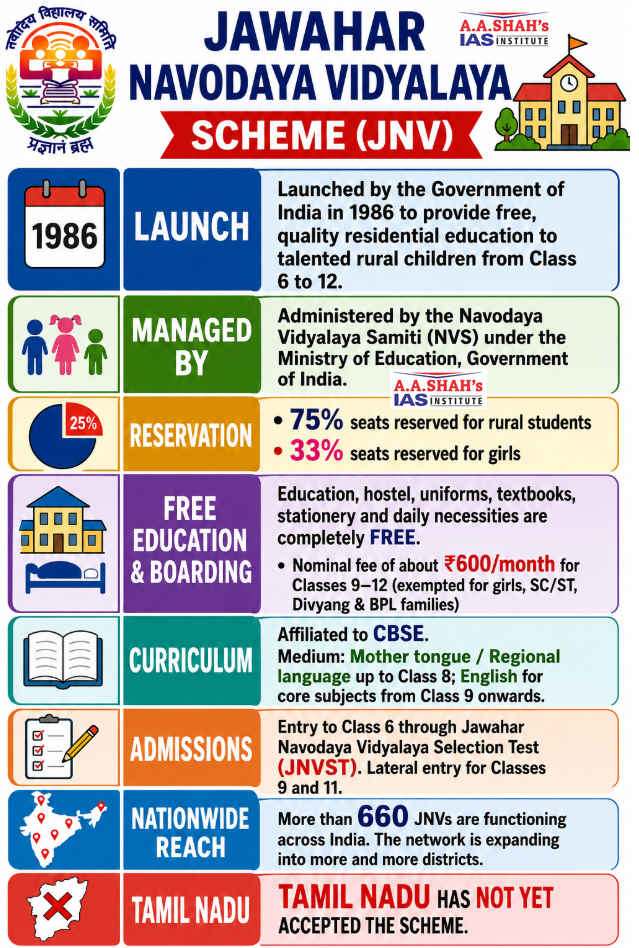
Jawahar Navodaya Vidyalaya (JNV) Scheme
- Launch: Introduced by the Government of India in 1986 under the National Policy on Education (1986) to provide free, quality residential education to talented children from rural areas from Class VI to XII.
- Management: Administered by the Navodaya Vidyalaya Samiti (NVS), an autonomous organization under the Ministry of Education.
- Reservation: At least 75% of seats are reserved for rural students, while at least one-third (33%) of the total seats are reserved for girls.
- Free Facilities: Provides free education, boarding, lodging, uniforms, textbooks, stationery, and other essential items. A Vidyalaya Vikas Nidhi (VVN) fee of about ₹600 per month is charged only for Classes IX–XII, with girls, SC/ST students, Divyang students, and BPL families exempted.
- Curriculum: Affiliated with the Central Board of Secondary Education (CBSE). The mother tongue/regional language is the medium of instruction up to Class VIII, after which English is used for Mathematics and Science, while Hindi is used for Social Science.
- Admissions: Admission to Class VI is through the Jawahar Navodaya Vidyalaya Selection Test (JNVST). Lateral entry is also available for Classes IX and XI against vacant seats.
- Migration Scheme: About 30% of Class IX students participate in a one-year migration programme between Hindi-speaking and non-Hindi-speaking states to promote national integration.
- Nationwide Network: Over 660 Jawahar Navodaya Vidyalayas are functioning across India, and the network continues to expand to cover newly created and uncovered districts.
- Tamil Nadu: Tamil Nadu has not implemented the Jawahar Navodaya Vidyalaya Scheme, making it the only state without any JNVs.