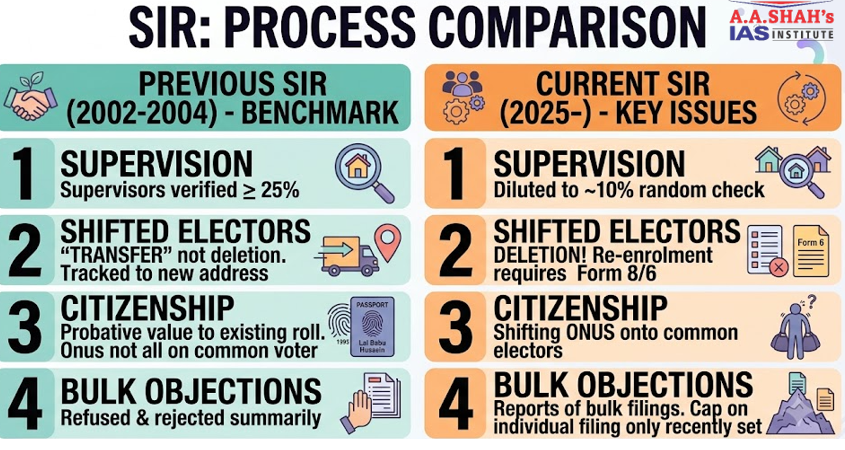
Comparing SIR 2002-04 and 2025-26
POLITY – ELECTIONS
13 OCTOBER 2026
Special Intensive Revision (SIR)
- The SIR is a comprehensive overhaul of the electoral rolls conducted by the Election Commission of India (ECI).
- Legal Mandate: Authorized under Section 21(3) of the Representation of the People Act, 1950 (RP Act), which gives the ECI the power to perform a special revision of electoral rolls for “any” constituency or part thereof as it deems fit.
- Current Rollout Schedule:
Phase I (June 2025): Initiated across the country starting with Bihar.
Phase II (Oct 2025 – Feb 2026): Covered 9 States and 3 Union Territories.
Phase III (May 2026 onwards): Expanded to 16 States and 3 Union Territories.
- Supreme Court Position: In May 2026, the Supreme Court ruled that the ECI is within its constitutional authority to execute an SIR for “many” or “all” constituencies in a state.
SIR (2002–2004)
- The last major nationwide SIR took place between 2002 and 2004 under strict operational guidelines:
| Aspect | 2002–2004 SIR Guidelines |
| Verification Method | Door-to-door physical enumeration using preliminary rolls; optional support from elected Panchayat members. |
| Supervisory Audits | Multi-tier checks: Supervisors verified more than 25 % of households (and all locked homes). Senior officers — Assistant Electoral Registration Officers (AEROs), EROs and District Election Officers — were required to check a minimum of 12%, 5% and 2% of the households, respectively. |
| Citizenship & Onus | Onus of proof on first-time applicants, but held probative value for voters already in the existing roll (Lal Babu Hussein vs. ERO, 1995). |
| Shifted Electors | Treated as a “transfer” rather than a deletion. Entries were marked with an “S”, cross-verified, and transferred directly to the new address by the Chief Electoral Officer acting as a clearinghouse. |
| Bulk Objections | Bulk claims/objections by individuals, parties, or organizations were summarily rejected to avoid malafide voter suppression. |
Major Concerns and Flaws in the Current SIR Process
The ongoing exercise has faced pushback from retired Supreme Court judges, former Election Commissioners, and civil society due to several operational departures from past protocol:
A. Exclusion & Treatment of “Shifted” Voters
- Electors not found or failing to return forms were omitted straight from the draft rolls, even if they had actively voted in recent elections.
- Instead of automatic cross-address transfers, shifted voters were forced to re-apply manually (Form 8 for address change or Form 6 as new voters).
- This directly violates the ECI Manual on Electoral Rolls (2023), which requires serving a formal notice (or pasting notice at the last known address before two adult witnesses) prior to deletion.
B. Diluted Supervision
- Verification checks were scaled down significantly. For instance, the Bihar notification mandated only a 10% random check by supervisors and generic review meetings by Electoral Registration Officers (EROs).
C. Shifted Onus of Proof
- Voters were expected to trace their own (or parent’s) lineage back to 20-year-old electoral rolls or supply extensive proof of citizenship, shifting the administrative burden directly onto citizens.
D. Automated & Software Exclusions
- Software algorithms flagged “logical discrepancies” (e.g., spelling differences, over 6 voters linked to one ancestor, parent-child age gaps outside 15–45 years), resulting in arbitrary deletion of lakhs of eligible voters.
E. Vulnerability to Bulk Objections
- Bulk Form 7 (objection forms) were misused by individuals to strike out valid electors. The ECI only introduced capping rules on individual bulk filings late in the process (October 9).
Deletion Metrics at a Glance
The current SIR process has led to the deletion of approximately 13.3 crore voters across Phases I–III:
- 20% (~2.7 Crore): Deceased voters.
- 8% (~1.01 Crore): Duplicate/repeat entries.
- 71% (~9.5 Crore): Flagged under “Absent, Shifted, and Others”.
A substantial portion of the 9.5 crore voters in the “absent/shifted” category are likely legitimate citizens entitled to re-enrolment.
Way Forward
- Independent Comprehensive Audit: Conduct a thorough audit of all finalized electoral rolls to identify incorrect exclusions.
- Proactive Re-Enrolment: Expedite eligible claims via proactive door-to-door visits rather than waiting for voters to navigate bureaucratic forms.
- Strict Door-to-Door Protocols: Mandate door-to-door enumeration for ongoing SIR states, finalizing rolls only after all claims/objections are systematically resolved.
- Use Existing Rolls for Elections: Rely on the proviso to Section 21(3) of the RP Act to allow pre-SIR electoral rolls to remain valid and operational for upcoming state elections until the new SIR rolls pass full verification.