A case against the SHANTI Act, 2025
POLITY – BILL/ACT
13 FEBRUARY 2026
(Sustainable Harnessing and Advancement of Nuclear Energy for Transforming India (SHANTI) Act, 2025
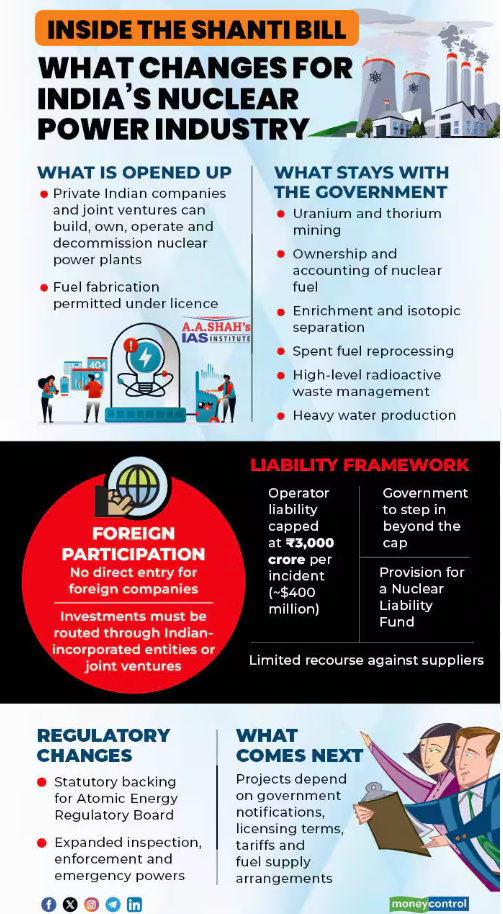
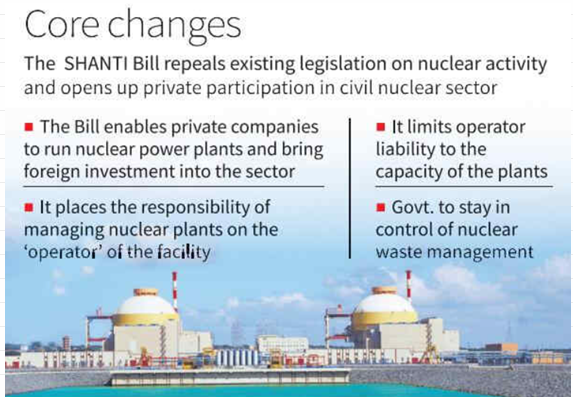
- The SHANTI Act, passed in the Winter Session of Parliament, makes major changes to India’s nuclear power framework by:
- Opening the sector to private operators
- Altering the liability regime
- Restructuring regulatory oversight
Critics argue that it weakens safety and accountability safeguards.
Key Features of the SHANTI Act
1. . Private Entry into Nuclear Power
- Ends the Union government’s exclusive control.
- Allows private entities to operate nuclear plants.
2. Changes to Liability Framework
Supplier Indemnity
- Liability for accidents is channelled solely to the operator.
- Removes the “right of recourse” (previously under CLNDA), which allowed operators to sue suppliers for defective equipment.
Liability Caps
- Operator liability:
- ₹100 crore (small plants)
- ₹3,000 crore (large plants)
- Total liability (including Centre):
- 300 million Special Drawing Rights (~₹3,900 crore)
Removal of Clause 46
- Victims can no longer invoke other laws (including criminal law) for additional remedies.
Critics say this protects suppliers and operators at the cost of victims.
3. Regulatory Structure
- Provides a legislative basis for the Atomic Energy Regulatory Board (AERB).
- However, Board members are selected by a committee constituted by the Atomic Energy Commission.
- Critics argue this limits regulatory independence.
Why Is Supplier Indemnity Controversial?
- Historically, major nuclear accidents involved design flaws:
- Fukushima (2011) – Weak containment structure.
- Chernobyl (1986) – Reactor design flaws and shutdown system failures.
- Three Mile Island (1979) – Control room design issues and communication failures.
- Critics argue that design defects have played central roles in past disasters, so shielding suppliers lacks scientific justification.
- However, U.S. suppliers had objected to India’s earlier liability regime.
- The 2026 U.S. National Defense Authorization Act urged India to align with international norms favouring suppliers.
Liability Cap vs Potential Damage
| Accident | Estimated Damage |
| Fukushima | ~₹46 lakh crore |
| Chernobyl (Belarus estimate) | ~₹21 lakh crore |
| SHANTI Act Cap | ~₹3,900 crore |
- The cap is roughly 1,000 times smaller than damage from major accidents.
- Even with international supplementary compensation, victims may receive less than 1% of potential losses.
Safety Concerns
- Moral Hazard
If operators and suppliers are shielded from full liability:
- They may take greater risks.
- Safety investments may decline.
- Natural Disaster Clause
- Operators indemnified for accidents caused by “grave natural disasters.”
- Critics say this weakens India’s earlier absolute liability principle for hazardous industries.
- Fukushima itself was triggered by a tsunami.
Nuclear Energy’s Role in India
- Contributes ~3% of electricity.
- Past targets repeatedly missed:
- 10 GW by 2000 → achieved 2.86 GW
- 20 GW by 2020 → achieved 6.78 GW
- New target: 100 GW by 2047.
Critics question feasibility due to:
- High capital costs
- Safety concerns
- Unproven small modular reactors
Economic Dimension
Nuclear projects involve massive commercial investments.
Example:
- Two AP1000 reactors in Georgia (U.S.) cost ~$18 billion each.
The Act:
- Creates opportunities for private and multinational firms.
- Shields them from extensive liability exposure.
Core Debate
| Supporters Say | Critics Say |
| Aligns with international norms | Weakens victim rights |
| Attracts private investment | Creates moral hazard |
| Speeds up nuclear expansion | Undermines accountability |
| Provides regulatory framework | Limits regulator independence |
Conclusion
- Should rapid nuclear expansion and commercial viability outweigh strict liability and victim protection in a high-risk industry?
- The answer depends on how India balances energy security, climate goals, safety and accountability and corporate risk-sharing.