BJP to mark 150 years of Vande Mataram
HISTORY – MODERN
6 NOVEMBER 2025
- The Bharatiya Janata Party (BJP) announced that Vande Mataram would be collectively sung across the country on November 7, 2025 to commemorate its 150th anniversary
- The celebrations will take place at 150 key sites of national significance, including the Kargil War Memorial.
Vande Mataram
Meaning
- “Vande Mataram” literally means “I bow to thee, Mother.”
- The “Mother” in the poem symbolizes the Motherland—India—depicted as a divine and nurturing entity.
- It expresses reverence, gratitude, and patriotic devotion toward the nation.
Origin
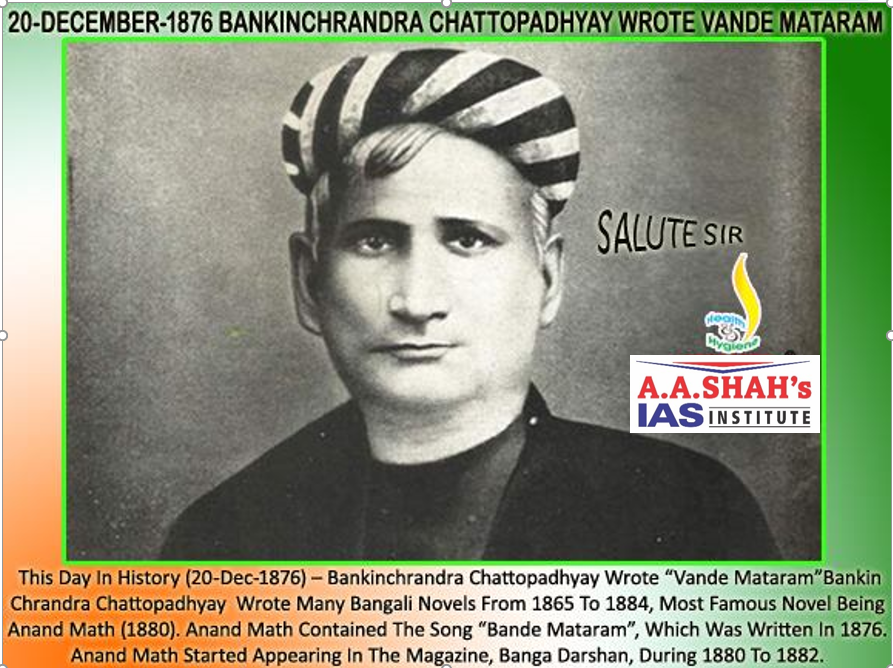
- Author: Bankim Chandra Chatterjee (Chattopadhyay)
- Composed: 7 November 1875
- Published in: literary journal Bangadarshan as part of his novel Anandamath, set against the backdrop of the Sannyasi Rebellion (late 18th century).
- The poem was originally written in Sanskritized Bengali, blending classical Sanskrit imagery with Bengali rhythm.
Role in the Freedom Struggle
- Became a rallying cry for Indian nationalists during the Swadeshi Movement (1905–1911), especially after the Partition of Bengal (1905).
- Chanted during protests, public meetings, and revolutionary gatherings.
- Its recitation was sometimes banned by the British for its strong nationalistic influence.
- Figures like Bipin Chandra Pal, Aurobindo Ghosh, and Lala Lajpat Rai popularized it.
- . A truncated version of Vande Mataram, keeping only the first two of the original six stanzas, was chosen as the National Song in 1937 by the Congress at its Faizpur Session.
National Song
- On 24 January 1950, the Constituent Assembly adopted it as the Republic of India’s National Song. It declared:
“Vande Mataram shall be the national song of India, with equal status to Jana Gana Mana, the national anthem.”
- The full poem consists of six stanzas; however, only the first two stanzas were adopted officially as National Song of India.
- The later verses contain Hindu goddess imagery (Durga, Lakshmi, Saraswati) that some felt could be exclusionary in a secular nation.
- Celebrated on “Vande Mataram Day” (January 24)—the date it was first sung in 1896 session of the Indian National Congress, with music composed by Rabindranath Tagore.