Courts cannot fetter President, Governor: SC
POLITY – JUDICIARY
21 NOVEMBER 2025
- The A five-judge Bench of the Supreme Court answered the 16th Presidential Reference under Article 143 of the Constitution.
- It followed the April 8, 2025 judgment (TN Governor case) that fixed a 3-month time limit for Governors and the President to dispose of State Bills pending with them.
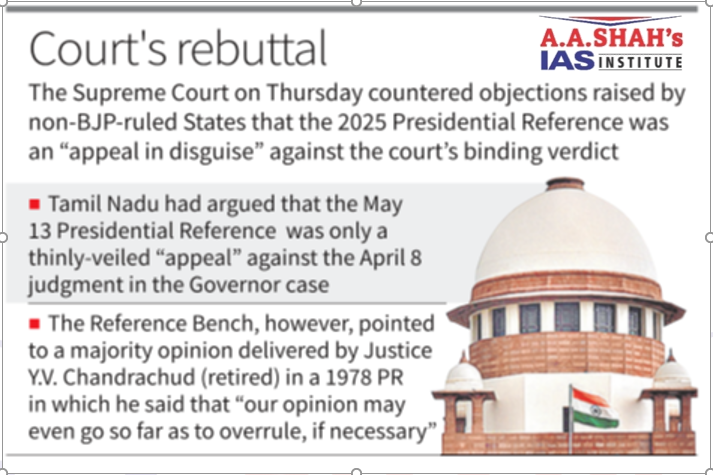
- Tamil Nadu and Kerala argued the Reference was an “appeal in disguise”. This divergence may open the path for the government to take the Presidential Reference route against an uncomfortable apex court judgment in future, rather than opting to file review or curative petitions.
Court’s Opinion on the April Judgement
- SC held that Governors/President cannot be tied to “one-size-fits-all” time-tables to dispose of State Bills.
- Imposing “deemed consent” of the proposed laws at the expiry of a court-ordered time frame would violate the separation of powers.
- “Such a usurpation of the gubernatorial function of the Governor, and similarly of the President’s functions, is antithetical not only to the spirit of the Constitution, but also specifically, the doctrine of separation of powers — which is a part of the basic structure of the Constitution.”
Court’s Opinion on limits on Governor/President
- They cannot show prolonged, evasive, or indefinite inaction.
- Indefinite silence violates federalism and State legislative powers.
- SC can issue a limited mandamus directing them to act within a reasonable time.
- Mandamus does not mean personal questioning because of Article 361 immunity.
Constitutional Provisions Involved
Article 143: Allows the President to refer legal questions to the SC.
Article 200 (Governor’s Options)
Governor has three choices:
- Assent to the Bill.
- Reserve it for the President.
- Return it (if not a Money Bill) with comments.
Article 141: SC’s law is binding on all courts.
Article 144: All authorities must act in aid of the SC.
Article 361: Grants President and Governors absolute immunity from being answerable to any court for the exercise and performance of their official duties during their term of office.
Fourteen questions and court’s responses
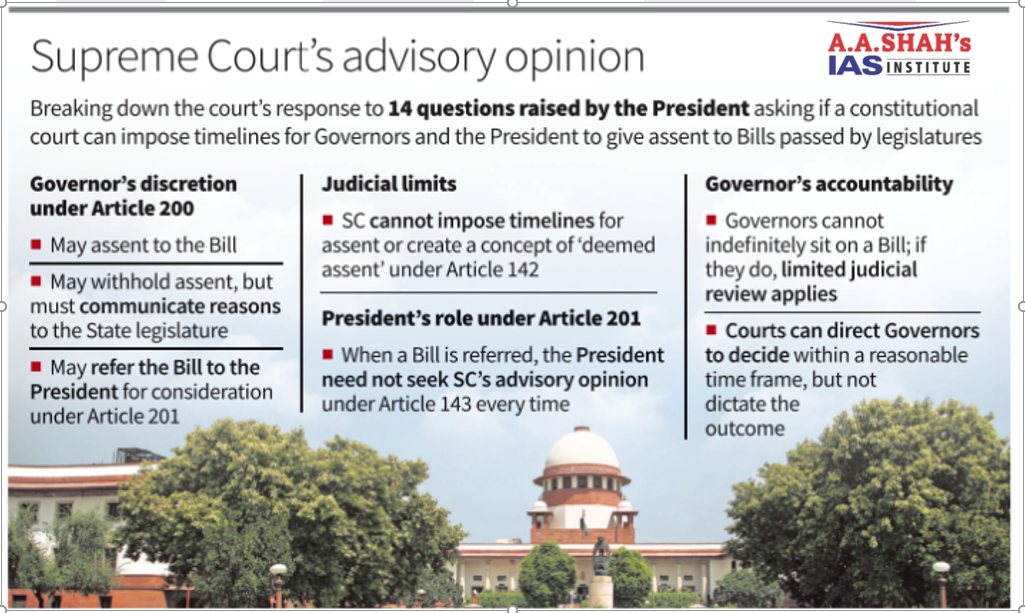
While it is not appropriate for the judiciary to impose timelines on the President and Governors, in glaring circumstances of indefinite inaction, the court can intervene, the Supreme Court said in its advisory to the Presidential Reference. Here are the 14 questions posed by the President and the court’s responses:
- What are the constitutional options before a Governor when a Bill is presented to him under Article 200 of the Constitution?
To assent, reserve the Bill for the consideration of the President, or withhold assent and return the Bill to the legislature with comments if the Bill is not a Money Bill.
- Is the Governor bound by the aid and advice tendered by the Council of Ministers under Article 200?
The Governor enjoys discretion and is not bound by the aid and advice of the Council of Ministers.
- Is the exercise of constitutional discretion by the Governor under Article 200 justiciable?
The discharge of the Governor’s function under Article 200, is not justiciable.
However, in glaring circumstances of indefinite inaction, the court has a limited power to issue a mandamus to the Governor to decide within a reasonable time period.
- Is Article 361 an absolute bar to judicial review in relation to the actions of a Governor under Article 200?
Article 361 is an absolute bar on judicial review in relation to personally subjecting the Governor to judicial proceedings.
- Can timelines be imposed under Article 200?
It is not appropriate as the Constitution is silent.
- Is exercise of constitutional discretion by the President under Article 201 justiciable?
For the same reasoning as held with respect to the Governor, the President’s assent too is not justiciable.
- Can the President be bound to timelines while exercising power under Article 201?
For the same reasons as indicated in the context of the Governor, the President, too, cannot be bound by judicially prescribed timelines.
- Is the President required to seek advice of the Supreme Court whenever a Governor reserves a Bill for assent?
The President is not required to seek SC’s advice. Subjective satisfaction of the President is sufficient.
- Are decisions of the Governor and President under Article 200 and Article 201 justiciable at a stage anterior into the law coming into force?
The decisions of the Governor and President under Articles 200 and 201 are not justiciable at a stage anterior into the law coming into force.
It is impermissible for courts to undertake judicial adjudication over the contents of a Bill before it becomes law.
- Can the exercise of constitutional powers and the orders of/by the President/Governor be substituted in any manner under Article 142?
The exercise of constitutional powers and the orders of the President/Governor cannot be substituted in any manner under Article 142 nor does it allow for the concept of ‘deemed assent’ of Bills.
- Is a law made by the State legislature a law in force without the assent of the Governor granted under Article 200 of the Constitution?
There is no question of a law made by a State legislature coming into force without assent of the Governor under Article 200.
- In view of the proviso to Article 145(3), is it not mandatory for any Bench of the court to first decide whether a case involves substantial questions of law and has to be referred to a Bench of minimum five judges?
Returns unanswered. Irrelevant to this reference.
- Do the powers of the Supreme Court under Article 142 of the Constitution limited to matters of procedural law?
Not possible to answer in a definitive manner. Scope of Article 142 answered as a part of earlier question.
- Does the Constitution bar the Supreme Court from resolving Centre-States disputes except by way of a suit under Article 131?
Irrelevant to the functional nature of the reference. Hence, returned unanswered.