Early March economic data shows slowing growth
ECONOMY – INDICATORS
29 MARCH 2026
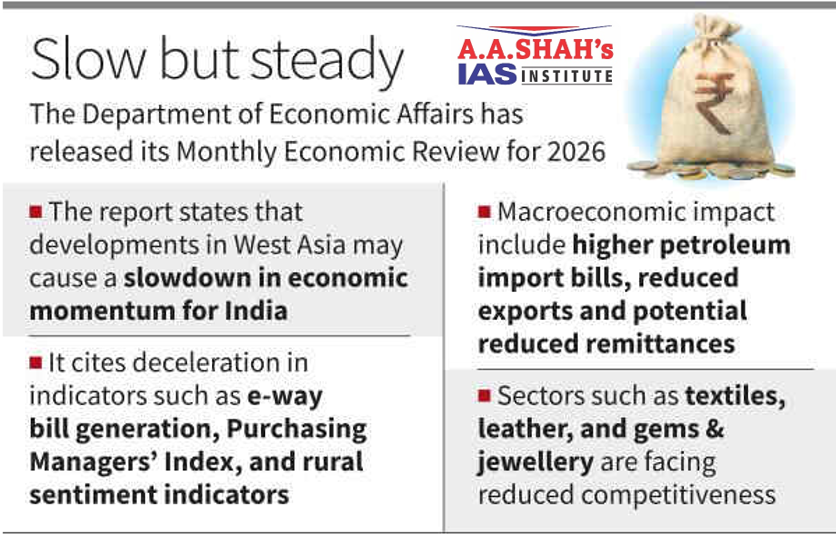
- Economic indicators are beginning to show signs of slowing growth in response to the constraints created by the war in West Asia, the Ministry of Finance has said in a new report.
- The Monthly Economic Review for March 2026, released by the Department of Economic Affairs (DEA), noted that the evolving conflict has “introduced a complex and multi-layered set of risks” for India, which is a major energy importer with strong trade, investment, and remittance linkages with West Asia.
Indicators:
- “E-way bill generation declined by 5.3% on a month-on-month basis, indicating some moderation in goods movement, although it remained higher by 9.4% on a year-on-year basis.”
- “Flash PMI [Purchasing Managers’ Index] estimates for March 2026 point to a softening in output growth following the energy price shock,” it added.
- However, the report noted that demand appears “relatively resilient”.
Sectors affected
- The report included a section on the macroeconomic impact of India’s dependence on imports, especially from West Asia, to meet its oil, LPG, and LNG needs.
- “In several segments, particularly MSMEs and continuous-process industries like glass or ceramics, the inability to switch fuels or inputs has led to production curtailment and temporary shutdowns,” the report said.
- “The dual impact of non-availability and cost escalation is amplifying stress on margins and output.”
Increasing costs
- Further, it noted that shipping disruptions, rerouting, and war-risk premiums have significantly increased freight and insurance costs, while transit delays have lengthened delivery cycles, hurting both imports of critical inputs and export commitments.
- “Export-oriented sectors — including engineering goods, textiles, leather, and gems & jewellery — are facing reduced competitiveness due to rising logistics costs and weakening demand from Gulf markets,” the report said.
- Airspace closures and higher aviation fuel prices are increasing operational costs, reducing connectivity, and dampening demand for the aviation sector, it added.
- The DEA highlighted in its report that higher petroleum import bills, combined with increased logistics costs and reduced exports to West Asia, could exert pressure on India’s current account.
Potential Remittances moderation:
- “Additionally, potential moderation in remittance inflows — given that a significant share originates from the Gulf — poses a downside risk,” the report said.
- It added that data from the Ministry of External Affairs showed that an estimated 9.2 million Indians live and work in West Asia, with the Reserve Bank of India estimating that at least 35% of India’s annual remittances originate from the region.
- “This implies that India’s exposure to remittances from the region is around $40 billion annually,” the report said.
- If conflict worsens, job losses or instability may result in remittances falling.
Depreciation pressures on the Indian rupee
- “These factors, alongside portfolio capital outflows, have contributed to depreciation pressures on the Indian rupee, necessitating calibrated policy responses.”
Widening of Fiscal Deficit
- “On the fiscal side, higher subsidy requirements [for fertilizer and fuel] and potential revenue shortfalls may widen the fiscal deficit, underscoring the need for expenditure prioritisation,” it added.