How does Canada’s uranium deal help India?
ECONOMY – ENERGY
8 MARCH 2026
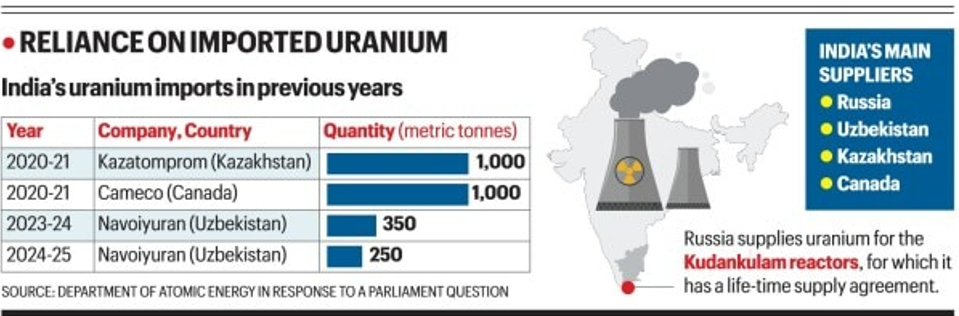
- In its quest for energy security, India signed a Canadian $2.6-billion deal with Cameco.
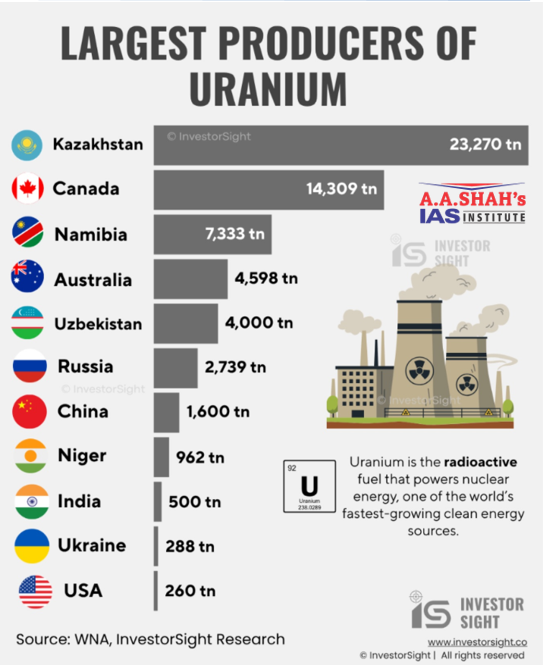
- The Canadian company is among the world’s top three largest uranium producers by volume.
- The deal ensures a supply of around 10,000 tonnes of uranium between 2027 and 2035 to India.
Indian Uranium Reserve
- India has both domestic reserves and imported stockpiles of uranium.
- The domestic reserves amount to 4.2-4.3 lakh tonnes of ore, spread across the major mines of Jaduguda and Turamdih in Jharkhand and Tummalapalle in Andhra Pradesh.
- Indian ore is ‘low grade’ (0.02-0.45% concentration).
- On the other hand, Canada has high-grade ore (10-100 times richer than Indian ore).
Import Dependence
- India has increasingly relied on imports, which currently meet nearly three-fourths of the civilian requirement.
- Aside from the Cameco deal, India also finalised a supply agreement with Kazatomprom of Kazakhstan in February 2026, and has ongoing contracts with Uzbekistan and Russia (both with low-grade ore).
- The government is also building a reserve intended to hold five years’ supply of fuel to protect against supply chain shocks.
- While importing uranium ore is cheaper than extracting it, it cannot legally be used in nuclear weapons. This is why India also mines ore domestically.
India-Canada Civil Nuclear Cooperation Agreement (NCA) 2010
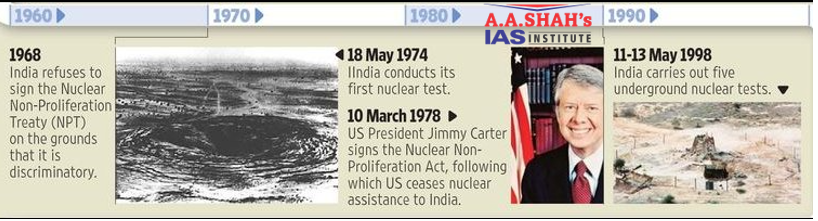
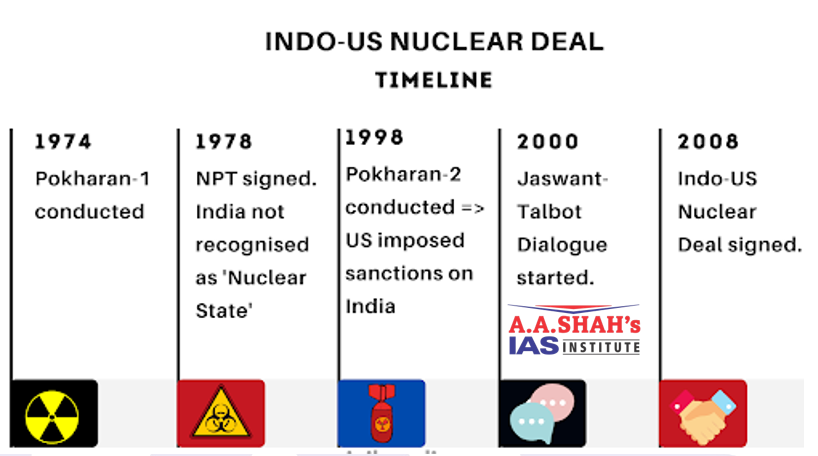
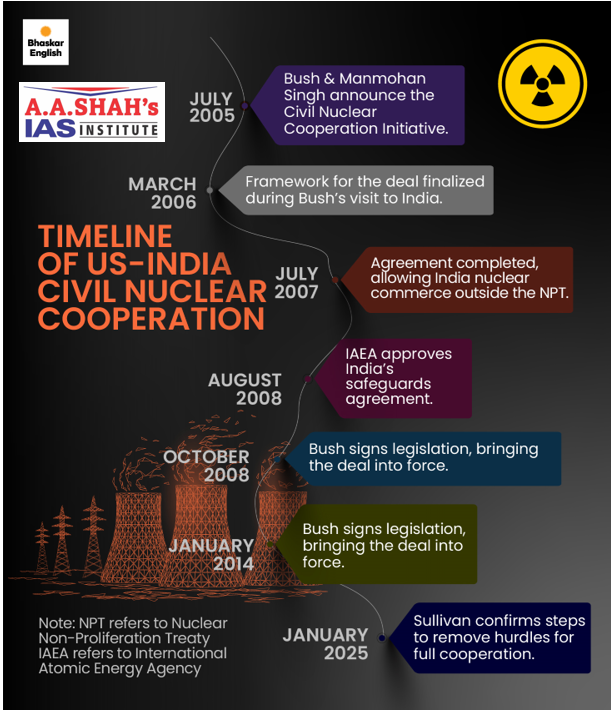
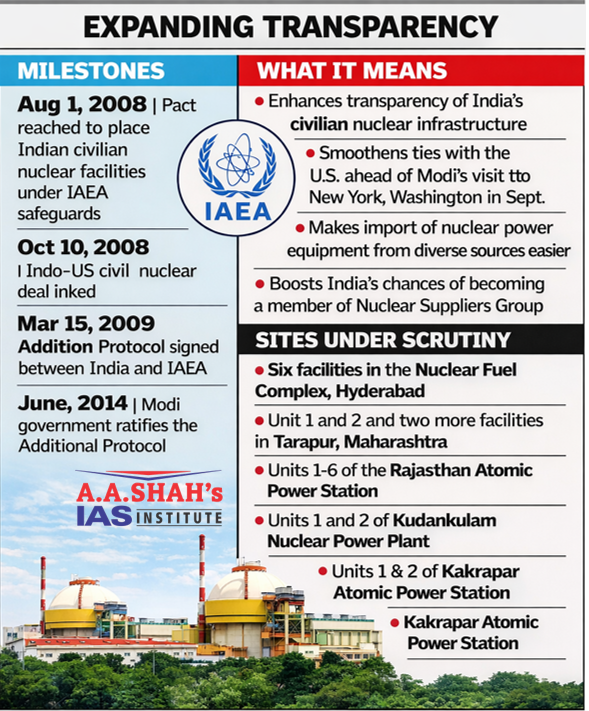
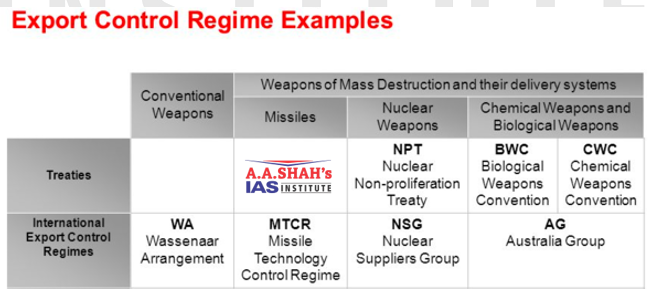
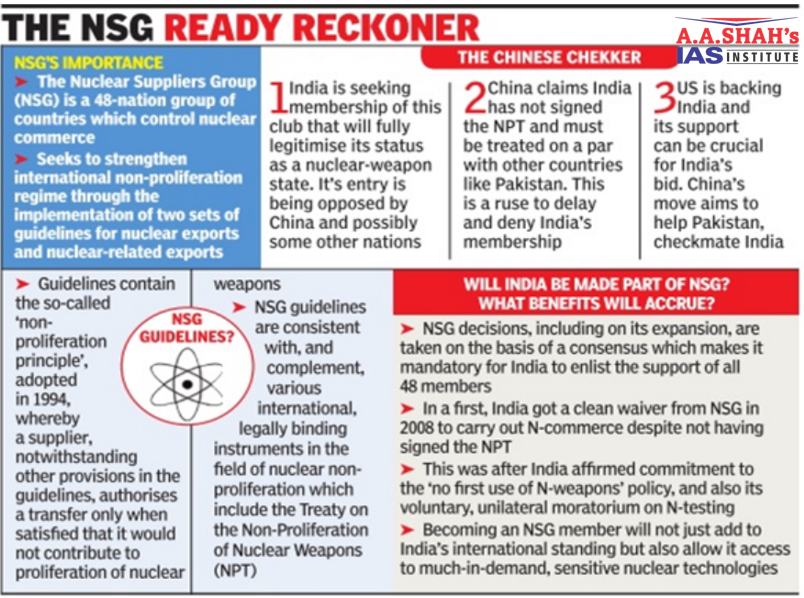
- India-Canada Civil Nuclear Cooperation Agreement (NCA) was signed in 2010, two years after the Nuclear Suppliers Group issued its ‘clean’ waiver for India, allowing it to engage in civil nuclear trade despite not signing the Nuclear Non-Proliferation Treaty.
- The waiver, in turn, was made possible by the 123 nuclear agreement between India and the U.S.
- Unlike the deal with Kazakhstan (which is less intrusive), the NCA requires India to provide “fissionable material accounts” to Canada, which critics have often called a slight against Indian sovereignty.
- On the flip side, the NCA has also been criticised for tacitly supporting India’s nuclear weapons programme: the more uranium India imports for civilian use, the more domestic uranium it can vouchsafe for military use.
India’s use of uranium
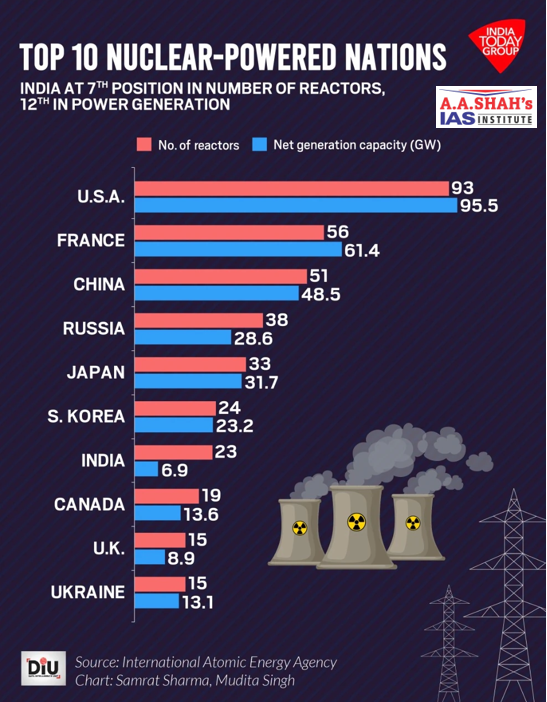
- India currently operates 24 nuclear reactors with a generation capacity of around 9 GW.
- The 700-MW pressurised heavy water reactors (PHWRs) that currently provide 6-7 GW, or roughly 3%, of India’s total electricity use uranium as fuel.
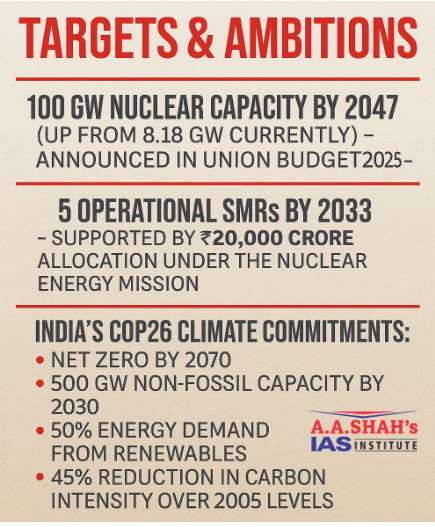
- The government is committed to increasing nuclear power capacity to 100 GW by 2047.
- Previous attempts to up this contribution have been set back by issues with land acquisition and local protests.
- Significant amounts of uranium are also used in research reactors, such as Dhruva in Trombay, to produce medical isotopes such as technetium-99m and iodine-131 and for advanced materials science research.
- In the 2025-26 Union Budget, Finance Minister Nirmala Sitharaman allocated ₹20,000 crore to develop a new generation of small modular reactors, which typically use 3-5% enriched uranium.
- Domestic uranium is also used for nuclear warheads (currently estimated to number around 170) and the nuclear-powered INS Arihant class submarines.
India’s nuclear power programme
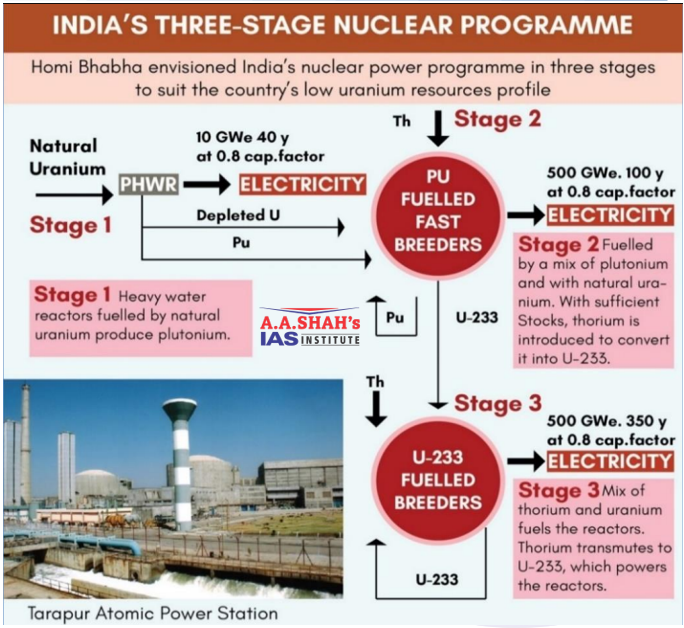
- Homi J. Bhabha envisioned this three-stage programme to take advantage of the fact that India hosts 20-25% of the world’s thorium deposits.
- India is currently transitioning from Stage 1 to 2 of the three-stage programme.
- In Stage 1, PHWRs will use natural uranium-235 to produce electricity and plutonium-239 as a byproduct.
- In Stage 2, fast breeder reactors will use a mixed oxide fuel of uranium-238 and plutonium-239 to produce electricity, uranium-233, and more plutonium-239. (The reactors are called so because they will produce more fuel than they consume.)
- The prototype fast breeder reactor (PFBR) in Kalpakkam is currently in an advanced stage of commissioning.
- Finally, advanced heavy water reactors will use plutonium-239 and thorium-232 as fuel, producing electricity and uranium-233.
Programme delayed
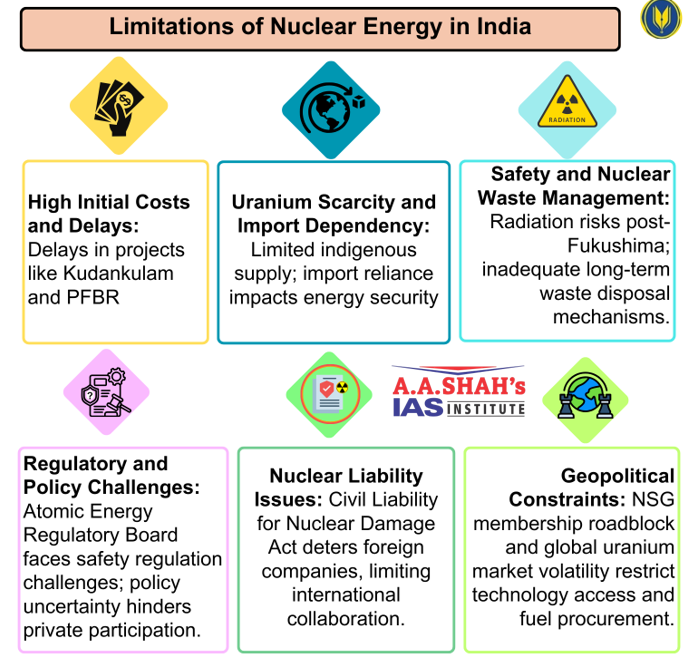
- However, the programme has been beset by numerous delays and cost overruns.
- The fast breeder test reactor was built at Kalpakkam in 1977 but the government did not sign off on the PFBR until the early 2000s, thanks in part to sanctions against India over its nuclear tests.
- The PFBR’s cost also nearly doubled from ₹3,492 crore at the time it was designed to more than ₹6,800 crore in 2019.
- In March 2013, the Department of Atomic Energy had said in a reply in the Lok Sabha, “The time of large-scale thorium deployment is expected to be 3-4 decades after the commercial operation of fast breeder reactors with short doubling time.” Given the PFBR’s own timeline, this period could be in the 2060s, if not later.
- Former Department of Atomic Energy Chairman Anil Kakodkar has explained that the doubling time — the time taken for one fast breeder reactor to produce enough fuel to start a second — is 15-20 years.
- To generate 100 GW, then, India has to go through several doubling cycles, which could explain the multiple deals now to secure the supply of uranium.