‘India studying implications of U.S. tariff moves’
BILATERAL – INDIA-ASIA
22 FEBRUARY 2026
Tariff under International Emergency Economic Powers Act
- The U.S. Supreme Court struck down the reciprocal tariffs imposed by Donald Trump on several countries, including India.
- The Court ruled on February 20, 2026 that Mr. Trump had exceeded his authority by using the International Emergency Economic Powers Act to impose these tariffs.
- As a result, the reciprocal country-specific tariffs were declared invalid.
- Trade analysts believe the ruling could prompt countries to re-examine their trade agreements with the U.S.
New Tariff under Section 122 of the Trade Act, 1974
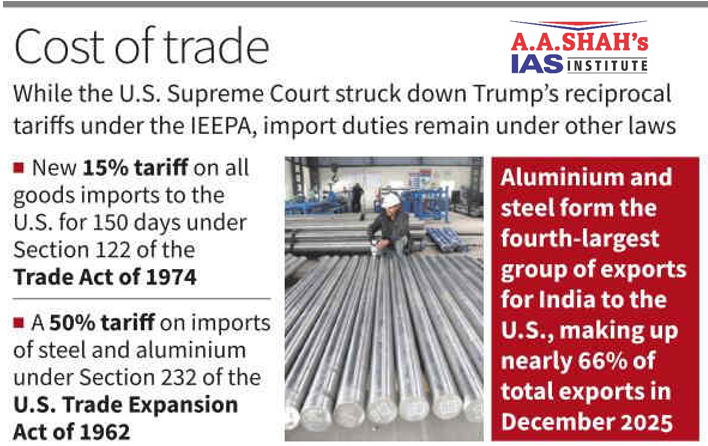
- Soon after the ruling, Mr. Trump announced a temporary 150-day 10% baseline tariff on all imports, effective from February 24, 2026.
- This tariff was imposed under Section 122 of the Trade Act of 1974.
- Section 122 allows the President to address international payment problems through special import restrictions and surcharges.
- In a post on Truth Social, Mr. Trump stated that the 10% tariff would be increased to a “fully allowed, and legally tested” 15% level, effective immediately.
Tariffs under Section 232 of Trade Expansion Act, 1962
- The U.S. continues to impose tariffs under Section 232 of the Trade Expansion Act of 1962.
- Under Section 232, the U.S. has imposed a 50% tariff on steel and aluminium imports.
- These tariffs remain unaffected by the Supreme Court ruling.
Impact on India’s Steel and Aluminium Exports
- Steel and aluminium together form the fourth-largest export category from India to the U.S.
- Exports of these items to the U.S. fell by nearly 66% in December 2025, according to trade data.
- The fall is linked directly to the high tariffs.
Suspension of ‘De Minimis’ Exemptions
- In August 2025, the U.S. suspended the ‘de minimis’ exemption, which had allowed duty-free imports of goods valued under $800 per person per day.
- After the Supreme Court ruling, Mr. Trump issued an executive order stating that the suspension of duty-free de minimis treatment would continue.
- This affects small Indian exporters and e-commerce businesses that relied on this route to ship products like textiles, toys, cosmetics, and electronic accessories to U.S. customers without paying duties.