India to spruce up mechanisms for accessing climate finance
ENVIRONMENT – CLIMATE CHANGE
17 NOVEMBER 2025
- India was among the 13 countries and a regional alliance of African countries that announced plans to set up a national platform for “climate and nature finance” at a ministerial event during the COP30 under way in Belem, Brazil.
- This would be coordinated through the Green Climate Fund (GCF), an institutional mechanism that has been at work since 2015, to fund projects in developing countries to adapt to unfolding climate change and to invest in clean energy.
- Despite being the world’s largest institutional mechanism for disbursing funds for climate finance, with commitments worth $19 billion, only a quarter of it has been properly allocated as of 2024.
- The GCF faces criticism from developing countries that its disbursal mechanisms are often difficult to comply with and there is limited technical support to avail these funds.
- Article 9.1 of Paris Agreement mandates that developed countries provide funds for mitigation and adaptation.
- The announcement of such a platform also ties in with expectations that negotiators may finalise a list of indicators that can be used to measure progress towards the so-called Global Goal on Adaptation (GGA).
- As of August 2024, India has received commitment from the GCF for 11 projects worth $782 million to mitigate and adapt to climate change in sectors, including water, clean energy, coastal, livelihood, transport, medium and small enterprises and climate start-ups.
- A bulk of the financing is in the form of concessional loans.
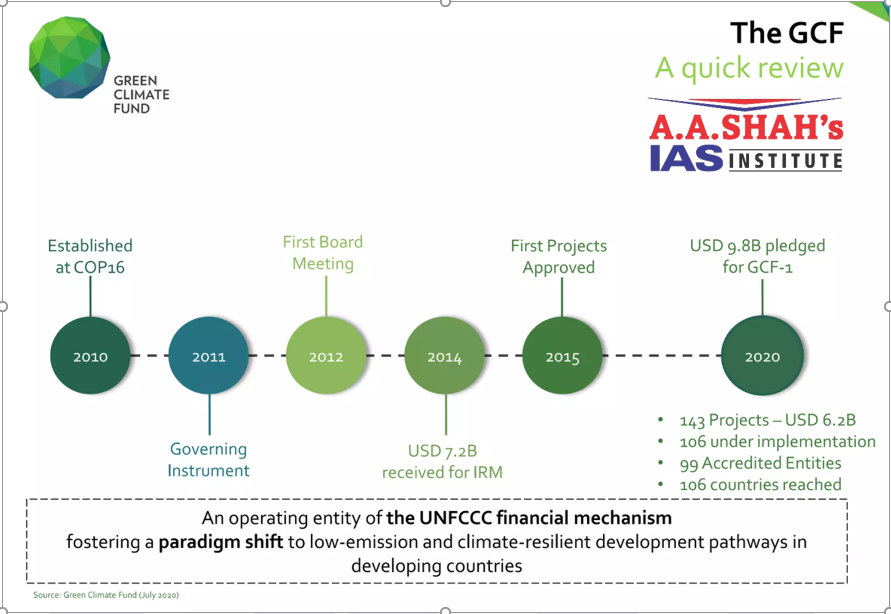
Green Climate Fund (GCF)
- It is the world’s largest dedicated climate finance fund, created under the UNFCCC and Paris Agreement to help developing countries tackle climate change.
- It was established in 2010 at COP16 (Cancún) Mexico.
- It began funding projects in 2015.
Purpose
- Support mitigation: reducing greenhouse gas emissions using clean energy, low-carbon transport, sustainable cities, etc.
- Support adaptation: building resilience against climate impacts (droughts, floods, cyclones, agriculture, water security).
- Ensure funding reaches vulnerable countries—Least Developed Countries (LDCs), Small Island Developing States (SIDS), and African nations.
How it works
- Developed countries pledge money to the GCF (replenished every 4 years).
- Funds are provided as grants, concessional loans, equity, or guarantees.
- Projects are proposed by “Accredited Entities” such as:
- UN agencies (UNDP, UNEP)
- Multilateral banks (World Bank, ADB)
- National entities (e.g., NABARD for India)
Priority Areas
- Transforming energy and transport
- Enhancing forests and land use
- Climate-resilient agriculture and water
- Climate-proof infrastructure and cities
- Reducing climate risks through insurance and early-warning systems