Indian HPV vaccine under test for single-dose roll-out
SOCIAL – HEALTH
6 MARCH 2026
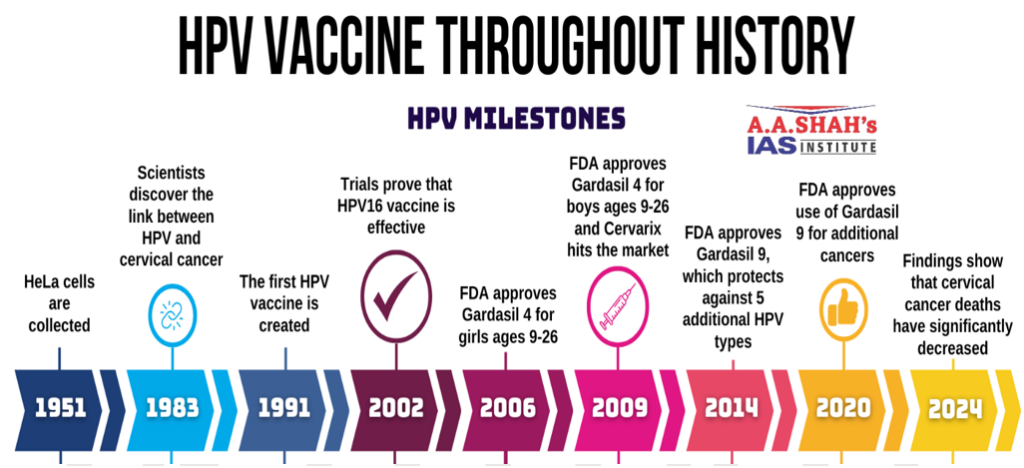
GARDASIL-4: HPV vaccine
- Prime Minister Narendra Modi, on February 28, 2026, launched a campaign in Ajmer, Rajasthan, to vaccinate 1.15-crore 14-year-old girls with Gardasil-4, developed by Merck and available in India since 2009.
- They were vaccination projects funded by Bill and Melinda Gates Foundation.
- It is one of the most well-tested HPV vaccines and part of the immunisation programmes in several countries.
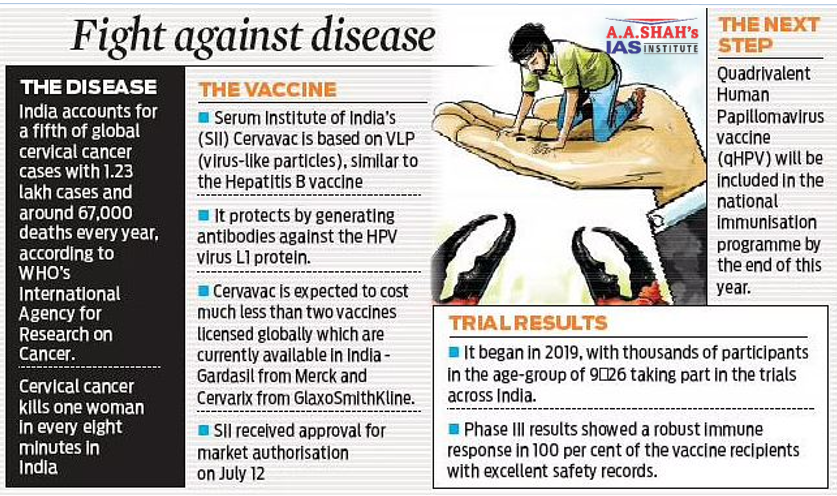
CERVAVAC: Indian-made quadrivalent HPV vaccine
- The Health Ministry in 2023 committing to preparing Cervavac, the Indian-made quadrivalent HPV vaccine for inclusion in the Universal Immunisation Programme (UIP), publicly available documents suggest.
- Following Phase ⅔ trials of the vaccine that showed Cervavac was “non inferior” to Gardasil, it was officially launched in September 2022 when Science Minister Jitendra Singh lauded it as an example of the private sector and the government coming together to create an affordable product.
- Reports in January 2023 said that the Health Ministry was planning to float a global tender for 16.02 crore doses of HPV vaccine in April towards the immunisation programme rollout in 2026.
- The minutes of a meeting of the National Technical Advisory Group on Immunisation (NTAGI) — India’s apex advisory body on vaccination — in July 2023 note that “…indigenously developed qHPV vaccine (Cervavac) may be considered for introduction in the UIP as a two-dose regimen”.
WHO norm’s relaxed
- Until early 2022, the WHO recommended a two-dose schedule for administering HPV vaccines for girls in the 9-15 age group for maximum generation of antibodies.
- However faced with “…stagnating pace of introductions, the low HPV vaccine coverage in many countries and the gap with the 2030 target of 90% coverage …” a Strategic Advisory Group of Experts (SAGE) of Immunisation of the WHO, recommended in March 2022 that national immunisation programmes could use either a two-dose or a single-dose vaccination schedule.
- This relaxation by the World Health Organization (WHO) in the prescribed dosage for the Human Papilloma Virus (HPV) vaccine and ‘free’ doses may have pushed back the inclusion of an Indian-made vaccine into the national programme to inoculate children against HPV.
Single dose testing
- The absence of Cervavac from India’s current UIP is due to an ongoing study led by the Indian Council of Medical Research (ICMR), which is testing whether a single dose of Cervavac generates enough protective antibodies and generates a stable immune response compared with a single dose of Gardasil vaccine.
- The results of this study are only expected in 2027, N.K. Arora, a member of the NTAGI said.