Mahad Satyagraha centenary on 20 March 2027
HISTORY
20 MARCH 2026
No peon, no water
- Think of a child in school. He is thirsty. There is water in the classroom. But he cannot drink it. Not because the water is dirty. Not because there is a rule against drinking in class.
- He cannot drink because the peon who is supposed to pour the water into his cupped hands, from a height, so that the vessel is not polluted by his touch, happens to be absent that day.
- That was the rule that governed the childhood of Bhimrao Ramji Ambedkar.
- He wrote about it with quiet, devastating precision in his autobiographical essay Waiting for a Visa, and in the fragment known as No Peon, No Water.
- He and his siblings, travelling to meet their father, arrived at a railway station parched with thirst. No one would give them water.
- They were Mahars. They were “untouchable.” The public tap was not for them.
Mahad Satyagraha
- That boy grew up. He went to Columbia. He went to the London School of Economics. He read law at Gray’s Inn. And then he came home and walked to a water tank.
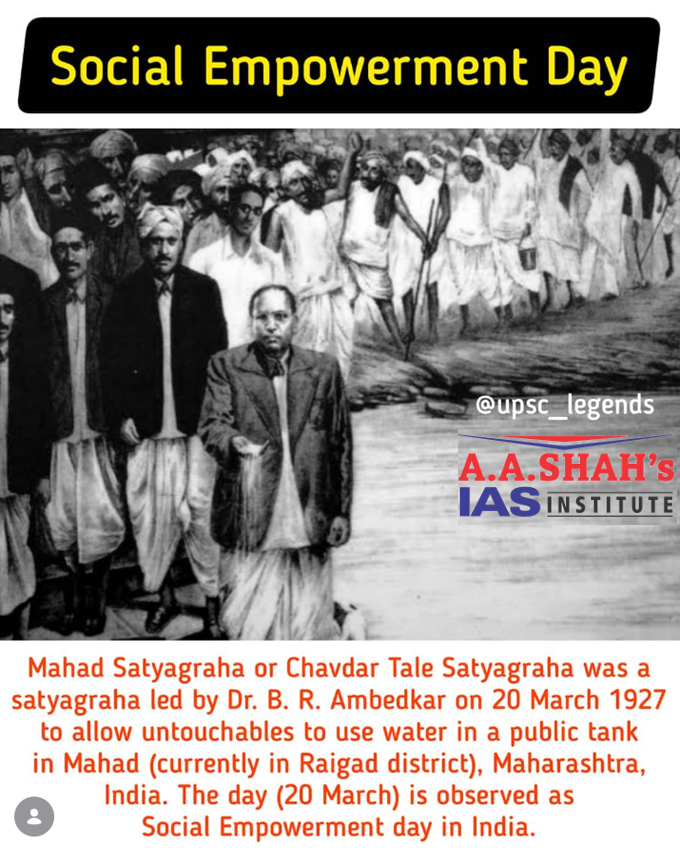
- On March 20, 1927, Ambedkar led a procession of thousands through the streets of Mahad, a small town in the Konkan, in the Bombay Presidency.
- Their destination was the Chavdar Tale, a public water tank.
- The Bombay Legislative Council passed the Bole Resolution in 1923, and the Mahad Municipality opened the tank to the depressed classes in 1924.
- But resolutions on paper and water in the throat are different things. The upper castes ensured that the resolution remained a dead letter.
- Ambedkar walked to the tank. He bent down. He drank.
- Thousands followed him — men, women, children. They drank. For perhaps the first time in their lives, they drank water from a public source as a matter of right, not as an act of stealth or charity.
- And then the violence came.
- Rumours spread that the satyagrahis intended to enter the Veereshwar temple.
- Returning delegates were attacked in the streets, in their bullock carts, in their villages.
- The tank was “purified” with cow dung and urine, as though human dignity were a contaminant that could be washed away.
Second Mahad visit
- When Ambedkar returned to Mahad in December 1927 for a second conference, he brought with him not just the resolve to drink water again but a deeper symbolic intent.
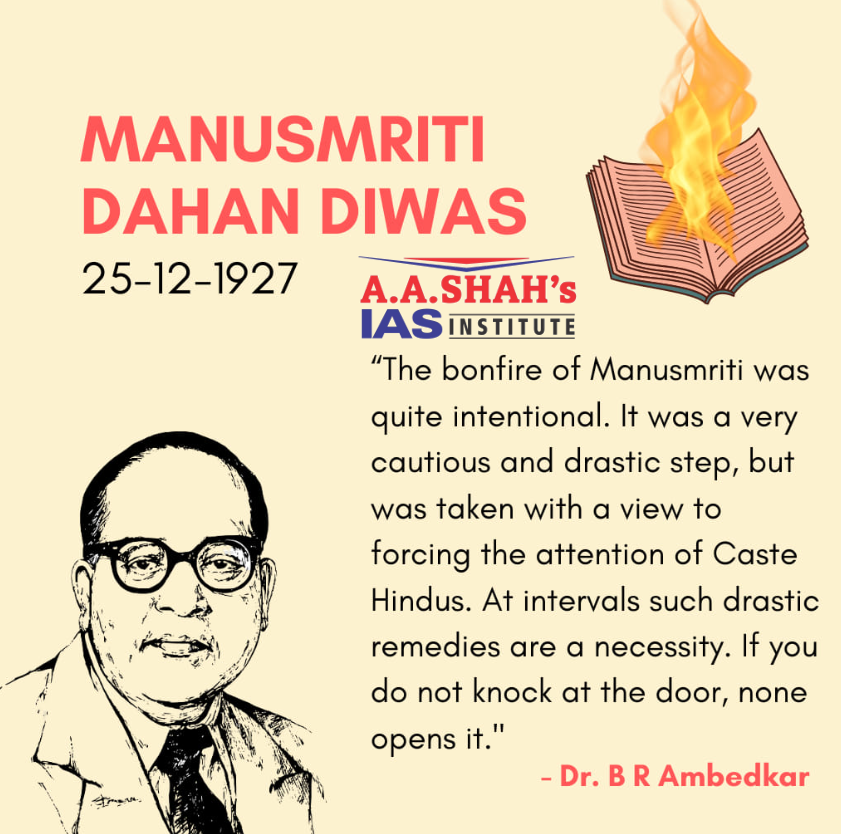
- On December 25, 1927, the conference publicly burned a copy of the Manusmriti.
- That fire was not a mere gesture.
- It was a declaration that the future republic, if it was to mean anything at all, would rest on rights, not on graded inequality codified in ancient texts.
Court Case
- The upper castes of Mahad did not merely resort to violence. They also went to court.
- On December 12, 1927, even before the second conference began, Hindu residents filed a civil suit in the Kolaba District Court seeking a temporary injunction to prevent the depressed classes from using the Chavdar tank. The injunction was granted on December 14, 1927.
- The litigation dragged on for a decade.
- The case finally reached the Bombay High Court, where it was decided on March 17, 1937, that the tank belonged to the municipality. It was public property and untouchables had every right to use it.
Centenary of Mahad Satyagraha
- The 100th anniversary of the Mahad Satyagraha falls on March 20, 2027.
- We are now in the 99th year.
- Let there be a year-long commemoration beginning on March 20, 2026, and culminating on March 20, 2027, with a great gathering at the Chavdar tank. Let citizens of every caste, creed, and class come to Mahad and drink together. Let it be a constitutional baptism: a re-immersion in the founding promise that no Indian shall be diminished by the accident of birth.
Manual Scavenging
- Let us ask whether the manual scavenger who cleans our sewers with bare hands occupies a fundamentally different position from the Mahars barred from the Chavdar tank.
- For every Indian whom the lottery of birth still consigns to a life of diminished citizenship, of invisible labour, of social suffering that is too familiar to even register as injustice any more.