Sixteenth Finance Commission — misses and concerns
POLITY – INDEPENDENT BODIES
2 MARCH 2026
- The Sixteenth Finance Commission had greater flexibility than earlier Commissions because its Terms of Reference flowed directly from the Constitution, rather than detailed central government instructions.
- Like previous Commissions, it dealt with two main aspects of fiscal transfers:
- Vertical devolution (Centre–State division of revenue)
- Horizontal devolution (distribution among States)
Vertical Dimension (Centre vs States)
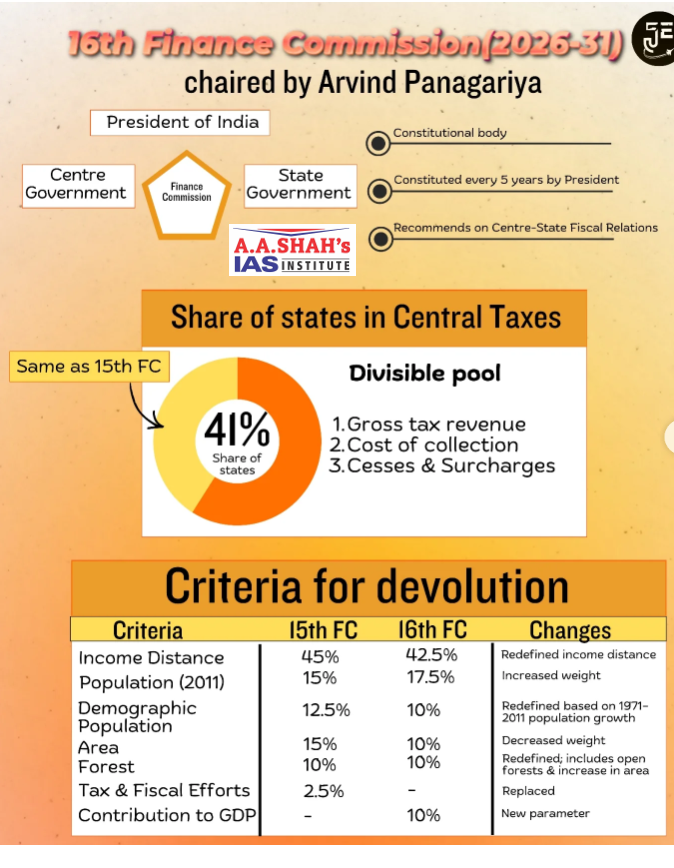
- The Fourteenth Finance Commission increased the States’ share in central taxes from 32% to 42%.
- Later reduced to 41% due to the change in status of Jammu & Kashmir.
- The Fifteenth Finance Commission retained 41%.
- The Sixteenth Finance Commission also retained 41%, making it somewhat permanent.
Centre’s Response to Higher Devolution
- After the 42% increase, the Centre increased non-shareable cesses and surcharges
- It reduced its share in centrally sponsored schemes
- It rejected sector-specific/state-specific grants suggested earlier.
Cesses and Surcharges
- The Sixteenth Finance Commission did not recommend limits on these cesses and surcharges, even though constitutionally they should be levied for specific purposes, be limited in durationand should not be merged with general funds.
- Instead, it proposed a “grand bargain”: States accept a slightly smaller share in a larger divisible pool if the Centre merges cesses and surcharges into shareable taxes.
Horizontal Dimension (Among States)
- The Commission introduced a new “contribution” criterion, based on a State’s share in total GSDP.
- Richer States naturally have higher GSDP due to capital concentration and migration.
- The Commission used the square root of GSDP to reduce extreme effects.
- The Commission dropped the tax effort/fiscal discipline criterion.
Criticism
- The 16th Finance Commission discontinued revenue deficit grants.
- It did not recommend state-specific or sector-specific grants.
- This effectively reduced States’ overall share compared to the Fifteenth Commission.
- The Sixteenth Finance Commission dropped revenue gap grants completely, which could have neutralised losses of poorer States and balanced performance and equity
- The criticism is that even if estimating such grants is difficult, they should not have been removed entirely.