THAAD US missile defence platform tested in U.S-Israel war against Iran
INTERNATIONAL – ASIA
8 MARCH 2026
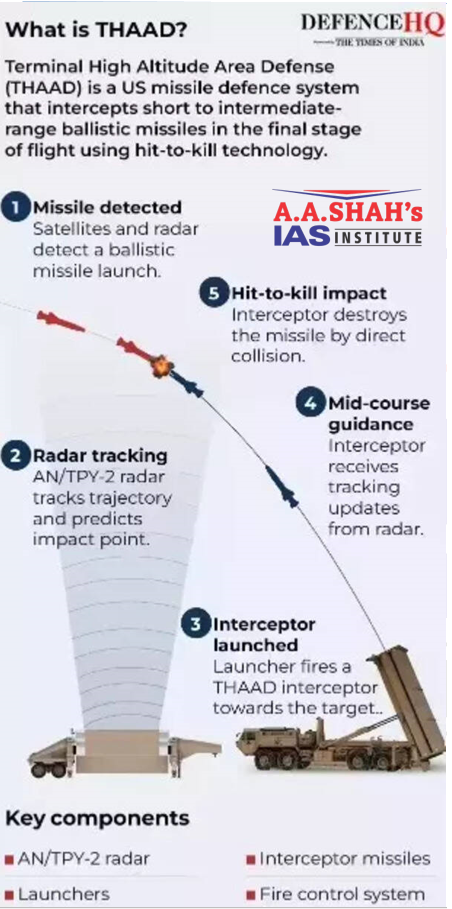
- The Terminal High Altitude Area Defence (THAAD) system is one of the most advanced missile defence platforms developed by the United States to counter ballistic missile threats.
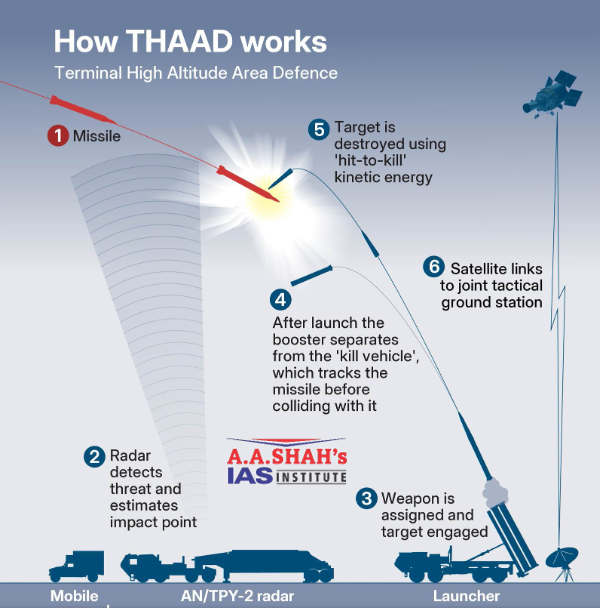
- Designed to intercept missiles during the final stage of their flight, THAAD can destroy incoming threats both inside and outside earth’s atmosphere, providing a critical defensive layer against short-medium- and limited intermediate-range ballistic missiles.
- The U.S. deployed additional THAAD batteries to the West Asian region before it launched the invasion of Iran on February 28, 2026 along with other weapons.
- Unlike many traditional air defence systems that rely on explosive warheads, THAAD uses “hit-to-kill” technology.
- This means its interceptor missiles destroy incoming targets by directly colliding with them at extremely high speeds, relying on kinetic energy rather than an explosive blast.
- This approach significantly improves precision and reduces the risk of debris from explosive interceptors affecting populated areas.
- THAAD can engage ballistic missile targets at ranges of roughly 150–200 kilometres, intercepting them at high altitude before they descend toward their intended targets.
Components of THAAD
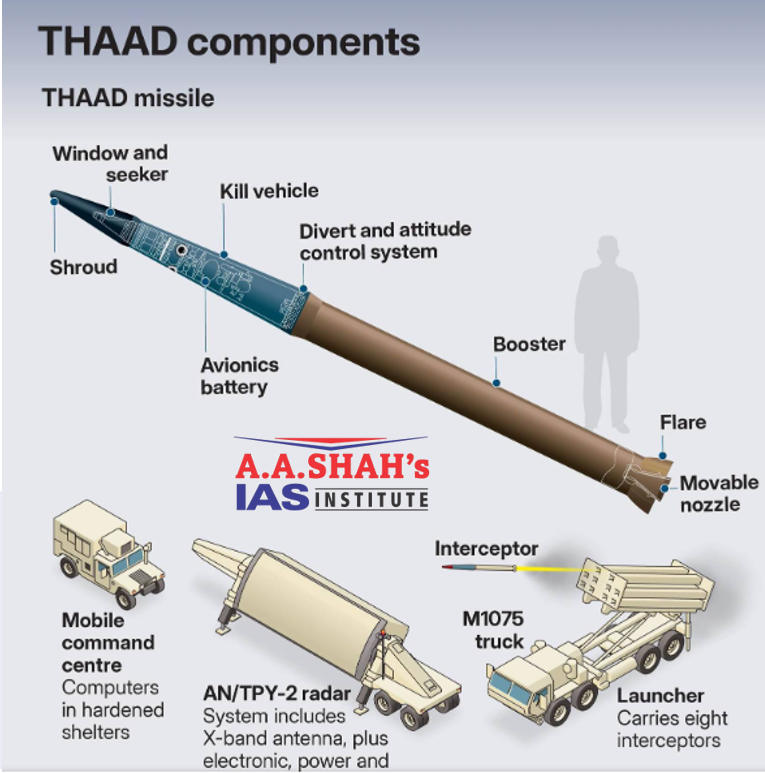
- The THAAD weapon system is a major element of the broader Ballistic Missile Defence System (BMDS) architecture and consists of several integrated components:
- interceptors that destroy incoming missiles through kinetic impact;
- truck-mounted launchers used to deploy the interceptors;
- AN/TPY-2 radar, powerful radars which detects and tracks missile threats at a long range;
- tactical fire control and communications unit that coordinates targeting and engagement;
- additional logistics and support equipment.
- A typical THAAD battery includes around 90 personnel, six launchers, and 48 interceptors, with each launcher carrying eight missiles.
- THAAD is designed to operate as part of a layered missile defence network.
- It can integrate with other systems such as the MIM-104 Patriot, including the Patriot Advanced Capability-3 (PAC-3), as well as the Aegis Ballistic Missile Defence system used by naval forces.
- In recent tests, THAAD has demonstrated its ability to launch PAC-3 missile segment enhancement (MSE) interceptors, highlighting growing interoperability within the U.S. missile defence architecture.
Deployment of THAAD
- The THAAD system is highly mobile and rapidly deployable, allowing the U.S. Army to position it in regions facing missile threats.
- The first operational THAAD battery was deployed to Guam in 2013.
- Internationally, the UAE became the first foreign buyer in 2011, followed later by Saudi Arabia.
- The system has been in the spotlight ever since the latest war on Iran began on February 28.
Iran destroys key THAAD radar
- Iran has reportedly destroyed a key radar associated with the THAAD system used by the U.S. to detect and intercept ballistic missiles in West Asia, dealing a major blow to Washington’s regional missile defence network as the war on Iran enters its second week, according to media reports.
- Satellite imagery cited in the reports suggests that an AN/TPY-2 radar, valued at around $300 million and manufactured by RTX Corp., along with its support equipment, was destroyed at Muwaffaq Salti Air Base in Jordan during the early days of the conflict.
- The radar plays a critical role in guiding U.S. missile defence batteries deployed across the Persian Gulf.