The quiet demographic revolution unfolding in India
POPULATION
5 MARCH 2026
- For much of the late 20th century, discussions of India’s future were framed by a single anxiety: population growth.
- The assumption was that rapid fertility would outpace the economy’s ability to generate food, infrastructure, and public services.
- The infamous “Population Bomb” thesis of Paul and Anne Ehrlich was a key text that informed public policy for decades.
- Over the last 25 years, India has experienced a fertility transition of extraordinary speed.
NFHS Data
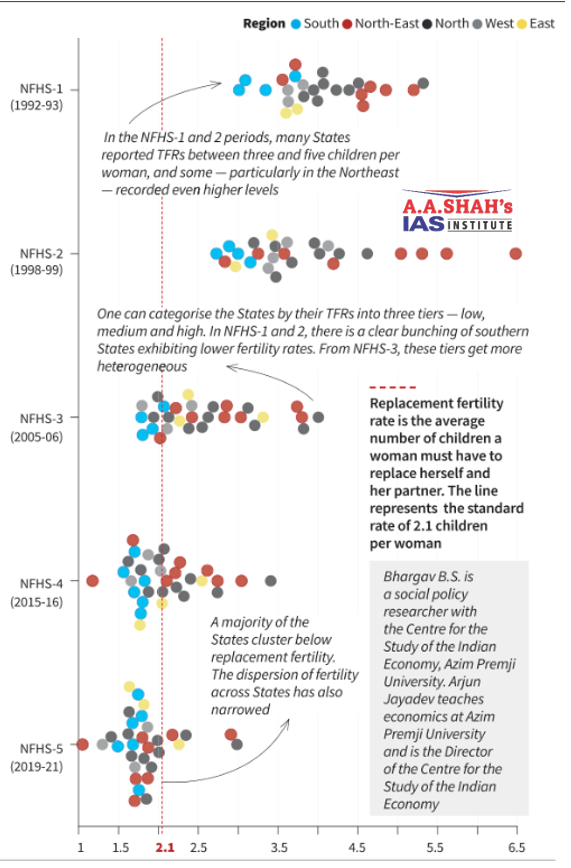
- Data from successive National Family Health Surveys (NFHS) show Total Fertility Rate (TFR) falling from levels near four children per woman in the 1990s to around replacement level, with most States now at or below 2.1 children per woman.
- In the NFHS-1 and 2 periods, many States reported TFRs between three and five children per woman, and some — particularly in the Northeast — recorded even higher levels.
- By NFHS-3 and NFHS-4, fertility had dropped substantially.
- But the most striking change appears in NFHS-5, where a majority of the States cluster below replacement fertility.
Disparity among states reducing
- The dispersion of fertility across States has also narrowed, indicating convergence towards a low-fertility norm across India’s regions.
- One can categorise the States by their TFRs into three tiers — low, medium and high.
- In NFHS-1 and 2, there is a clear bunching of southern States exhibiting lower fertility rates relative to central, northern and northeastern States.
- However, starting from NFHS-3, these tiers get more heterogeneous, where States from other regions also begin to move into lower fertility categories.
- The northeastern States (except Tripura), Uttar Pradesh, Jammu & Kashmir, Haryana, Punjab, and Rajasthan show the highest declines in fertility across the five rounds.
- Of the States that had relatively low fertility rates to begin with, Karnataka, West Bengal, Gujarat, Maharashtra and Odisha have the highest decline.
Causes for declining fertility
- Almost all scholars of the phenomenon have pointed to rising women’s education and delayed marriage as proximate causes.
- As educational attainment rises, the expected returns to labour market participation increase, while the opportunity cost of early and repeated childbearing grows.
- Where the labour market offers meaningful opportunities, fertility tends to fall faster and where employment remains precarious, the transition proceeds more unevenly.
- A second factor could be the diffusion of new family-size norms through migration, urbanisation, and media exposure.
- Once smaller families become the social standard, fertility decline accelerates even where income levels or institutional conditions lag behind.
- Third, the decline reflects public health successes. Improvements in child survival reduced the need for ‘precautionary fertility’.
- However, not all the reasons for this decline may be positive. It is also possible that the rising cost of raising children is a factor.
Consequences
- The first is that there is a “demographic dividend,” in which the share of working-age people with low dependency ratios creates the potential for faster growth.
- Without a structural shift towards labour-absorbing industrialisation and public investment, the dividend risks being squandered.
- The second surrounds the political economy of fertility. Southern and western States, where fertility has been below replacement level for some time, are moving more rapidly towards aging populations.
- The key policy concerns now will be those of employment, aging, migration, and the social organisation of care.