Transgender Persons (Protection of Rights) (Amendment) Bill, 2026
POLITY – BILL/ACT
19 MARCH 2026
- The government has introduced a new amendment Bill (2026) to change parts of the Transgender Persons (Protection of Rights) Act, 2019.
- This Act was originally based on a landmark Supreme Court ruling — the NALSA v. Union of India (2014) — which recognised a third gender and the right to self-identify one’s gender
Key Changes Proposed in the Amendment
1. Removal of self-identification right
- The current law allows people to identify their own gender (self-perceived identity).
- The amendment removes this right which is the biggest controversy.
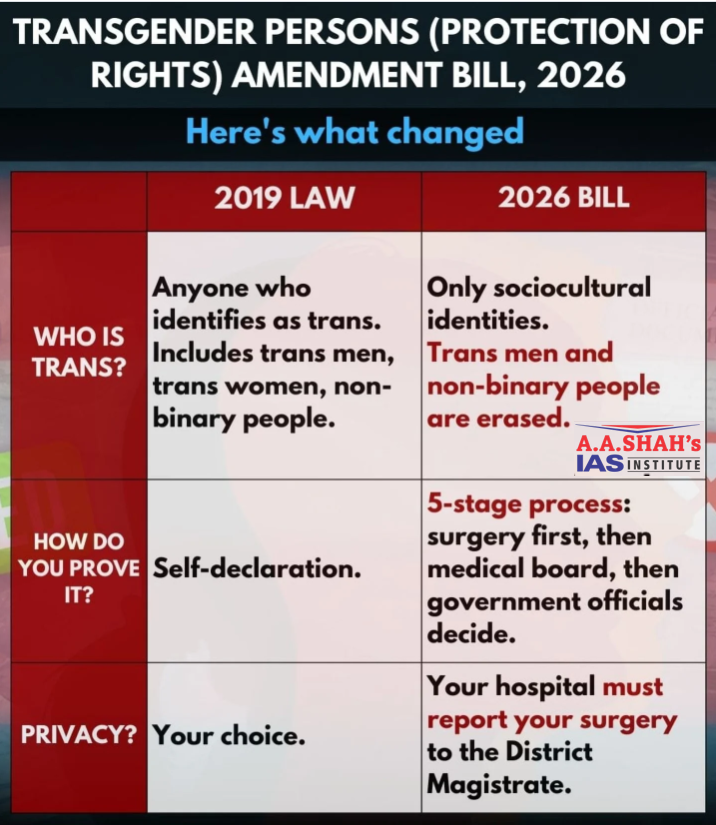
2. New definition of “transgender person”
- Earlier: Broad and inclusive (included trans men, trans women, genderqueer people, etc.)
- Now: More restricted and medical/social category-based, including:
- Hijra, kinner, aravani, etc.
- Intersex persons
- People with biological variations
- It excludes self-perceived identities and sexual orientation
3. Medical involvement in identity recognition
- Before: Just a self-declared affidavit
- Now: A medical board (“authority”) must be consulted
- District Magistrate may require medical review before issuing certificate
4. Mandatory certificate after surgery
- After Sex Reassignment Surgery (SRS), one must apply again for a revised gender certificate
- Hospitals must report such procedures to authorities
5. Name change allowed (with conditions)
- Trans persons can change their name in documents but only if they fit the new definition
6. Stricter punishments
- Stronger penalties for crimes against transgender persons:
- Up to life imprisonment
- Fines up to ₹5 lakh
Key Concerns related to the Amendment
1. Violation of Supreme Court ruling
- The NALSA v. Union of India (2014) clearly said:
- Gender identity = personal choice
- No one should be forced into medical procedures
- The amendment seems to go against this principle
2. Loss of autonomy
- Moves from self-identification → state/medical control
- People may have to prove their identity
3. Narrow definition
- May exclude many people who identify as transgender
- Could create divisions within the community
4. Lack of consultation
- Activists say the Bill was introduced without proper discussion
- Many reacted with shock
Government’s reasoning
- The government says the current definition is too vague and makes it hard to identify “genuine beneficiaries” and implement policies properly
- They want a more precise, targeted definition involving people facing biological/social hardship, not all gender identities
Core Debate
Should gender identity be a personal choice (rights-based approach)
OR Should it be defined and verified by the state (regulation-based approach)?