Trump’s surprise order to test nuclear weapons triggers global tensions
INTERNATIONAL – USA
1 NOVEMBER 2025
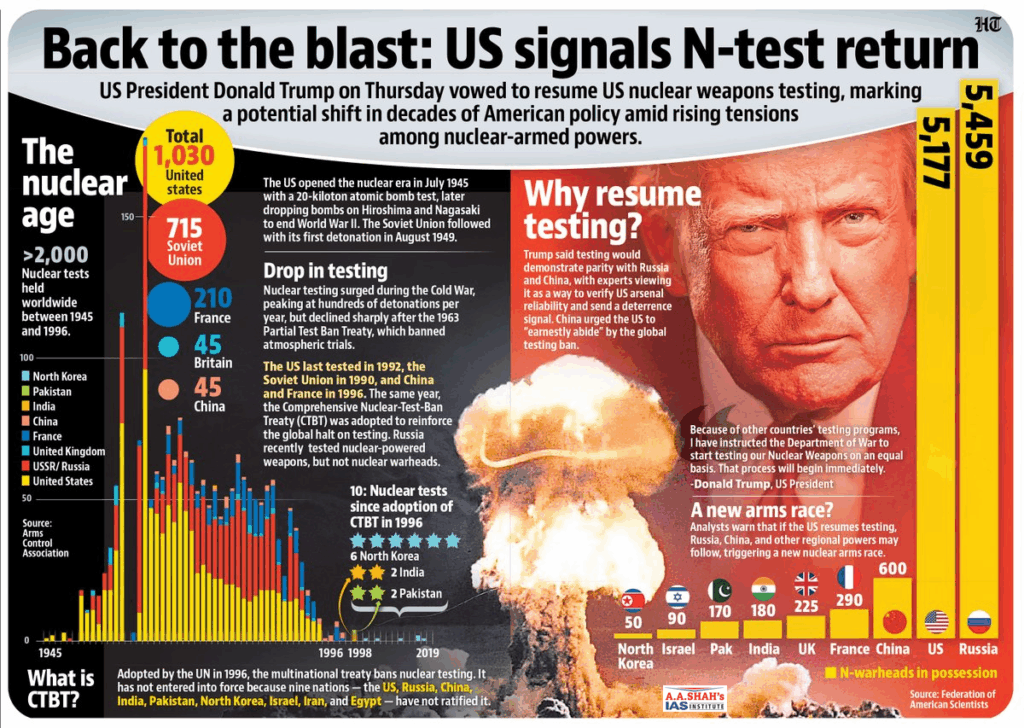
- U.S. President Donald Trump’s surprise directive to begin nuclear weapons testing provoked global criticism on 31st October 2025, as it raised the spectre of renewed superpower tensions.
- The announcement on social media was issued just before Mr. Trump – who boasts frequently about being a peace president – went into a summit with Chinese leader Xi Jinping in South Korea.
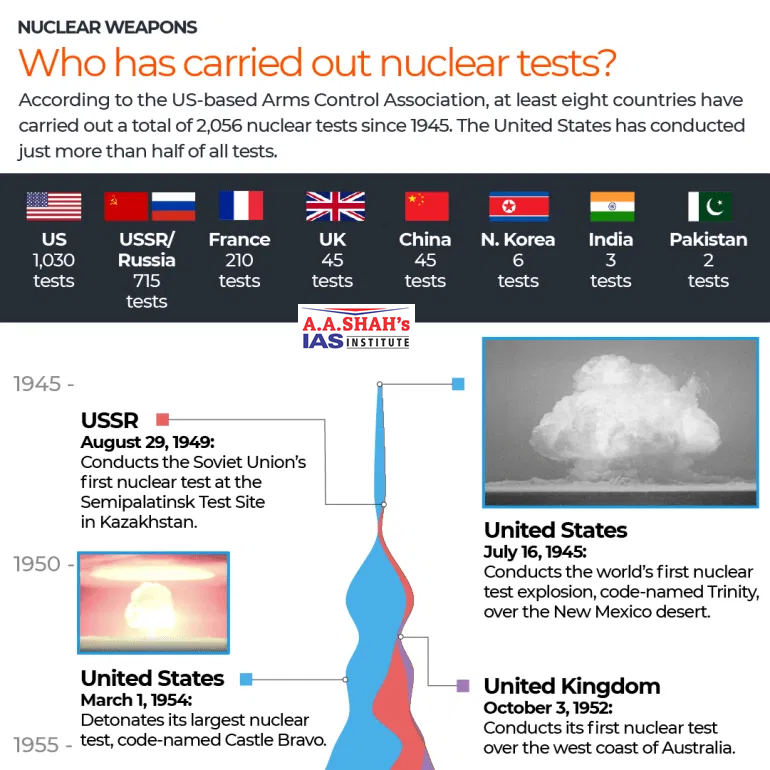
- Mr. Trump’s announcement left much unanswered – chiefly whether he meant testing weapons systems or actually conducting test explosions, something the United States has not done since 1992.
- China and the United States observe a de facto moratorium on testing nuclear warheads, though Russia and the United States regularly run military drills involving nuclear-capable systems.
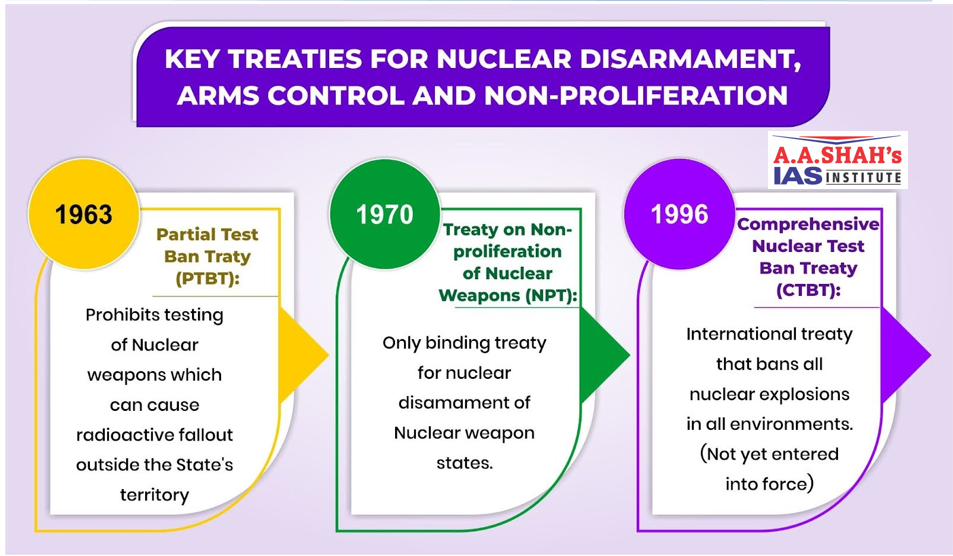
- The United States has been a signatory since 1996 to the Comprehensive Nuclear-Test-Ban Treaty, which bans all atomic test explosions, whether for military or civilian purposes.
- The announcement came days after Russia declared it had tested nuclear-capable, nuclear-powered cruise missiles and sea drones.
Comprehensive Nuclear-Test-Ban Treaty
- A multilateral treaty adopted by the UN General Assembly in 1996.
- Objective: Prohibit all nuclear weapon test explosions and any other nuclear explosions, anywhere (underground, underwater, atmosphere, space).
Key Features
- Bans all nuclear tests (complete prohibition).
- Establishes International Monitoring System (IMS): Seismic, Hydroacoustic, Infrasound, Radionuclide
- 180 states have signed but treaty not yet in force.
Why is CTBT not in force?
- Requires ratification by 44 specific states (Annex 2 states) i.e. those with nuclear power or research reactors that participated in the 1996 negotiations.
- 8 of these have not ratified: China, Egypt, Iran, Israel, and U.S. have signed but not ratified.
- India, Pakistan, North Korea have not signed.
India and CTBT
India has not signed the CTBT because:
- Treaty is discriminatory (did not include a commitment to nuclear disarmament).
- Would lock India into a “no nuclear testing” regime without addressing global disarmament.
- India opposed the manner of adoption (vote in UNGA instead of consensus at Conference on Disarmament).
Related Treaties
- NPT (1968) – Non-Proliferation Treaty; India not a member.
- PTBT (1963) – Partial Test Ban Treaty: It is in force. It bans atmospheric, space, underwater tests, but not underground tests.
- FMCT – Fissile Material Cut-off Treaty (still under negotiation).