Union Budget sets Centre’s capital expenditure target at ₹12.2 lakh crore
ECONOMY – BUDGET
2 FEBRUARY 2026
Union Budget 2026: Background
- Presented by Finance Minister Nirmala Sitharaman amid global economic uncertainties such as slowing global growth, geopolitical tensions, and supply-chain disruptions
- Marks her ninth consecutive Union Budget
- Stresses that India must remain deeply integrated with global markets by expanding exports and attracting long-term, stable foreign investment
Growth and Investment Push
- Emphasis on export-led growth and improving India’s competitiveness in global value chains
- Customs duty reductions announced for marine products, leather goods, and textiles to make Indian exports cost-competitive
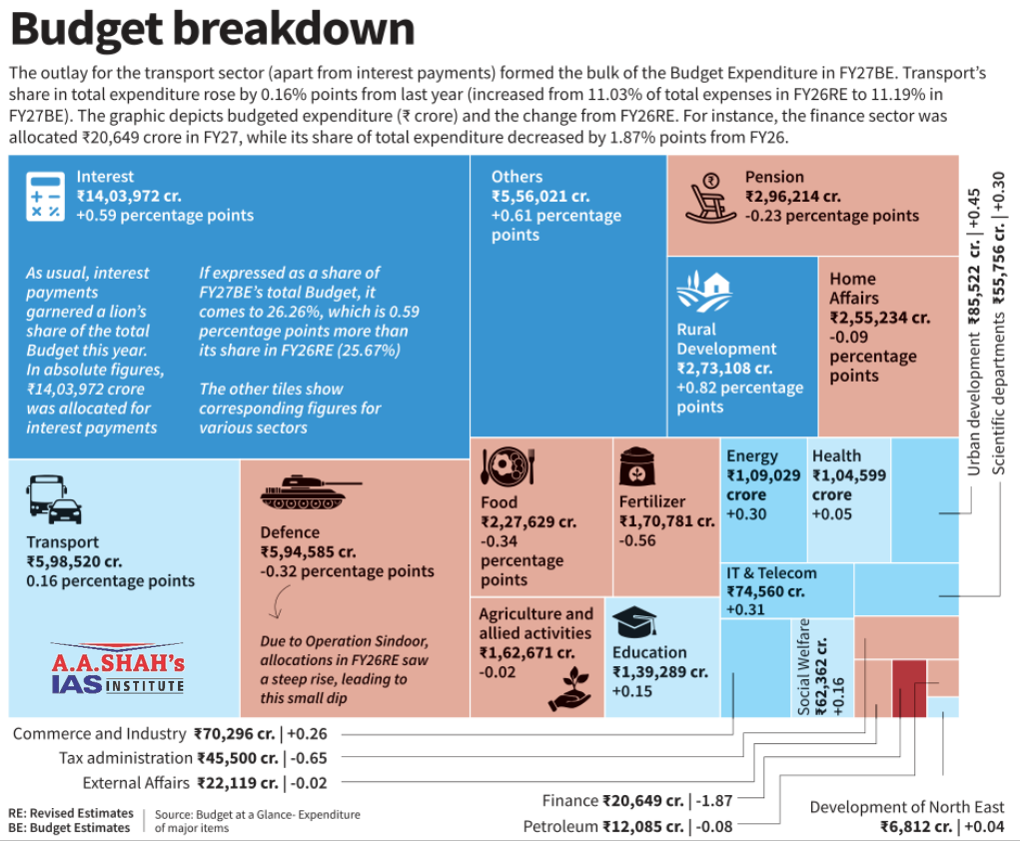
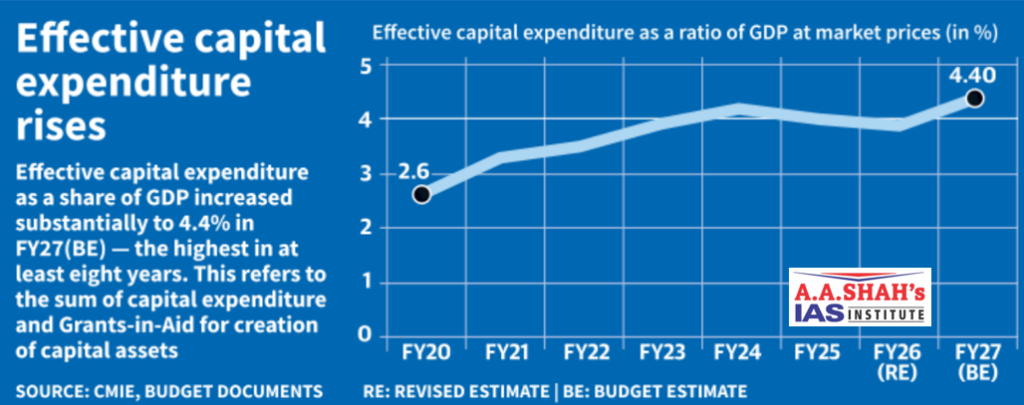
- Capital expenditure (Capex) set at ₹12.2 lakh crore for 2026–27, higher than both the Budget Estimates and Revised Estimates of the previous year
- Continued focus on infrastructure-led growth covering transport, logistics, ports, waterways, and industrial corridors
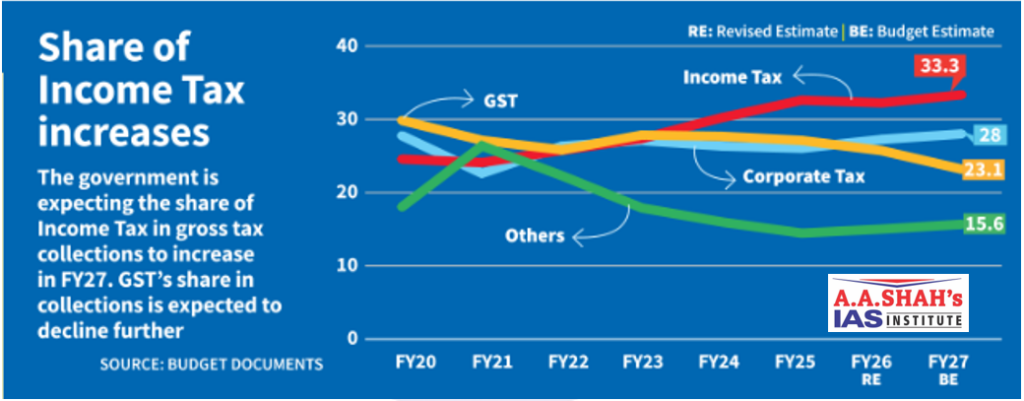
- No major direct tax relaxations for individuals or corporates, indicating fiscal discipline and priority on public investment
Three ‘Kartavyas’ of the Budget
- First Kartavya – Accelerating and Sustaining Economic Growth
– Enhancing productivity, competitiveness, and resilience to global volatility
– Scaling up manufacturing in seven strategic and frontier sectors
– Rejuvenation of legacy industries and creation of “champion MSMEs”
– Large push for infrastructure creation, energy security, and city-economic regions - Second Kartavya – Building Human Capacity and Aspirations
– Focus on education, training, and skilling of the workforce
– Targeted skilling in healthcare, medical tourism, animal husbandry, AVGC (animation, visual effects, gaming and comics), and design sectors
– Strengthening the services sector to support future employment and exports - Third Kartavya – Inclusive and Balanced Development
–– Measures to increase farmer incomes through productivity and entrepreneurship
– Empowerment of divyang and vulnerable populations through livelihoods, skill training, assistive devices, and mental health support
Regional Development and Infrastructure Expansion
- Proposal to establish dedicated rare earth corridors in Odisha, Kerala, Andhra Pradesh, and Tamil Nadu
- These corridors will promote mining, processing, research, and manufacturing of critical and rare earth minerals, reducing import dependence.
- Development of the first new national waterway in Odisha, linking Talcher, Angul, and Kalinga Nagar with Paradip and Dhamra ports
- Aimed at reducing logistics costs and improving movement of minerals and industrial goods
- Announcement of an integrated East Coast Industrial Corridor, connecting industrial clusters and ports along the eastern coastline
- Proposal for a new dedicated freight corridor from Dankuni (West Bengal) to Surat (Gujarat) to improve east-west freight movement and industrial connectivity.