West asia crisis creates fears of further rupee depreciation
ECONOMY – INDICATORS
29 MARCH 2026
- The West Asia crisis has increased uncertainty and economic risks for India.
- Rising oil prices (since India imports most of its oil from the region) increase import bills.
- Higher imports lead to greater demand for foreign currency (US dollar), putting pressure on the rupee.
- Capital outflows and global instability further weaken investor confidence.
- As a result, there are fears of further depreciation of the Indian rupee.
Depreciation of Rupee
- Depreciation of the rupee means a fall in the value of the Indian Rupee compared to foreign currencies (like the US dollar).
- It means more rupees are needed to buy the same amount of a foreign currency.
- It can be caused by factors like higher imports, capital outflows, and global uncertainties.
- It makes imports costlier and can increase inflation, but may make exports cheaper and more competitive.
Devaluation
- Devaluation is a deliberate reduction in the value of a currency by the government or central bank.
- It happens in a fixed or semi-fixed exchange rate system.
- It is usually done to make exports cheaper and reduce imports.
Quick Difference
- Depreciation → Value falls (market forces)
- Appreciation → Value rises (market forces)
- Devaluation → Value falls (government decision)
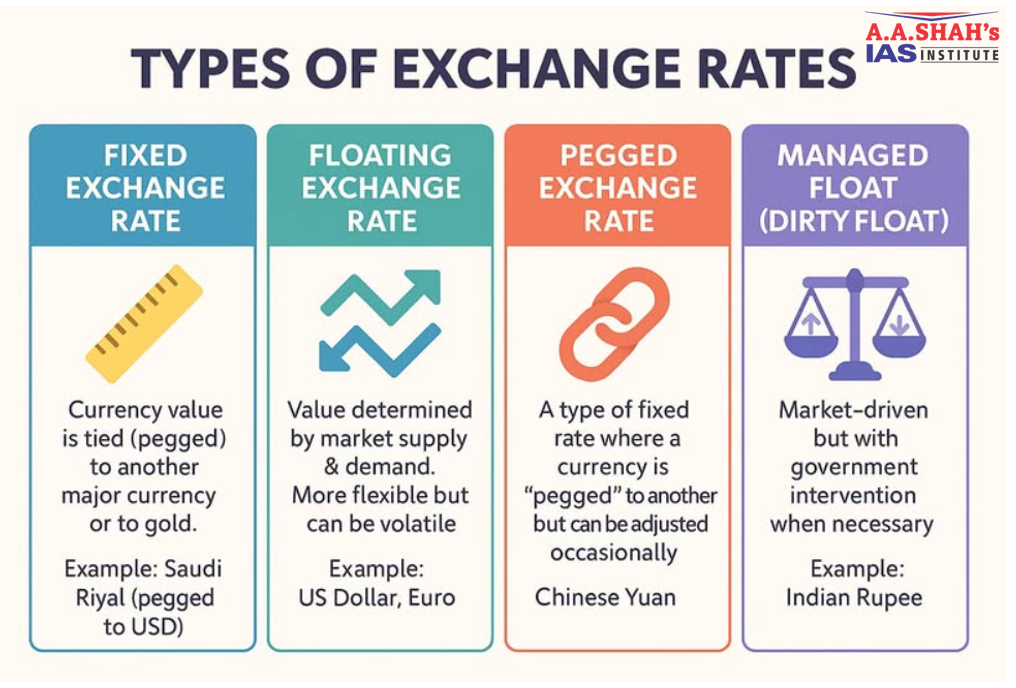
India has managed floating exchange rate
- India operates a managed floating exchange rate system (or managed float).
- Since 1993, the rupee’s value is primarily market-determined, but the Reserve Bank of India (RBI) actively intervenes in the foreign exchange market to reduce volatility and ensure stability, avoiding extreme fluctuations rather than targeting a specific rate.
- The exchange rate is not fixed by the government, but the RBI buys or sells foreign currency to manage supply and demand.