Why key to coconut cultivation today is sustainability, not productivity
AGRICULTURE
2 MARCH 2026
Coconut Promotion Scheme
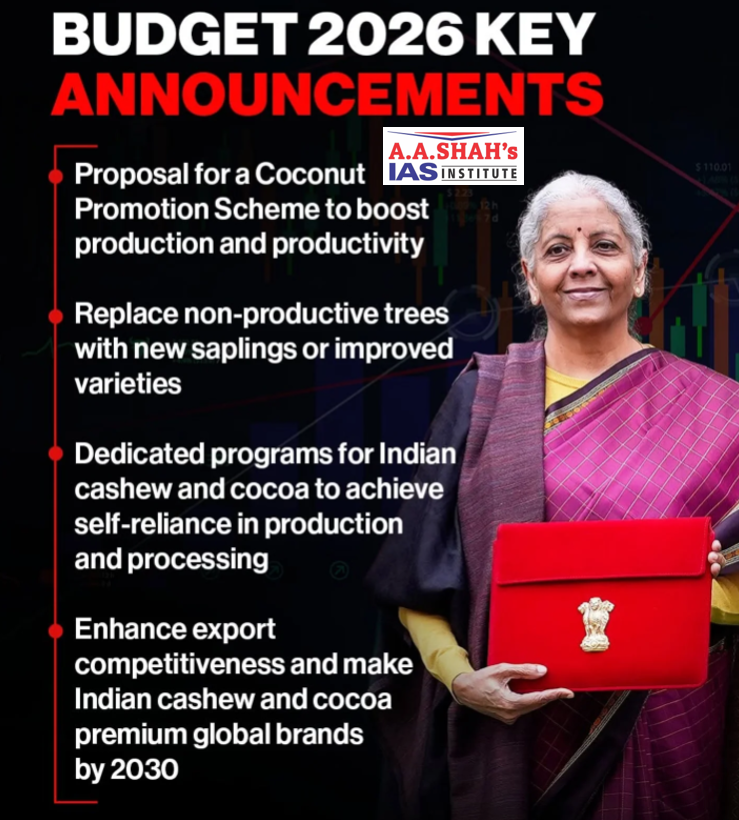
- The 2026–27 Union Budget announced a ‘Coconut Promotion Scheme’ to rejuvenate old and unproductive coconut gardens, introduce high-yielding varieties and expand plantations along coastal areas.
- The Coconut Development Board (CDB) already runs similar schemes and has expanded coconut farming into non-traditional states like Gujarat and Assam.
- This helped offset losses in Kerala and Tamil Nadu due to disease.
India’s Position in Coconut Production
- India is the world’s largest producer and consumer of coconuts.
- Productivity per tree is already higher than in Sri Lanka, Philippines, and Indonesia.
- In places like Anaimalai (Tamil Nadu), hybrid palms produce 250–300 tender coconuts per tree.
- So the real issue today is not productivity — it is climate change and disease.
Climate Change & Heat Stress
- Research by the Central Plantation Crops Research Institute (CPCRI) predicts temperature rise of 1.6–2.1°C by 2050 and upto 3.2°C by 2070
- This will increase drought stress and make parts of Karnataka, Andhra Pradesh, and Tamil Nadu less suitable for coconut farming
- However, the Western Ghats region may still remain suitable.
Root Wilt Disease Crisis
- Regions like Alappuzha and Pollachi have been severely affected by root wilt disease, which has devastated coconut plantations and damaged farmers’ livelihoods.
- Therefore, the Coconut Promotion Scheme must focus on developing heat-tolerant coconut varieties suitable for the east coast and other dry regions facing rising temperatures.
Problem with Input Subsidies
- Many government schemes distribute micro-nutrients, bio-fertilisers, and microbial formulations, but these inputs are often of poor quality, improperly stored, and therefore ineffective for farmers.
- Instead, the government should use Direct Benefit Transfers (DBT) so farmers can decide how to spend funds (irrigation, labour, soil care, etc.).
Value Addition – Why It Failed
- Domestic coconut prices have tripled since 2024.
- National Horticulture Board (NHB) launched a ₹150 crore Cluster Development Programme covering production, value addition, and marketing, but it failed due to high investment requirements, limited participation of FPOs, and lack of interest from private firms.
- Coconut Development Board (CDB) already provides a 25% capital subsidy, making the NHB scheme confusing and redundant.
- The banana cluster in southern Tamil Nadu also exists mostly “on paper.”
Suggested Better Approach
- Instead of large centralised clusters, smaller pilot projects based on a strong cooperative model should be promoted,
- Marketing partnerships with experienced companies such as Amul and ITC Limited, and implementing them in pilot areas like Tiptur for ball copra, Anaimalai for tender coconuts, and Pollachi for coconut oil is desirable.