Aditya-L1 gets a close look at eruptions from the sun
S&T – SPACE
10 NOVEMBER 2025
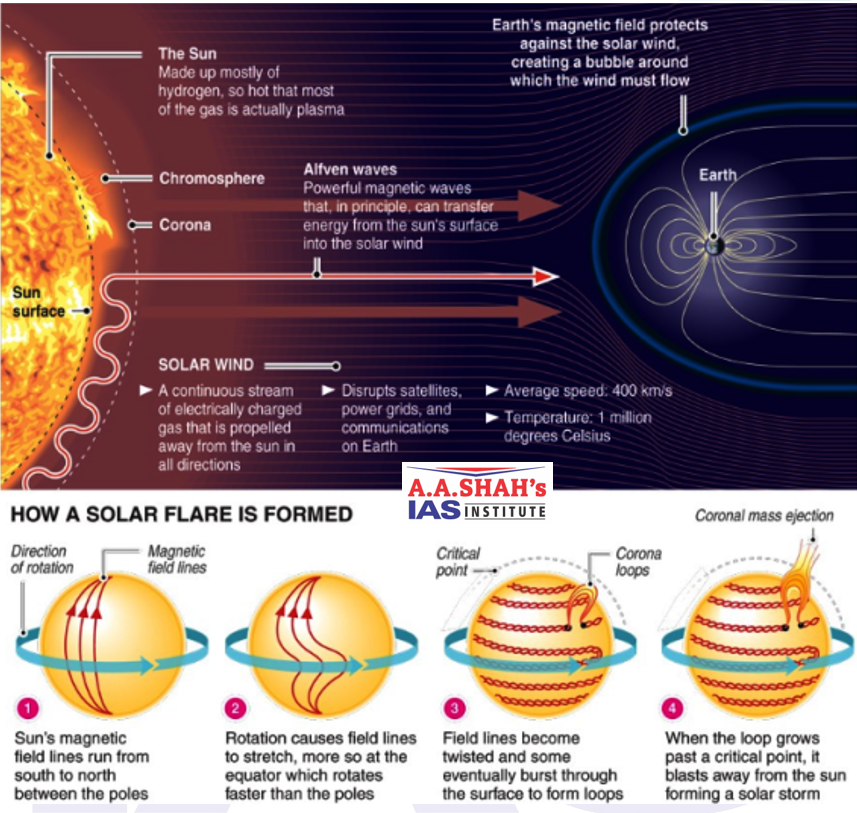
- India’s first dedicated space-based solar mission, Aditya-L1, scientists at the Indian Institute of Astrophysics (IIA), along with NASA, have collaborated to estimate the crucial parameters like electron density, energy, mass, temperature and speed of a coronal mass ejection (CME), for the first time.
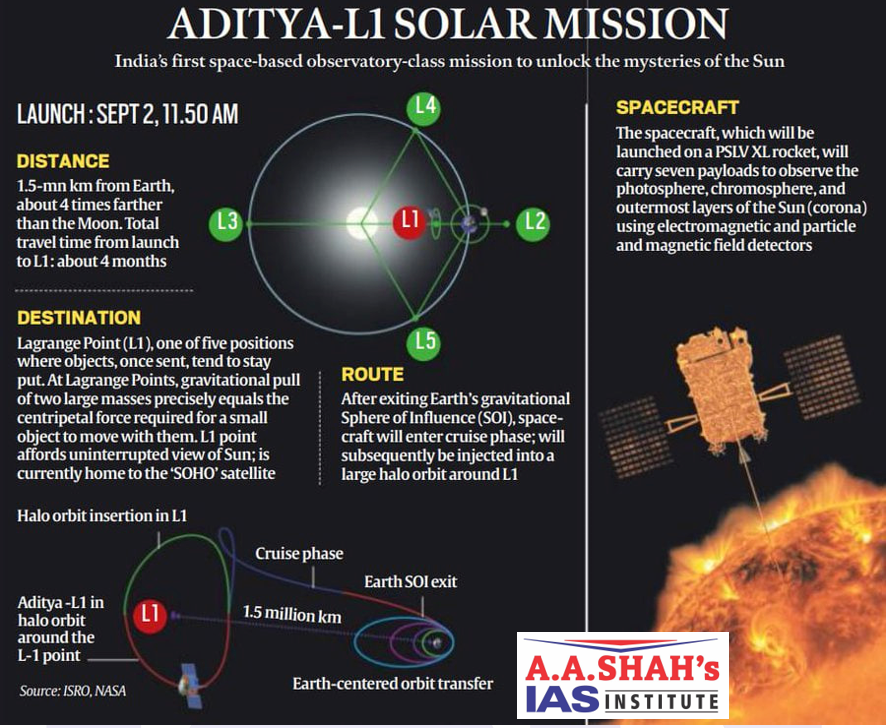
- “It provides a sustained view of the sun for 24 hours every day because of being at the sun-earth Lagrangian L1 location where the sun never sets.
- An understanding of the parameters of a CME in relation to how much is lost from the sun during a CME per se is crucial,
- With the sun nearing the maximum activity phase of the current sunspot cycle 25 and with the VELC now stabilised in its operations, more energetic eruptions from the sun are expe
Aditya-L1
- Launched by: ISRO (Indian Space Research Organisation)
- Launch Date: September 2, 2023
- Launch Vehicle: PSLV-C57
- Destination: Lagrange Point 1 (L1) — about 1.5 million km from Earth, between Earth and the Sun. L1 point offers a continuous, uninterrupted view of the Sun, without Earth’s shadow. It is ideal for real-time monitoring of solar activity and space weather.
Scientific Goals
- Study solar corona (outermost layer of the Sun).
- Understand coronal heating and solar wind acceleration.
- Observe solar flares and Coronal Mass Ejections (CMEs).
- Measure magnetic field dynamics near the Sun.
- Study solar irradiance and its impact on Earth’s climate.
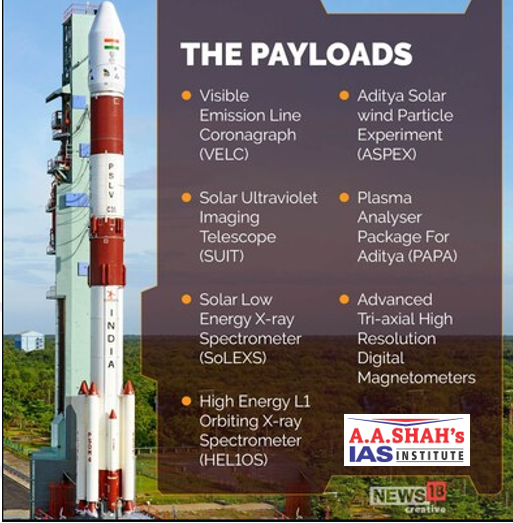
Payloads (Instruments) — 7 in total
| Type | Instrument | Purpose |
| Remote Sensing | VELC (Visible Emission Line Coronagraph) | Studies the solar corona. |
| Remote Sensing | SUIT (Solar Ultraviolet Imaging Telescope) | Observes Sun in UV light. |
| Remote Sensing | SoLEXS (Soft X-ray Spectrometer) | Measures solar X-ray emissions. |
| Remote Sensing | HEL1OS (High Energy L1 Orbiting X-ray Spectrometer) | Observes high-energy solar flares. |
| In-situ | ASPEX (Aditya Solar Wind Particle Experiment) | Measures solar wind particles. |
| In-situ | PAPA (Plasma Analyser Package for Aditya) | Studies plasma properties. |
| In-situ | Magnetometer | Measures interplanetary magnetic fields. |
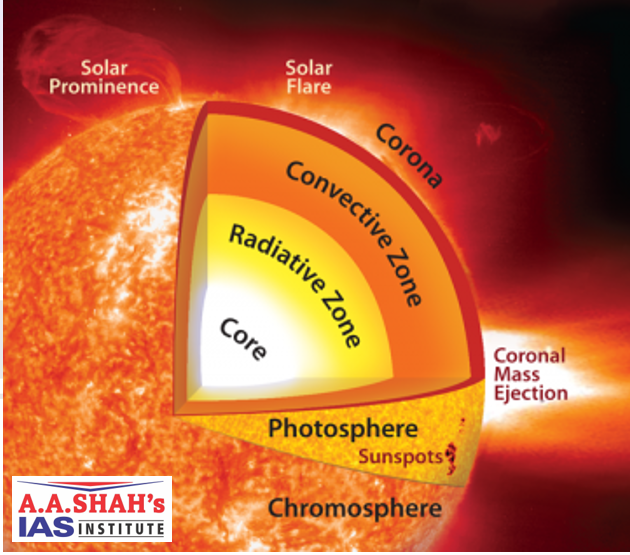
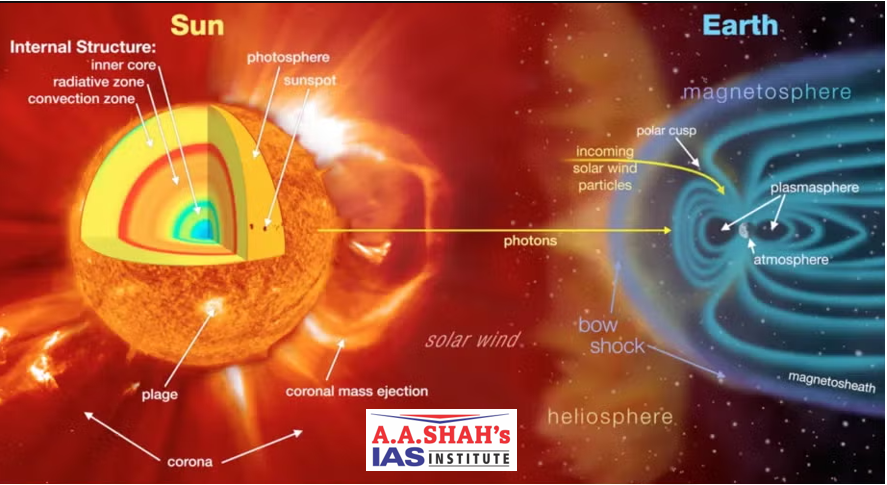
Main Parts of the Sun
A. Internal Structure (Inside the Sun)
| Part | Description | **Temperature (approx.) | Function |
| Core | Central region where nuclear fusion occurs (hydrogen → helium). | ~15 million °C | Produces all the Sun’s energy. |
| Radiative Zone | Layer around the core where energy travels outward by radiation. | ~2–7 million °C | Energy moves slowly through photons. |
| Convective Zone | Outer layer of the interior; energy moves by convection currents (hot gas rises, cool gas sinks). | ~2 million °C – 5,500°C | Brings heat to the surface (photosphere). |
B. Atmospheric Layers (Outer Part)
| Part | Description | **Temperature (approx.) | Special Features |
| Photosphere | The visible surface of the Sun (what we see). | ~5,500°C | Has sunspots and gives off visible light. |
| Chromosphere | The reddish layer above the photosphere, visible during solar eclipses. | ~6,000–20,000°C | Emits ultraviolet light; shows spicules (jets of gas). |
| Corona | The outermost layer, extends millions of km into space. | ~1–3 million °C | Seen as a white halo during a total solar eclipse; source of solar wind. |