Citizen scientists help reveal ‘odd’ twin rings around galaxy
S&T – SPACE
9 NOVEMBER 2025
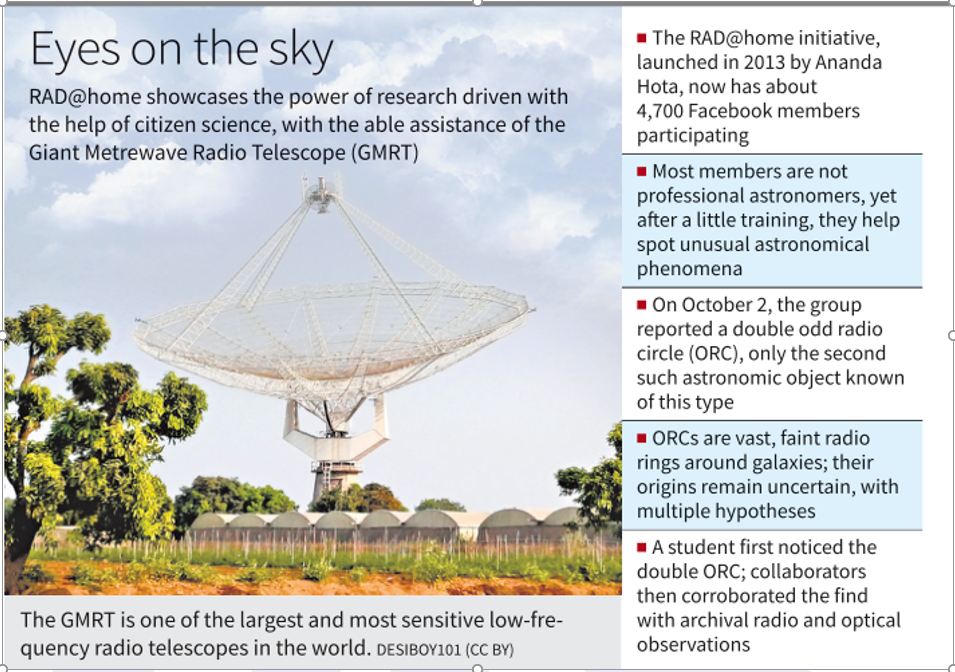
- University of Mumbai professor Ananda Hota and his collaborators have been running the RAD@home Facebook group since 2013. Today it boasts around 4,700 members. Most of them are not professional astronomers, yet they essay important roles in making real astronomical discoveries.
- On October 2, the group reported a highly unusual object first identified only in 2019 — an odd radio circle (ORC) — using data from the LOFAR telescope network in Europe. ORCs are large but faint circular radio sources typically surrounding a distant galaxy, and among the least understood objects in deep space.
- The team also regularly unearths significant information on new galaxies and transient astronomical phenomena. RAD@home thus showcases the power of research driven with the help of citizen science, plus the assistance of the Giant Metrewave Radio Telescope (GMRT) near Pune.
- Spiral galaxies like the Milky Way contain many hot, young, bluer stars — while elliptical galaxies are dominated by older, cooler, redder stars. Most massive galaxies also host a supermassive black hole millions to billions of times the mass of our sun, at their centre. While in most galaxies these monsters are quiet, in some they’re extraordinarily active: they feed on the gas and dust to release enormous amounts of energy. Such galaxies are said to be active. When their black holes launch jets of plasma that shine brightly in the radio frequency, they’re called radio galaxies.
- These jets can extend for millions of lightyears on either side of the galaxy. At the ends of these jets, there are two vast ‘radio lobes’. The appearance is akin to two balloons tethered by slender threads to either side of a sphere.
- Because these jets typically form in massive, elliptical galaxies, astronomers long believed that spiral galaxies couldn’t host them. That assumption was upended when Hota et al. discovered an unusual spiral galaxy with large radio lobes in 2011. When Dr. Hota shared news of his discovery on a social media platform, he was surprised by the questions and comments his post elicited. Soon after, he launched RAD@home on Facebook and invited students to join, learn astronomy, and contribute to research.
- Each search begins with virtual lectures over a weekend, where Dr. Hota and other researchers train participants to recognise the standard colour and structures of galaxies in ultraviolet, optical, infrared, and radio images. Radio galaxies can be classified by their shape and brightness.
- In the Fanaroff-Riley (FR) classification, FR I sources are less luminous, with jets that fade as they move outward, and FR II sources are more powerful, with bright hotspots at the ends of their lobes. Astronomers also identify special subtypes such as X-shaped, double-double or giant radio galaxies, each revealing distinct episodes of jet activity.
- Once participants understand what a typical radio galaxy looks like, they’re encouraged to look for sources that buck expectations.
- Their latest discovery, a rare double-ORC, was published months after Prasun Machado, a RAD@home student participant, spotted two faint, circular structures in a non-standard radio galaxy in LOFAR data. These circles, far larger than the galaxies themselves, were a pair of ORCs — only the second known instance of such a twin and one of the most powerful ORCs on record.
- Over the following months, Dr. Hota and his collaborators investigated the finding using archival radio and optical telescope data.
- There is still no widely accepted definition of ORCs. Their true nature remains uncertain, and astronomers are exploring several possibilities. Dr. Hota said one idea is that when galaxies collide, they can generate powerful shockwaves that propagate outward into intergalactic space.
- Over a billion years, these waves could form large circular structures, visible only at radio wavelengths. Another possibility is that ORCs are the aftereffects of powerful outbursts, perhaps when two supermassive black holes merge.
- In the case of the twin ORCs, Dr. Hota speculated that plasma rings might be expanding in opposite directions, forming two large circles flanking the galaxy.
- For now, he and his collaborators also aim to take advantage of the data collected by GMRT, one of the largest and most sensitive low-frequency radio telescopes in the world.
- “People still think education and research are two separate stages: you first study, then do research,” Dr. Hota said. “That model is over. At any stage in your career, you can join research if you find a good mentor and a good project. Once we create this combined model of learning and discovery through various citizen science projects, Indian astronomy will grow faster.”