COP30 ends with plan for road maps on fossil fuels and deforestation
ENVIRONMENT – ORGANISATIONS
23 NOVEMBER 2025
- The 30th edition of the Conference of Parties (COP30) in Belem, Brazil, drew to a close with COP President Andrei Lago giving a personal commitment to get countries to deliberate upon two “road maps” to end deforestation as well as a path towards ending fossil fuel use by countries.
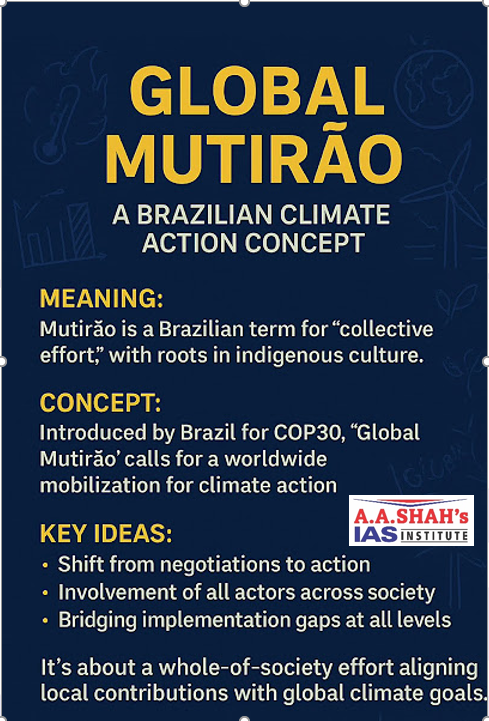
- A consensus agreement, called the Global Mutirão: Uniting humanity in a global mobilisation against climate change was adopted.
- Mutirão refers to a consensus on the most contentious climate-talk issues — implementing Article 9 of the Paris Agreement that requires developed nations to mobilise funds for developing countries to shift from fossil fuels; advancing international cooperation on steps by countries to impose “trade-restrictive unilateral measures”; progress on countries’ nationally determined contributions; and addressing the 1.5°C ambition and implementation gap, among others.
- Developing countries (including some petro states and India) were insistent on not including language that commits countries to a timeline on eliminating fossil fuels from their economies.
- Developed countries have insisted that specifying such a path is critical to keep the planet from overheating beyond 1.5°C by century end and that the finance necessary for adapting to climate change and transitioning away from fossil fuel use must mobilise money from private and public sources.
- While the final Mutirao agreement did not include language on fossil fuels, the President’s opening statement was seen as a outreach to developed nations as a way to keep conversation open on a definitive fossil fuel road map.
Key Agreements & Outcomes from COP30
- Climate Finance Boost
- Parties agreed on a target to mobilize US$ 1.3 trillion annually by 2035 for climate action.
- The Loss & Damage Fund (created earlier) will be operationalized more fully, with direct-access channels for vulnerable countries to receive US$5–20 million/year.
- New funding pledges announced: ~US$ 135 million to the Adaptation Fund, plus US$ 300 million for a health-climate resilience plan (“Belem Health Action Plan”).
- Adaptation Tracking & Metrics
- COP30 agreed on a reduced set of global adaptation indicators to track progress under the Global Goal on Adaptation (GGA).
- These indicators are meant to help countries measure progress on resilience (water security, infrastructure, early-warning systems, etc.) in a more standardized way.
- Just Transition Mechanism
- A Just Transition Mechanism (JTM) was established to ensure the shift to greener economies does not leave behind workers, Indigenous communities, or other vulnerable groups.
- The mechanism emphasizes labour rights, fair work, and social protection during the energy transition.
- However, it lacks dedicated funding in the COP30 text — how the JTM will be financed remains unclear
- Climate Action Implementation Tools
- Launch of a Global Implementation Accelerator to help turn climate pledges into real-world action.
- Introduction of the “Mission 1.5 °C” initiative (sometimes called “Belém Mission”) — aimed at pushing countries to align with 1.5 °C pathways.
- Deforestation / Forest Protection
- While COP30 did not adopt a binding global deforestation “roadmap,” host country Brazil launched the Tropical Forest Forever Facility, a multibillion-dollar fund to pay countries (especially tropical forest countries) to preserve forests.
- This fund is outside the formal UNFCCC process, but could complement formal climate finance channels.
Major Shortcomings, Controversies & Criticisms
- No Fossil Fuel Phase-Out Commitment
- Perhaps the biggest disappointment: no explicit mention of fossil fuels (coal, oil, gas) in the final COP30 decision text.
- Despite over 80 countries pushing for a roadmap to phase out fossil fuels, major producers (e.g., Saudi Arabia) blocked the language.
- The final text only refers indirectly to fossil fuel transition by “recalling” the UAE Consensus from COP28.
- Deforestation Roadmap Falls Short
- A binding global deforestation cessation pathway was not included. I
- The Tropical Forest Forever Facility is a positive move, but critics argue it’s not enough to match the scale of forest loss, and that more systemic commitments were needed.
- Adaptation Finance: Ambitious but Vague
- While the tripling of adaptation finance is a major step, the 2035 target (rather than 2030) has drawn criticism for being too delayed given the urgency of climate impacts.
- It’s not clear exactly who (which countries) will contribute what to hit the $120B/year target.
- Some adaptation indicators (for tracking) were weakened in last-minute negotiations, reducing their potential effectiveness.
- Just Transition Mechanism: Principles But No Guarantees
- The JTM is promising in principle, but without guaranteed funding or clear mechanisms, its effectiveness is uncertain. Civil society has warned it could remain symbolic.
- The mechanism will need political will and financial backing to translate into real protection for workers, especially in fossil-fuel dependent regions.
- NDC (Nationally Determined Contributions) Ambition Remains Weak
- Though many countries were urged to submit more ambitious NDCs, a significant number still missed updated pledges.
- The final COP30 text does not dramatically raise the bar for emissions reductions; critics say it falls short of what science says is needed to stay close to 1.5 °C.