Proton accelerator facility to come up in Visakhapatnam
S&T – ENERGY
- Andhra Pradesh is set to play a key role in advancing one of India’s most ambitious atomic science programmes, with plans to establish a high-energy proton accelerator system in Visakhapatnam as part of the country’s long-term nuclear research roadmap.
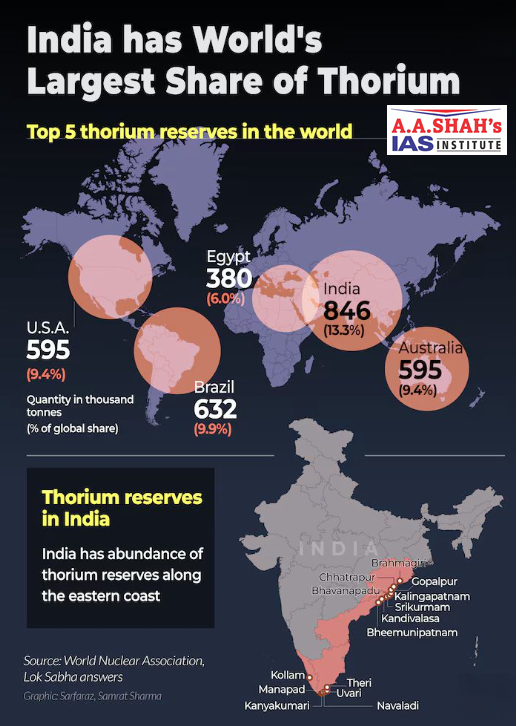
- The proposed facility would form a crucial component of India’s accelerator-driven systems to harness vast thorium reserves for nuclear energy.
- Once running, the facility will generate high-energy neutrons through spallation reactions to convert India’s abundant thorium into uranium fuel for reactors.
- Visakhapatnam was chosen for its strong technological ecosystem and proximity to the sea, providing ample cooling water for such high-energy systems.
Raja Ramanna Centre for Advanced Technology (RRCAT)
- RRCAT was established in Indore, Madhya Pradesh, in 1984 under the Department of Atomic Energy
- It leads research in particle accelerators and laser technologies with applications in space, defence, communications, and medical science.
- It also runs experiment labs for industries, hospitals, and institutions.
- RRCAT’s linear accelerators power electron beam facilities are used to sterilise medical devices.
High-Energy Proton Accelerator System (HEPAS)
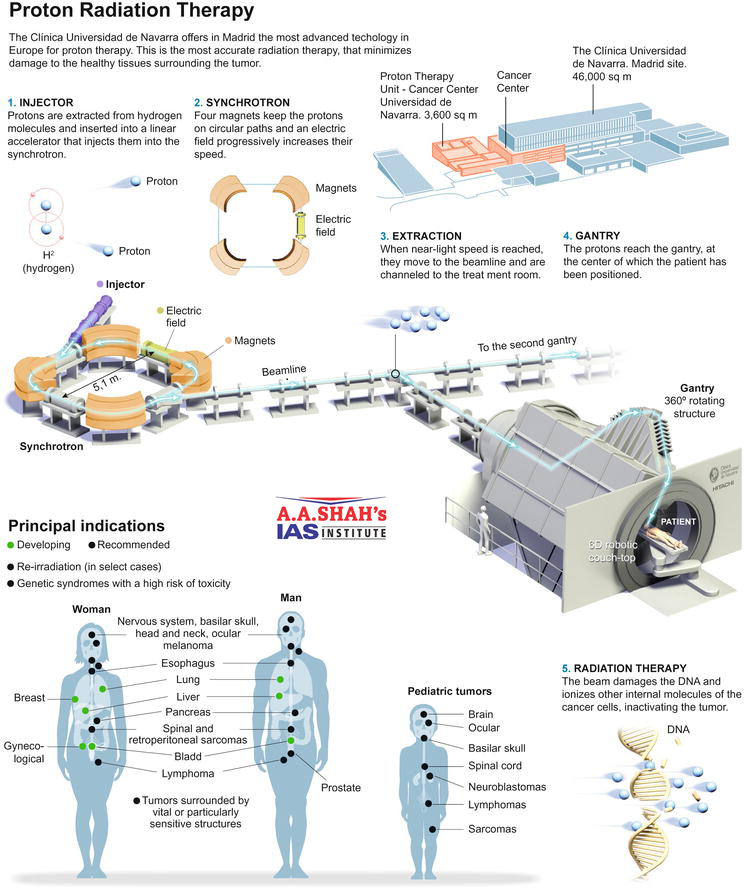
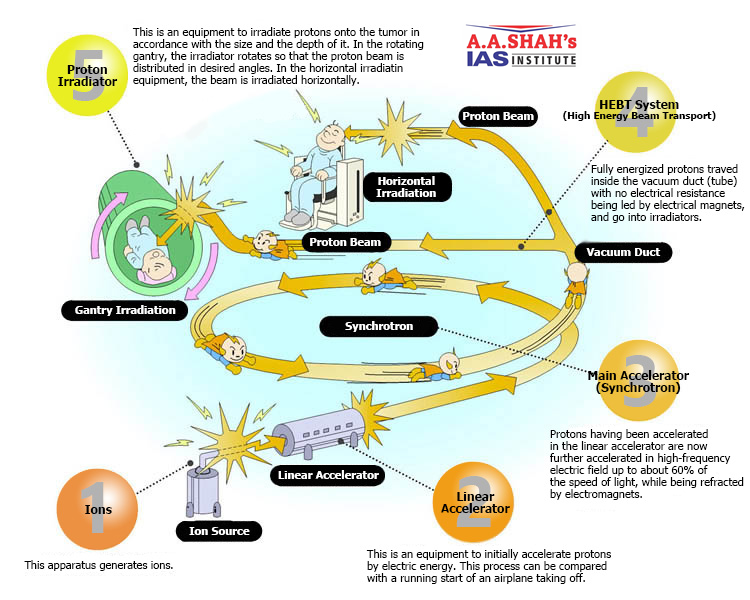
- A High-Energy Proton Accelerator System is a technology that uses electromagnetic fields to accelerate protons (positively charged particles from ionized hydrogen) to extremely high speeds, producing a powerful proton beam.
- How it Works
- Acceleration of Protons
- Protons are accelerated to very high speeds using strong electromagnetic fields inside an accelerator.
- Target Collision (Spallation Reaction)
- The high-energy proton beam is directed at a heavy metal target such as lead or bismuth.
- The collision breaks the heavy atomic nucleus and releases a large number of neutrons.
- This process is called a spallation reaction.
- Neutron Production and Energy Generation
- The neutrons produced can trigger nuclear fission reactions, which release energy.
Accelerator-Driven System (ADS)
- An Accelerator-Driven System (ADS) combines a proton accelerator with a sub-critical nuclear reactor.
- The reactor core cannot sustain a chain reaction on its own.
- It depends on external neutrons supplied from the spallation process.
- These neutrons maintain the fission reaction and generate energy.
Safety Advantage
- If the accelerator stops due to power failure or malfunction, the neutron supply stops instantly.
- Without neutrons, the chain reaction stops automatically.
- This prevents reactor meltdown, making ADS inherently safer than traditional reactors.
Need of ADS for India
1. Harnessing Thorium
- India possesses about 25% of the world’s thorium reserves.
- Natural thorium (Th-232) is fertile, not fissile, so it cannot directly sustain a nuclear chain reaction.
- When thorium absorbs a neutron, it converts into Uranium-233 (U-233), which is fissile and can produce energy.
- The high-energy neutrons from ADS help convert thorium into U-233, enabling large-scale electricity generation.
2. Nuclear Waste Management (Transmutation)
- Conventional nuclear reactors produce long-lived radioactive waste such as minor actinides.
- These remain hazardous for thousands of years.
- The high-energy neutrons in ADS can transmute this waste into shorter-lived or stable isotopes, reducing long-term nuclear waste problems.