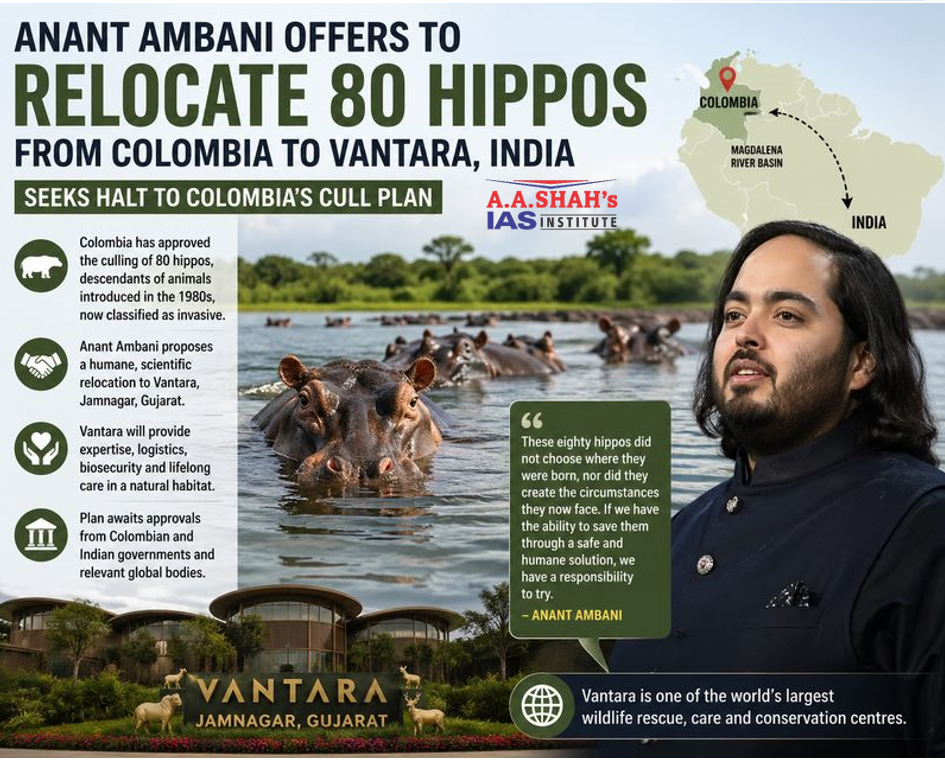
Can Vantara solve Colombia’s hippo problem?
ENVIRONMENT – BIODIVERSITY
3 MAY 2026
- Vantara, the 3,500-acre wildlife rescue and rehabilitation centre in Jamnagar, Gujarat, owned by Anant Ambani, son of Reliance chairman Mukesh Ambani, has offered to take in 80 hippos scheduled for euthanasia.
- The animals descend from four hippos — three females and one male — imported in 1981 by Colombian drug lord, Pablo Escobar, to his private menagerie at Hacienda Nápoles in Antioquia.
- After Escobar was killed in 1993, the estate was abandoned and the hippos were judged too dangerous and logistically complex to recapture.
- They escaped into the Magdalena River basin and have been reproducing since. There are roughly 170 today.
- Colombia declared Hippopotamus amphibius an invasive alien species in March 2022.
Sterilisation & Tranquilisation
- A sterilisation programme began in October 2021, but was deemed labour-intensive, expensive, and ineffective unless a high proportion of dominant males were castrated, since they can mate with multiple females.
- Hippos are difficult to tranquilise because they have thick skin, are usually in or near water (where a sedated animal can drown), and are dangerous to approach.
- Capture myopathy — the malignant outcome of stress during capture, — accounts for the highest number of deaths in wildlife translocations globally.
- An adult male hippo weighs up to 3,000 kg; per-animal costs would run to tens of thousands of dollars before receiving-facility costs.
CITES observations
- CITES (Convention on International Trade in Endangered Species of Wild Fauna and Flora) is a legally binding international agreement in force since 1975.
- CITES sent a Secretariat team to inspect Vantara in 2025, prompted by allegations of discrepancies in animal imports from Congo, Mexico, and elsewhere.
- In a document published in October 2025, the Secretariat found that India had not exercised “due diligence” in issuing several import permits and recommended that India issue no further permits for endangered wildlife imports until it implemented procedural reforms and properly identified the provenance of imported animals.
- The recommendation was reversed in November 2025 after India, the U.S., Japan and Brazil argued the measure was “premature.”