Trump’s 10% tariff ‘invalid’, rules U.S. trade court
INTERNATIONAL – USA
9 MAY 2026
- The U.S. Court of International Trade (CIT) has ruled that the 10% temporary tariff President Donald Trump imposed on all U.S. trade partners, including India, was “unauthorised by law”, striking a further blow to his attempts at using tariffs as tools to advance his policy priorities.
- However, while the ruling sets a precedent, it does not translate into immediate relief for exporters around the world.
- The court provided relief to only the plaintiffs — two small companies in the U.S. and Washington State — with the tariff remaining on all other importers.
- The U.S. government is expected to appeal the judgment at the federal level, which could extend the process by several months.
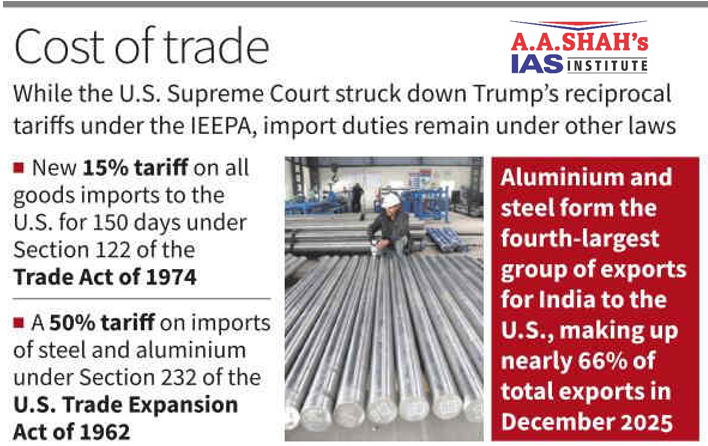
- Mr. Trump, on February 24, 2026, used Section 122 of the Trade Act of 1974 to impose a 10% tariff on imports from around the world for 150 days.
- This was in response to the U.S. Supreme Court striking down his country-wise reciprocal tariffs, which were based on the International Emergency Economic Powers Act (IEEPA) of 1977.
- ‘Not universal’
- The Court of International Trade, in a 2-1 decision, ruled that, although the U.S. Congress had originally passed Section 122 to give the President the authority to address balance of payments deficits, this did not include the trade deficit and current account deficits cited by Mr. Trump when he levied the 10% tariff.
- The U.S. government has also launched a number of investigations under Section 301 of the Trade Act of 1974 regarding fair trade practice and labour rights violations by several of the U.S.’s trade partners, including India.
- If these investigations find violations, they would empower the U.S. to once again levy tariffs on the relevant countries.