Solar firms move High Court over ‘unreasonable’ mandate
ECONOMY – ENERGY
9 JUNE 2026
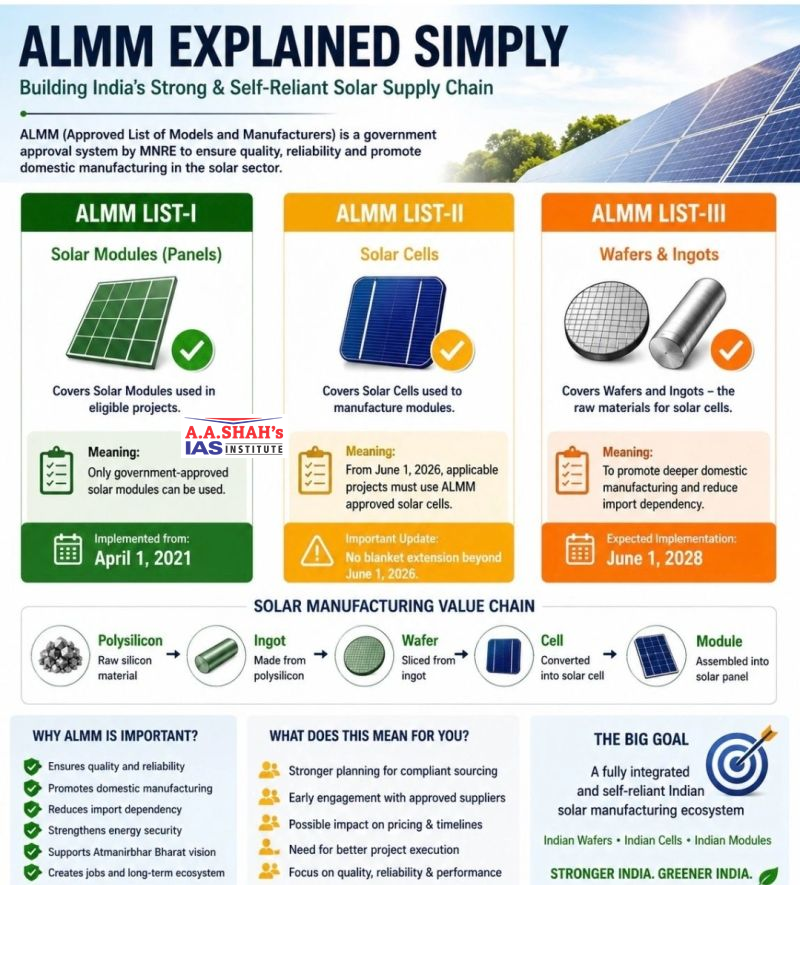
- A group of solar manufacturers and developers has approached the Karnataka High Court to defer a rule that, from June 1, 2026, requires most new solar projects to use only domestically made cells.
- They cite the gap between what Indian solar-cell makers charge and international prices.
- Cells listed under the government’s mandatory ‘ALMM List-II’ sell at around ₹13 a watt, against an imported price of about ₹5 a watt, the petitioners said.
- ALMM is the government ratified Approved List of Models and Manufacturers (ALMM) and a list of domestic producer companies whose solar panels and constituent cells are mandatory for electricity distribution in India.
- ALMM-1 is a list of about 130 module manufacturers.
- ALMM-2 is a smaller group of about 17 companies that makes the solar cells for these modules.
- The petitioners said they do not oppose the list, but want its enforcement deferred, at least a year, until domestic cells are available in adequate quantity and quality, and at a competitive price.
- The petitioners also pointed to the Finance Ministry’s classification of the West Asia conflict as a force majeure event, under which the MNRE allowed extensions of contractual deadlines to solar-cell makers; the same consideration, they said, should apply to developers.
Structural gap
- The dispute exposes a structural gap at the heart of India’s solar expansion.
- Installed solar capacity has crossed 144 GW and is growing about 40% a year, and module-assembly capacity has reached roughly 210 GW.
- But upstream cell manufacturing — the step the new rule targets — stood at only about 27 GW at the end of 2025, according to Mercom India, a clean-energy research group.
- Ratings agency CareEdge estimates domestic cells meet just 25-30% of demand, leaving India reliant on imports, mainly from China. “Right now the whole capacity (of high efficiency cells) manufactured in India is not enough for our requirement,” Mr. Shivanna said.
- “When we ask for cell supply, [many] don’t have stock.”