What is lost and gained in NFHS-6
SOCIAL – HEALTH
9 JUNE 2026
- The National Family Health Survey (NFHS) is India’s largest household health survey, commissioned by the Ministry of Health and Family Welfare and conducted by the International Institute for Population Sciences (IIPS).
Major Improvements in NFHS-6
Maternal & Child Health
- Mothers receiving 4+ antenatal check-ups increased by about 7 percentage points.
- Institutional births increased.
- Child stunting declined significantly (over 6 percentage points from NFHS-5).
- Spousal violence against women declined from 29.3% to 22.3%.
Digital Inclusion
- Women’s Internet use increased substantially.
- Andhra Pradesh recorded the largest rise (21% → 63.6%).
Financial & Social Inclusion
New questions added on:
- Direct Benefit Transfers (DBTs)
- Self-Help Group (SHG) membership
- Digital literacy
- Digital financial transactions
New Additions in NFHS-6
- Testing introduced for Hepatitis-B and Hepatitis-C among women and men and for children (4–5 years for Hepatitis-B)
- Biological HIV testing has been reintroduced.
- NFHS-5 had dropped HIV testing but retained awareness-related questions.
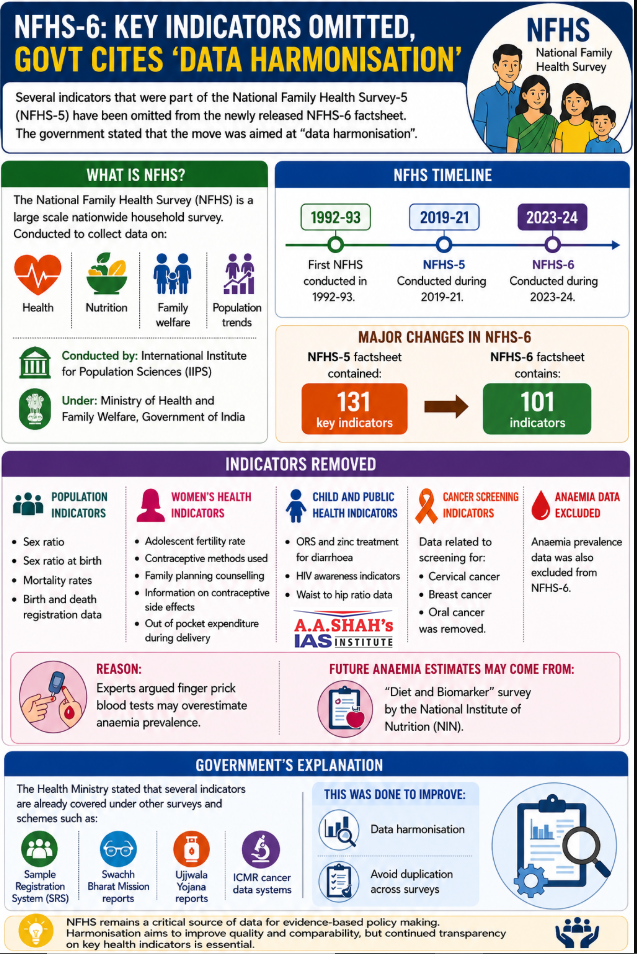
Key Indicators Removed from NFHS-6
| Indicator Removed | Significance |
| Anaemia | Major nutrition and public health indicator |
| Infant Mortality Rate (IMR) | Child survival indicator |
| Neonatal Mortality Rate (NMR) | Newborn health indicator |
| Under-5 Mortality Rate | SDG health indicator |
| Sex Ratio at Birth | Measures gender bias and sex selection |
| Overall Sex Ratio | Demographic balance |
| Sanitation Coverage | Swachh Bharat progress |
| Clean Cooking Fuel Use | Ujjwala Yojana performance |
| Cancer Screening Indicators | NCD prevention assessment |
| Comprehensive HIV Knowledge Indicators | HIV awareness measurement |
Total change:
- 43 indicators removed
- 13 indicators added
- Net reduction: 30 indicators (131 → 101)
Why was Anaemia Removed?
- NFHS measured haemoglobin using finger-prick blood sample using a portable analyser.Researchers argued this method overestimated anaemia prevalence and produced results differing from venous blood tests.
- The National Institute of Nutrition launched the Diet and Biomarkers Survey in India (DBSI) in 2022 which uses venous blood samples and measures anaemia and obesity simultaneously.
- The data collection has been completed; results yet to be released.
Why Are the Removed Indicators Important?
Sanitation
- NFHS-5 showed 70% households had sanitation facilities.
- Removal makes it harder to independently assess Swachh Bharat Mission outcomes.
- Clean Cooking Fuel
- NFHS-5 showed 58.6% households used clean cooking fuel.
- Removal makes it harder to evaluate Pradhan Mantri Ujjwala Yojana.
- Mortality Indicators
- Now tracked mainly through the Sample Registration System (SRS).
- But SRS lacks district-level and socio-economic breakdowns available in NFHS.
- Sex Ratio at Birth
- NFHS-5 showed sex ratio at birth as 929 females per 1000 males
- Its removal weakens monitoring of gender discrimination and sex-selective practices
Biggest Improvements
- West Bengal: Health insurance coverage rose from 33.7% → 88.2%.
- Andhra Pradesh: Women’s Internet use increased from 21% → 63.6%.
Areas of Concern
- Haryana: Exclusive breastfeeding fell from 69.5% → 41.2%.
- Overweight/obesity among women increased in every State.