Green activist approaches NGT, seeks action against illegal riverbed mining near Kaziranga
ENVIRONMENT – BIODIVERSITY
13 AUGUST 2026
- Sand mining in the Deihori River, near Kaziranga National Park and Tiger Reserve in Assam has been reported by green activists.
- Mohajon Kro, a resident of Diphu in Karbi Anglong, complained to the National Green Tribunal (NGT) and the Ministry of Environment, Forest and Climate Change on August 5, 2026.
- He alleged that large-scale mechanised sand mining is taking place in the Deihori River.
- According to the complaint, excavators, earthmovers and dumpers are being used to remove sand.
- The allegations have not yet been verified by the Karbi Anglong authorities.
- The alleged mining is occurring within the proposed ESZ of Kaziranga.
- The Supreme Court order has imposed a complete ban on mining and related activities along Kaziranga’s southern boundary.
- The concern now is that renewed riverbed excavation could undermine those protections.
Kaziranga National Park affected
- Karbi Anglong forms the southern boundary of Kaziranga.
- During the monsoon, Kaziranga is prone to flooding.
- Animals such as Rhinoceroses, tigers and deer move towards the higher hills of Karbi Anglong to escape floodwaters.
- Therefore, environmental damage in the area can affect not only the river ecosystem but also an important wildlife refuge connected to Kaziranga.
- The river is also important to nearby Scheduled Tribe communities, who depend on it for fishing, livestock, domestic needs and groundwater recharge.
Environmental effects
Heavy machinery
↓
Riverbed disturbance
↓
Change in river’s natural shape
↓
Increased sediment and water turbidity
↓
Damage to fish breeding areas
↓
Possible effects on groundwater and water quality
Eco-Sensitive Zone (ESZ)
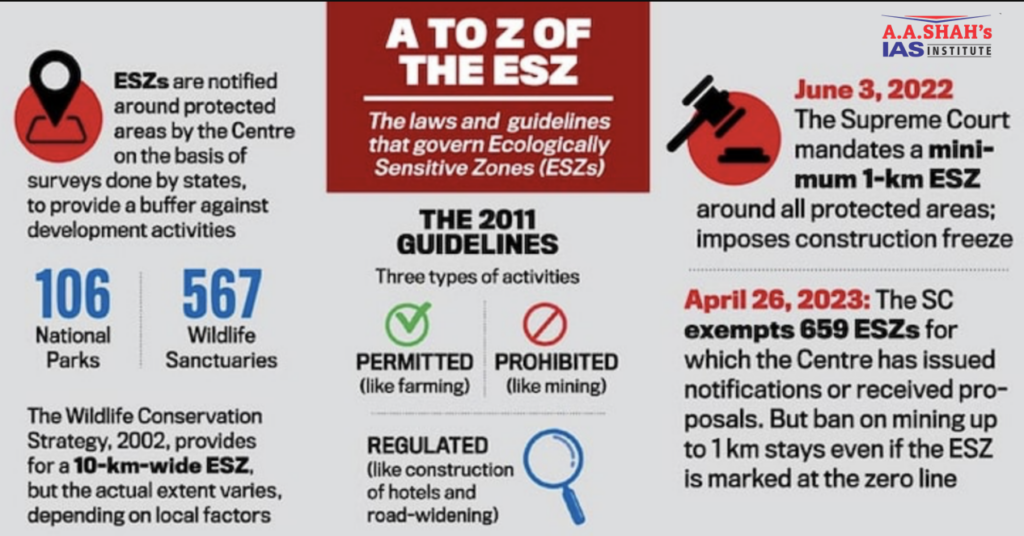
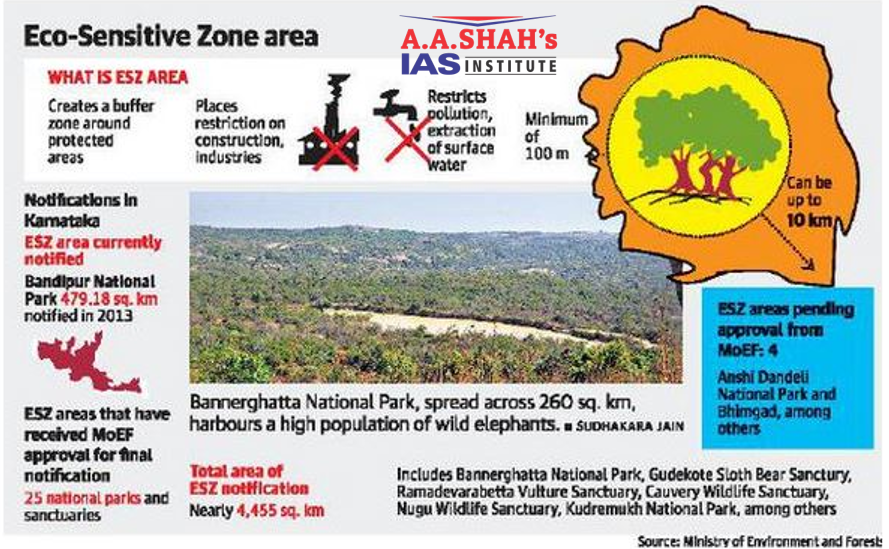
- An Eco-Sensitive Zone (ESZ) is an area around a protected area such as a national park or wildlife sanctuary where certain activities are regulated or restricted to protect the environment and wildlife.
- They act as a “buffer zone” between a protected area and areas where people carry out activities such as farming, construction, mining, tourism, etc.
- The default ESZ is 10 km around Kaziranga while the site-specific ESZ proposal is awaiting notification.
- The Assam government has recently proposed reducing it from 10 km to 1 km in parts of the area.
- This is a distance/buffer, not a fixed area in square kilometres, because the total area depends on the shape and boundaries of the protected area.
- For comparison, Kaziranga National Park itself is about 430 km² in its original/main park area, while the larger Kaziranga Tiger Reserve is over 1,000 km².
NGT — National Green Tribunal
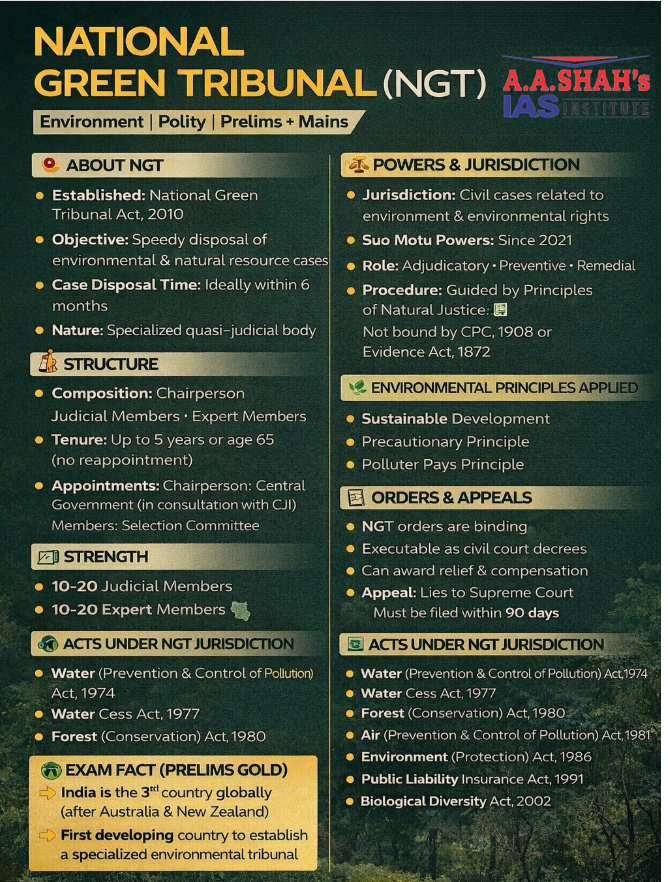
- The National Green Tribunal (NGT) is a specialised judicial body in India that deals with environmental protection and environmental disputes
- It was established in 2010 under the National Green Tribunal Act, 2010
- It aims to provide speedy disposal of cases involving environmental protection, forests and natural resources.
- It can deal with matters involving environmental laws and can order measures to prevent or compensate for environmental damage.
Powers of NGT
The NGT can:
- Order activities causing environmental damage to stop
- Award compensation to people affected by environmental damage
- Order authorities to take measures to protect ecosystems
- Hear appeals against certain environmental decisions made by government authorities
- Examine whether environmental laws and regulations have been followed