Charges made against Justice Varma ‘proved’, says probe report
POLITY – JUDICIARY
13 AUGUST 2026
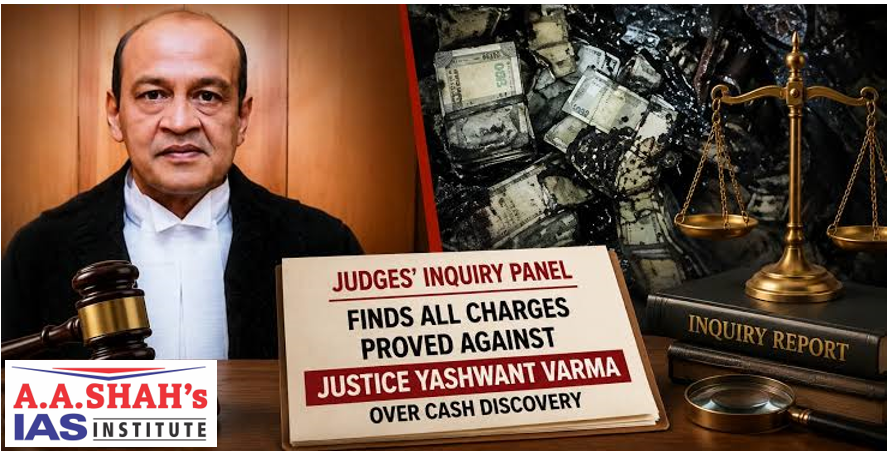
- Justice Yashwant Varma, who was a judge of the Delhi High Court, became the subject of an inquiry after burnt currency notes were discovered at his official residence.
Removal of High Court and Supreme Court Judges
- The Constitution provides for removal of a judge on grounds of “proved misbehaviour or incapacity.”
- The process generally involves Inquiry → Parliament considers removal motion → Both Houses must approve it with the required special majority → President issues the removal order.
Removal process for Justice Yashwant Varma
- Lok Sabha Speaker Om Birla constituted a three-member inquiry committee to investigate the allegations.
- The committee concluded that the three charges against Justice Varma were proved.
- Articles of Charges I, II and III → PROVED
- The committee also found problems concerning the preservation of evidence at the residence. It said material evidence in the storeroom had been disturbed before the site was properly sealed and inspected.
- It found his explanations regarding the presence, source and ownership of the cash to be “evasive and unsatisfactory.”
- The committee said his explanation did not show the candour, transparency and institutional responsibility expected from a judge.
Who was on the committee?
| Member | Position |
| Justice Aravind Kumar | Supreme Court judge — Chairperson |
| Justice Shree Chandrashekhar | Chief Justice of Bombay High Court |
| B.V. Acharya | Senior advocate, Karnataka High Court |
Justice Varma resigned.
- The important complication is that Justice Varma resigned.
- However, the government is considering whether the removal process can continue despite his resignation, because the removal proceedings had already begun.
Judge Removal Process
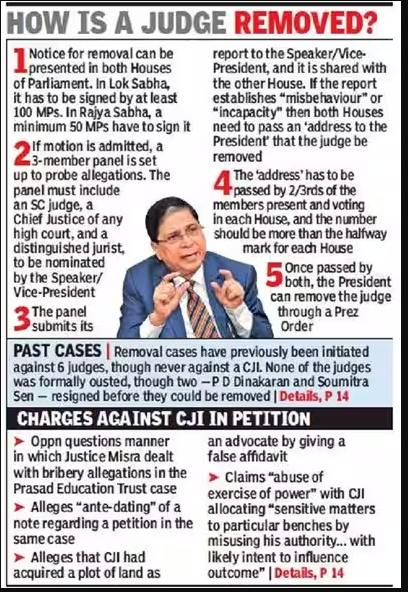
The Constitution provides a special parliamentary process for removal of a Supreme Court or High Court judge.
- Allegation of “proved misbehaviour or incapacity”
- A judge can be removed only on these grounds.
- For a Supreme Court judge, this is provided under Article 124(4);
- The same procedure applies to High Court judges through Article 217 read with Article 218.
- Removal motion is initiated in Parliament
- In the Lok Sabha → at least 100 MPs must sign the notice.
- In the Rajya Sabha → at least 50 MPs must sign it.
- The Speaker/Chairman can admit or reject the motion.
- Three-member inquiry committee is formed
- If the motion is admitted, a committee of three members investigates the allegations:
- One Supreme Court judge
- One Chief Justice of a High Court
- One distinguished jurist
- The judge is given the charges and an opportunity to defend themselves.
- Committee submits its report
- There are two possibilities:
- Charges not proved → the removal process ends.
- Misbehaviour/incapacity proved → the motion can proceed in Parliament.
- Both Houses of Parliament must pass the removal motion
- Each House separately must approve the motion by:
- Majority of the total membership of that House, AND
- At least two-thirds of members present and voting.
- The approval must occur in the same parliamentary session.
- President orders removal
- After both Houses pass the motion with the required majority, they present an address to the President.
- The President then issues the order removing the judge.
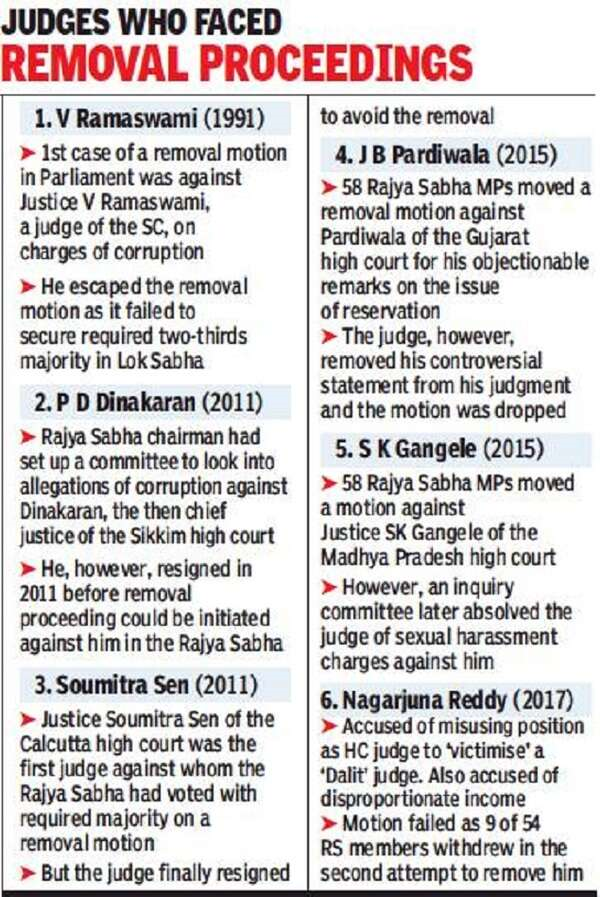
Earlier Judges Removal Cases
| Year | Judge | Court | What happened? | Outcome |
| 1993 | Justice V. Ramaswami | Supreme Court | Allegations of financial/administrative irregularities | Inquiry found 11 of 14 charges proved; Lok Sabha motion failed to get the required majority |
| 2011 | Justice Soumitra Sen | Calcutta High Court | Misappropriation of funds while acting as a court-appointed receiver | Rajya Sabha passed removal motion, but Sen resigned before Lok Sabha could vote |
| 2011 | Justice P.D. Dinakaran | Karnataka/Sikkim High Court | Allegations of corruption and judicial misconduct | Removal proceedings initiated; resigned before completion |
| 2026 | Justice Yashwant Varma | Delhi High Court | Discovery of burnt currency at his official residence | Inquiry committee found all three charges proved; Parliament is now dealing with the findings |