Great Indian Bustard – one of India’s most critically endangered species
ENVIRONMENT – BIODIVERSITY
8 OCTOBER 2026
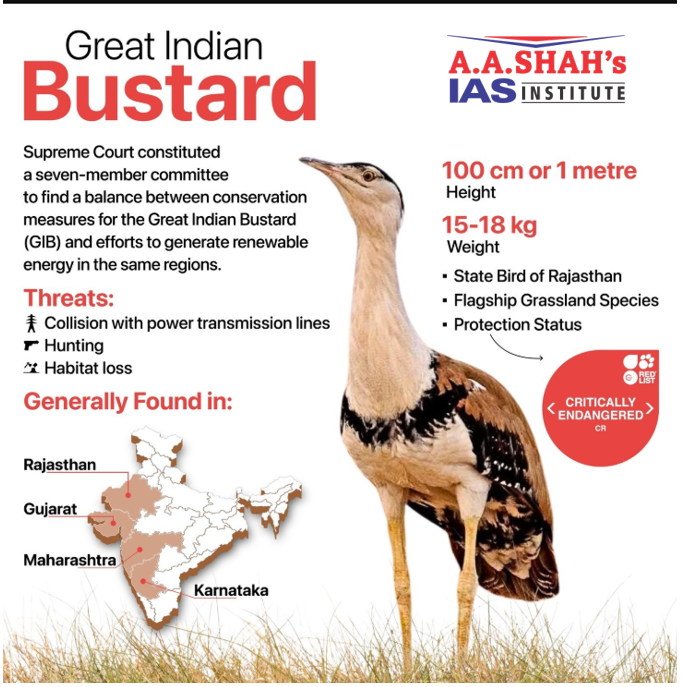
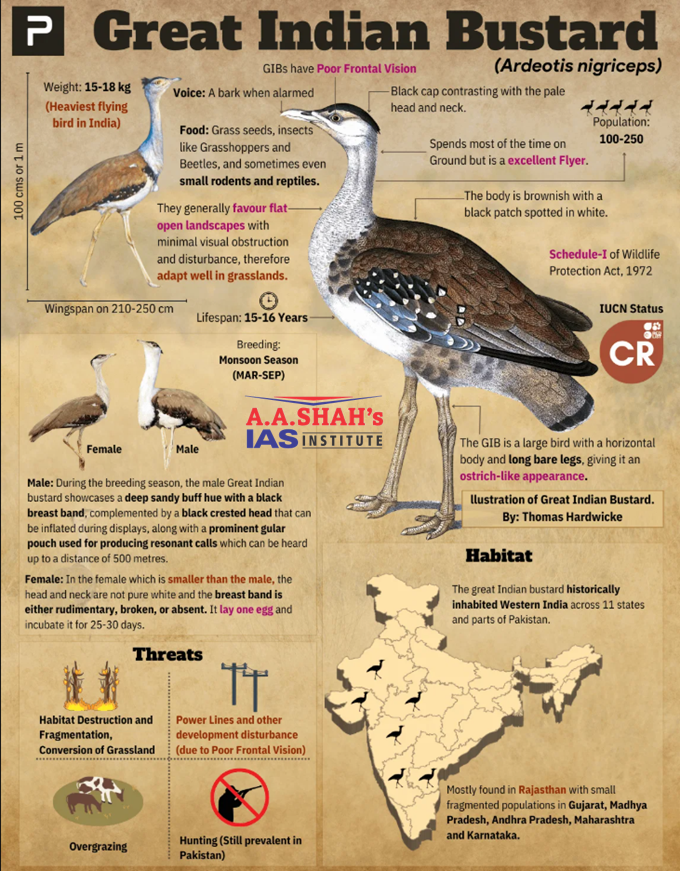
- The Great Indian Bustard (Ardeotis nigriceps), locally known as Godawan, is one of the heaviest flying birds in the world and one of India’s most critically endangered species.
- Once widespread across the dry grasslands of 11 Indian states, its wild population has plummeted to fewer than 150 individuals, with over 90% confined to the Thar Desert around Rajasthan’s Desert National Park (Jaisalmer) and small pockets in Gujarat.
Physical Characteristics & Behavior
- Appearance: Standing up to 1 meter tall and weighing between 8–14.5 kg (males), the bird has long yellow legs, a sandy-brown body, a white neck, and a distinct black crown cap.
- Habitat: Open, dry grasslands, scrublands, and semi-arid agro-ecosystems.
- Diet: Omnivorous—feeding on seeds, insects (especially grasshoppers and beetles), small reptiles, and rodents.
- Breeding: Low reproductive rate. Females lay typically one egg per year on the bare ground, making eggs extremely vulnerable to land predators.
Why the Species is on the Edge of Extinction
- High-Voltage Power Lines: Because GIBs have poor frontal vision, they cannot spot overhead power cables connecting solar and wind farms in Rajasthan and Gujarat in time, making collisions the leading cause of adult mortality.
- Grassland Loss: Dry grasslands were historically misclassified as “wastelands,” leading to widespread diversion for agriculture, industrial energy parks, and infrastructure.
- Predation: Free-ranging stray dogs and invasive species raid un-fenced ground nests to eat GIB eggs and chicks.
Key Conservation Status & Protection
- IUCN Red List: Critically Endangered (one step away from Extinction in the Wild).
- Wildlife Protection Act, 1972: Schedule I (highest level of legal protection under Indian law).
- CITES: Appendix I.
Conservation Initiatives & Milestones
- Supreme Court Intervention: In 2021, the Supreme Court ordered power companies to divert or underground high-voltage lines in key GIB habitats and install bird diverters. In 2024–2026, the directives were refined to balance green energy infrastructure with designated priority conservation zones.
- Conservation Breeding Programme: Set up at Ramdevra and Sam in Rajasthan (managed by the Wildlife Institute of India and Rajasthan Forest Dept). Over 80+ bustards have been successfully hatched and raised in captivity.
- First Wild Release: Two captive-bred male bustards were officially released into the wild inside fenced predator-proof enclosures at Desert National Park.
- “Jumpstart” Egg Adoption: Scientists successfully placed captive-laid eggs into wild nests, where wild female GIBs accepted and incubated them to hatch wild chicks.