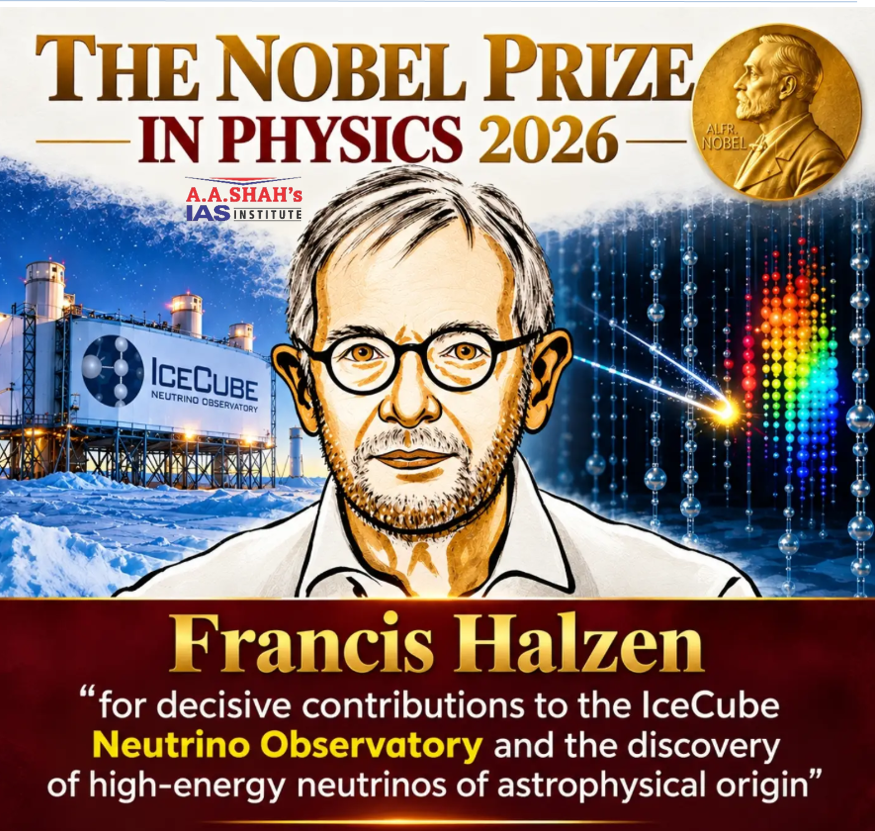
Francis Halzen, IceCube founder given the physics Nobel
S&T – NOBEL
11 OCTOBER 2026
- Francis Halzen was awarded the 2026 Nobel Prize in Physics for proposing the concept and leading the international collaboration behind the IceCube Neutrino Observatory, pioneering the field of high-energy neutrino astronomy.
Neutrinos & Cosmic Rays
- High-energy protons and atomic nuclei constantly bombard Earth from outer space.
- While suspected to originate from high-energy cosmic events (such as exploding stars or active galaxy jets), their origins cannot be traced directly because magnetic fields deflect their electric charges.
- Neutrinos are uncharged subatomic particles with minimal mass that rarely interact with matter.
- They travel through space in a straight line, making them ideal “messengers” to pinpoint extreme cosmic phenomena.
- High-energy cosmic rays collide with matter to produce neutrinos.
- Detecting these rare interactions requires a vast volume of matter.
- Francis Halzen co-proposed using Antarctic ice in 1987–1988.
IceCube Neutrino observatory
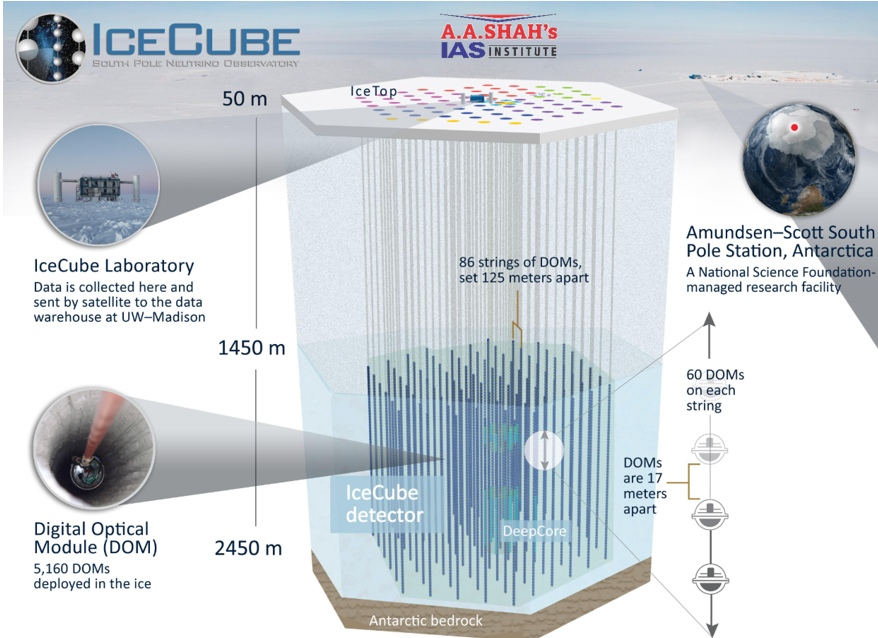
- The IceCube Neutrino Observatory was completed in 2011.
- It encompasses 1 km3 of ice embedded with 5,160 optical sensors across 86 cables at depths of 1.4 to 2.4 km.
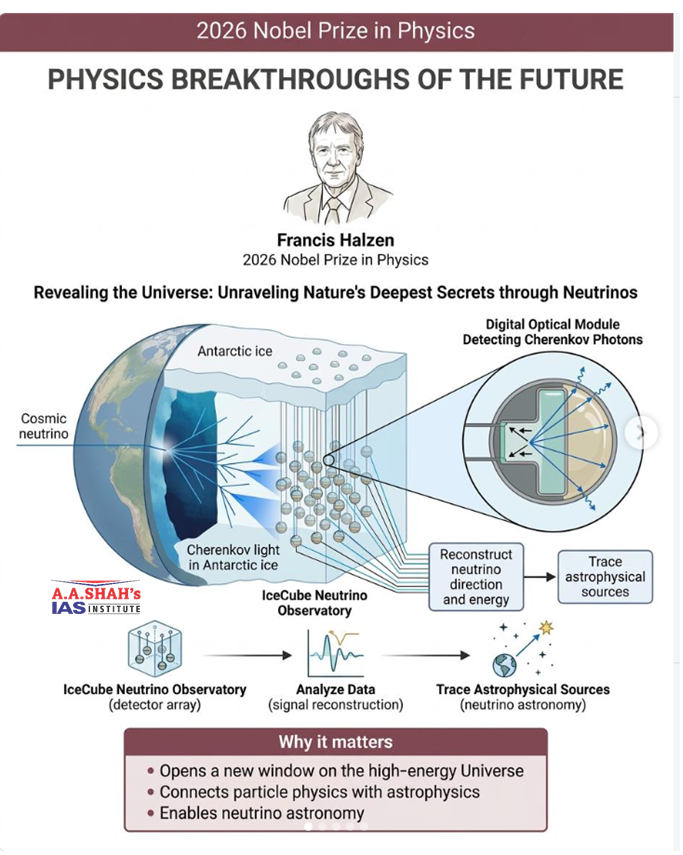
- When a high-energy neutrino strikes an atomic nucleus in the ice, it generates secondary charged particles traveling faster than light in ice, emitting a faint blue Cherenkov radiation recorded by optical sensors.
Major Scientific Breakthroughs
- 2013: Confirmed the detection of high-energy neutrinos originating from beyond our solar system.
- 2017 & 2022: Traced high-energy neutrinos back to distant active galaxies with supermassive black holes emitting radiation jets (e.g., galaxy NGC 1068).